

Landscape Lighting in Raleigh, NC: Costs, Types, and Why It’s Worth It
By Ken Erickson · Updated June 2026
Landscape Lighting Cost: Light Is the Upgrade You Notice First
Landscape lighting cost depends on fixture count and quality — here is what to actually budget. A landscape lighting system is the final upgrade that pays off the moment the sun goes down. It’s the cherry on top of the sundae. It makes a house look finished at night, extends your patio hours past dusk, lights the walks so nobody trips, and quietly tells anyone driving by that someone takes care of this place. With modern LED, it costs almost nothing to run and lasts for years.
Here’s what the different types of lighting do, what it costs in the Triangle, and how we install it.
Key takeaways
- Landscape lighting provides — curb appeal, safety, and security — it adds real resale value.
- Low-voltage LED in warm white light (2700–3000K), uses about 80% less energy than old halogen bulbs, and it lasts 15+ years.
- Budget roughly $150–$199 per fixture installed; a typical front-yard system runs from a handful of lights to a couple dozen.
- The installation is the part the DIY’er stumbles on, and honestly, it is just not that hard.
Tired of Replacing Cheap Solar Lights?
If you’ve bought a row of solar path lights from the big-box store, you know how this goes. They’re bright and cheerful for a few weeks, then one by one they go dim, flicker, and quit — and by next summer you’re back in the same aisle buying the same lights again. The batteries die, the plastic clouds over, and they never threw much light to begin with.
And honestly? Even when they’re working, the look just isn’t the same. Solar lights sit there glowing like little night-lights; a real low-voltage system lights the landscape — it grazes a brick wall, lifts a tree out of the dark, and lays soft pools of light along the walk. It’s the difference between dotting the yard with gadgets and actually designing how your home looks after dark. Stop replacing the cheap stuff and do it once. (Here’s our landscape lighting service.)
Here’s the part the box stores don’t mention: those cheap solar lights run on low-quality, often non-UL batteries that can overheat and catch fire. The U.S. Consumer Product Safety Commission already forced a recall of about 350,000 solar light fixtures sold at Home Depot and Lowe’s because the batteries could overheat and melt the housing — a fire hazard. In November 2025, fire investigators in Tennessee determined a solar pathway light sitting on a back deck was the most likely cause of a house fire that destroyed the home in under 20 minutes. A real low-voltage system runs on a UL-listed transformer that steps power down to a safe 12 volts — no battery baking in the sun against your deck.
What the Different Lights Actually Do
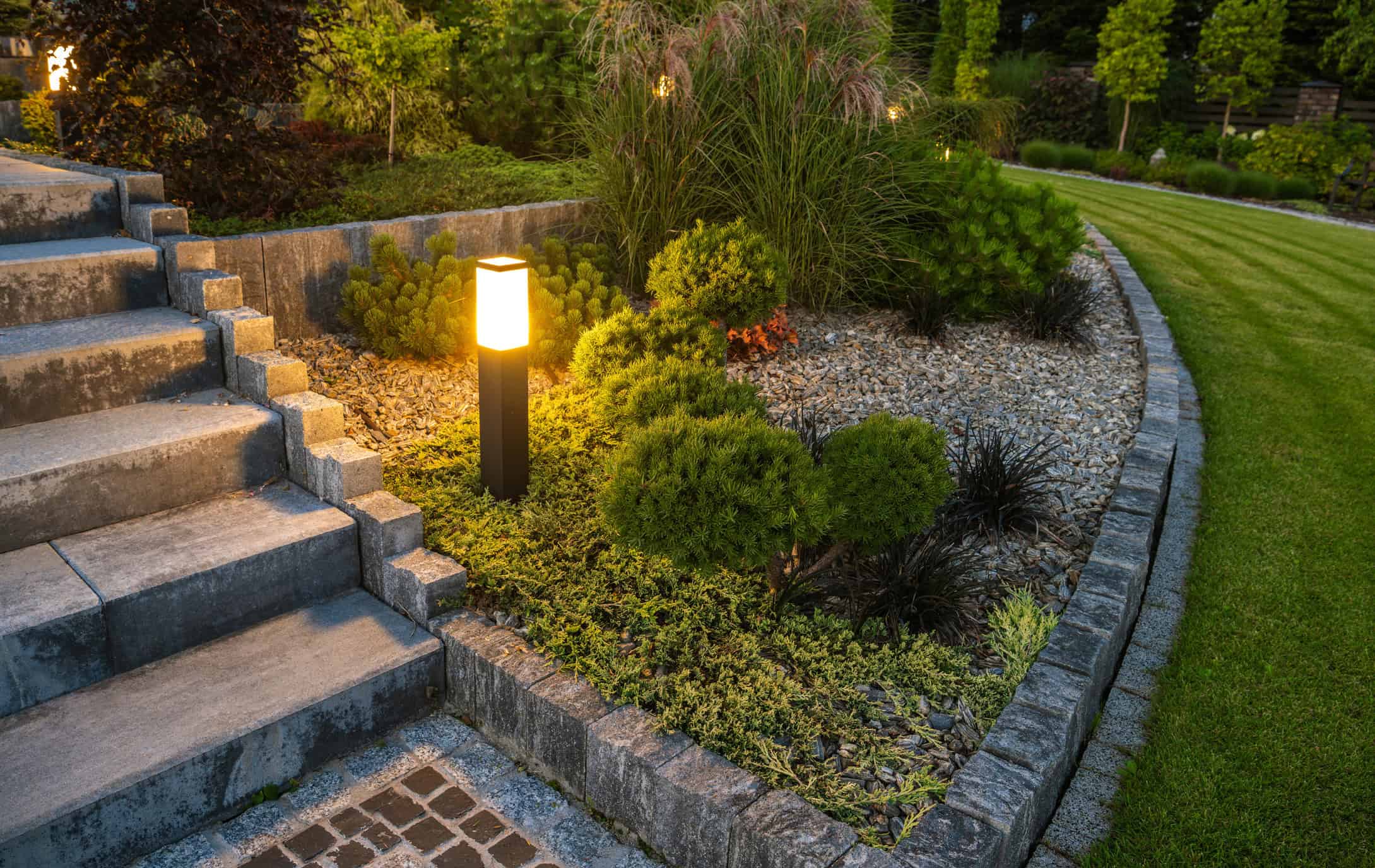
Landscape lighting isn’t one thing — it’s a handful of techniques you combine. The art is using the right one in the right spot instead of dotting the yard with the same fixture.
A good plan layers two or three of these so the yard has depth, instead of a runway of identical path lights.
The Main Techniques
Path lighting lines walkways and beds for safe, elegant footing. Uplighting sits at the base of a tree or wall and washes it upward — the most drama for the money. Spotlighting throws a tight beam on a feature: a specimen tree, a flag, an architectural detail. Downlighting (or “moonlighting”) mounts high in a tree and casts a soft, natural glow down through the branches. Wash and flood lights spread a wide, even light across a wall or hedge.
The Install Is What Lasts or Fails
The difference between a system that looks great for 15 years and one that fails in two years, is in the install, and the materials: the right transformer sized to the load (run it at about 80% so there’s headroom), the right wire gauge for the distance so the far lights aren’t dim, wire buried so the mower can’t cut it, connections that are actually waterproof, and the transformer mounted by a GFCI outlet up off the ground. Get those wrong and you’re chasing dead lights every few months.
Cutting In the Wire
The real work is underground. We cut a narrow slit in the turf or beds and run the low-voltage cable through it — about 6 inches deep in the lawn (below a mower or edger) and 8 to 12 inches in planting beds, where a shovel or an aerator might find it. A narrow trenching blade keeps soil disturbance to almost nothing, so the lawn heals in a week. Every connection is a silicone-filled, direct-burial connector — waterproof for good, no corrosion creeping in.
Daisy-Chain or Hub
There are two ways to lay the wire. A daisy chain runs the cable from the transformer to the first light, then on to the next, and the next, in one continuous line — simple and clean for a path. For bigger layouts we use the hub method: group the lights in a zone (roughly a 40-foot circle), run one feed wire to a hub in the middle, then short jumps to each fixture. The hub keeps every light in the group at the same brightness instead of the last one on a long chain going dim.
Sizing the Transformer (the Quick Math)
Every fixture draws watts, and the transformer has to carry the total — with room to spare. Add up the wattage of all your lights (LEDs are tiny, often 1 to 3 watts each) and pick a transformer you’ll load to about 80%, leaving a 20% cushion so it runs cool and you can add lights later. Wire matters too: the longer the run, the more the voltage drops and the dimmer the far lights get — so longer runs want heavier wire, 12-gauge for most yards and 10-gauge when the run is long. As a feel for it, a 100-watt transformer comfortably runs around 40 watts of fixtures on a couple hundred feet of wire with headroom to grow. That headroom is exactly how you add lights down the road without starting over.
While the Trench Is Open, Add Drip Irrigation
Here’s a move that saves money and a second torn-up yard: put in a drip irrigation line at the same time as the lighting. They share the same trench. The wire and the tubing run side by side, you backfill once, and the lawn heals once instead of twice. Or really, put lighting in when you put an app based drip irrigation system in for your shrubs. Everything grows twice as fast in this North Carolina sun during the summer with water. Trust me. I see it all the time.
“Can you really run water right next to electricity?” — yes, because landscape lighting isn’t house current. The transformer drops your 120-volt power down to a gentle 12 volts, about what a car battery puts out. It won’t shock you and it won’t arc to a wet drip line — that’s the whole reason low-voltage systems are safe to bury in the garden in the first place.
And the two just belong together: where the light shows off the landscape, the drip line nurtures it. The beds you’re uplighting are the same ones that want steady water at the roots, and doing both in one trench is far cheaper than two separate digs — you pay for the trenching once. (See our drip irrigation service.)
Technique | What it does | Best for | Note |
|---|---|---|---|
Path lighting | Lines walks & beds | Safety + curb appeal | Don’t overdo the runway look |
Uplighting | Washes up a tree/wall | Drama for the money | Warm white; hide the fixture |
Spotlight | Tight beam on a feature | Specimen tree, flag | Aim to avoid glare |
Downlight / moonlight | Soft glow from above | Patios, natural look | Mount high in a tree |
Wash / flood | Wide, even light | Walls, hedges, facades | Great for house fronts |
Color temp | Warm white 2700–3000K | Inviting, not blue | Match across the yard |
System | Low-voltage 12V LED | Whole-yard standard | Safe, efficient, long-lived |
Transformer | Size to ~80% load | Powers it all | Leave room to add lights |
Accent / step lighting | Soft light under steps, walls, BBQ, deck | Safety + ambiance | Low glare — see without flooding the yard |
Accent Lighting: See Where You’re Going, Without the Glare
Here’s the lighting people don’t think to ask for but love the most: accent lighting — small, low, hidden fixtures that light the things you actually use instead of blasting the whole yard. Tucked under steps, under counters and a built-in BBQ, along the sides of walls, and under the deck, they wash a soft glow right where your feet and hands go.
The whole point is that you walk out back at night and it isn’t bright — it’s just lit enough to see and move around safely. No more flipping on the harsh porch light every time the dog needs out or guests show up. The yard stays calm and inviting, and you can actually use it after dark.
Accent lighting is also where a property gets its personality — a small spotlight under a bird bath, a piece of statuary, a Japanese maple. Little touches like those make a home feel finished and inviting instead of just “lit.”
Why Low-Voltage LED Is the Standard
Modern systems run on low-voltage (12-volt) LED, and there’s no real reason to do anything else on a home. LEDs pull up to 80% less power than the old halogen fixtures, so a whole yard of lights costs a few dollars a month to run. Quality LED fixtures last 15 years or more, so you’re not back out there swapping bulbs every season.
Low voltage is also safe to work around — the wire runs at 12 volts, not 120 — and it’s flexible: you can add fixtures later as long as the transformer has headroom.
The one spec that decides the look is color temperature. Stick to warm white, 2700 to 3000K. Anything cooler reads blue and harsh on a home; warm white makes brick, stone, and plantings look rich. Keep it consistent across the whole yard so it doesn’t look patched together.

Cheap big-box kits cut corners on all of this — thin wire, weak transformers, plastic fixtures that yellow and crack in a year. The fixtures are where the money should go.
What It Costs in the Triangle
Budget roughly $150 to $199 per fixture installed for a quality low-voltage system — that covers the fixture, wire, a share of the transformer, and labor. A simple front-entry job might be a handful of lights; a full front-yard design with uplit trees and path lighting runs a couple dozen.
What Drives the Price
Fixture quality (brass and copper last decades; plastic doesn’t), the number of fixtures, wire runs and trenching distance, and transformer size. A bigger transformer and thicker wire cost more up front but let you expand later.
Where Not to Cheap Out
The fixtures and the transformer, and definitely the wire. Do not use anything less then 12 gauge. You do not want to have to re-bury a wire a second time. That is where all the labor is. A $40 big-box kit looks fine for one season, then the fixtures cloud over and the underpowered transformer browns out the far end of the run. Spend on the hardware — it’s the part that’s out in the weather for 15 years.
It Pays Back
Good landscape lighting is consistently cited as adding to home value and curb appeal — and with LED, the running cost is almost nothing. It’s one of the few outdoor upgrades you actually enjoy every single night.
Think of it as a one-time install you use 365 nights a year.
How We Do It
Design to the House, Not the Catalog
We start with what the property wants lit — the trees worth uplighting, the walks that need safe footing, the facade that deserves a wash — and place fixtures to those, instead of spacing identical lights down a path like an airport runway. And you can always more a light. It is easy, and we do it all the time for customers.
This part isn’t sub contracted. We design it, cut in the wire, set the transformer, and aim every fixture ourselves — running professional FX Luminaire and Pro-Trade lines, in warm white, sized with headroom so you can add to the system later. We install lighting across the south Raleigh suburbs, from Holly Springs to Fuquay-Varina.
We install landscape lighting across the Triangle — Lillington, Garner, Angier, Willow Spring, Cary, Apex, Raleigh, Fuquay Varina, Holly Springs — and the surrounding towns. Same hands-on crew, same fixtures, wherever you are.
And we bury the wire, waterproof the connections, and set the transformer correctly — the boring parts that decide whether it lasts.
Lighting Shows Off Everything Else
Lighting is the finish on a property we’re often already maintaining — the lawn, the beds, the trees. It puts that work on display after dark.
It Makes the Landscape Look Better
Uplighting a tree you’ve had us prune, or washing a freshly mulched bed, makes the whole property read as cared-for at night. The lighting and the landscape make each other look better.
Low Maintenance, Not No Maintenance
LED systems are nearly set-and-forget, but they want an occasional pass: trim plant growth off the fixtures, re-aim any that get bumped, and check the connections. We handle that on the lawns we already service.
One Company for the Whole Property
Lighting, lawn, beds, trees — one crew that already knows your property, so the lighting fits what’s growing instead of fighting it.
Built to Add To
We size the transformer and wire so you can start with the front and add the back patio or a new tree later without redoing the system.
We Handle the Whole Thing
From the design to the trenching to the transformer settings, we install landscape lighting the right way across the south Raleigh suburbs.
Done right, it’s the upgrade you notice every night and never have to think about otherwise.
Good fixtures, a proper install, warm light — that’s the whole game.
Can You DIY It?
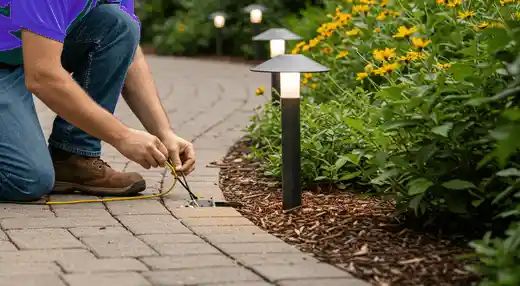
Where DIY Works — and Where It Doesn’t
A small plug-in path-light kit for a short walkway is a fine weekend DIY. Where it gets hard is a real system — sizing the transformer, avoiding voltage drop on long runs, burying wire, and aiming fixtures so it looks designed instead of dotted. If you want a few lights by the door, DIY away; if you want the whole property to look intentional at night, that’s where we come in.
Landscape Lighting FAQs
Want Your Property to Look Like That at Night?
Landscape lighting is the upgrade you see every evening — and the install is what makes it last. We design and install warm-white, low-voltage LED systems (and drip irrigation in the same trench) across the south Raleigh suburbs. Text us at 984-284-5399 — text is fastest — for a lighting quote.
Sources
LawnStarter — Landscape Lighting Cost
VOLT Lighting — How to Create a Landscape Lighting Plan
Tru-Scapes — Low-Voltage Landscape Lighting Guide
U.S. Consumer Product Safety Commission — Cooper Lighting Recalls Solar/Battery Powered Light Fixtures Due to Fire Hazard (Recall 19-009).
