

Boxwood Blight in North Carolina: How to Spot It, Stop It, and Save Your Shrubs
By Ken Erickson · Updated June 2026
Boxwood blight treatment is as much about containment as cure — this one spreads fast. Walk down almost any street in Raleigh’s southern suburbs and you will see boxwoods. They frame front porches in Apex, line formal beds in Cary, and edge walkways all over Holly Springs and Fuquay-Varina. Boxwoods are the backbone shrub of the Southern landscape, which is exactly why boxwood blight is such a serious problem here. This is a fungal disease that spreads fast, kills the plants it infects, and has no cure once it takes hold. It was first confirmed in North Carolina in 2011, and it has been showing up in home landscapes ever since. If you have boxwoods turning brown and dropping leaves, you need to know whether you are dealing with blight or one of its look-alikes, because the difference decides whether you can save the plant or need to remove it before it spreads to the rest of your hedge. I am licensed in North Carolina to work on trees and shrubs, and this guide walks through what boxwood blight is, how to recognize it, how it moves, and what can realistically be done about it.
Key takeaways
- Boxwood blight is a fast-moving fungal disease that has been confirmed in North Carolina since 2011, and it can strip a healthy boxwood bare in a matter of days.
- The telltale signs are dark-bordered leaf spots, black streaks or lesions on the stems, and rapid leaf drop that starts at the bottom of the plant and moves up.
- There is no cure. Management means containment – sanitation, removing infected plants, and protecting the healthy ones.
- It spreads easily through splashing water, dirty tools, wind, infected nursery plants, and even holiday greenery like boxwood wreaths and garlands.
- We are licensed by the state of North Carolina to work on trees and shrubs, and boxwood blight is one of the diagnoses where catching it early makes the difference between saving a hedge and losing it.
Boxwood Blight Treatment: What is boxwood blight and how serious is it?
Boxwood blight is a fungal disease that attacks the leaves and stems of boxwood shrubs. It was first identified in the United States in 2011, and North Carolina was one of the earliest states to confirm it. What makes it so serious is the speed: under warm, humid conditions, a shrub can go from its first spots to nearly complete leaf loss within days. The fungus does not directly kill the root system, but repeated waves of infection stress the plant until it declines and dies, especially younger or newly planted boxwoods. It infects all common types of boxwood, with English boxwood being the most vulnerable of all. Once it is present in a landscape, it is very difficult to get rid of, which is why identifying it early matters so much.
What does boxwood blight look like?
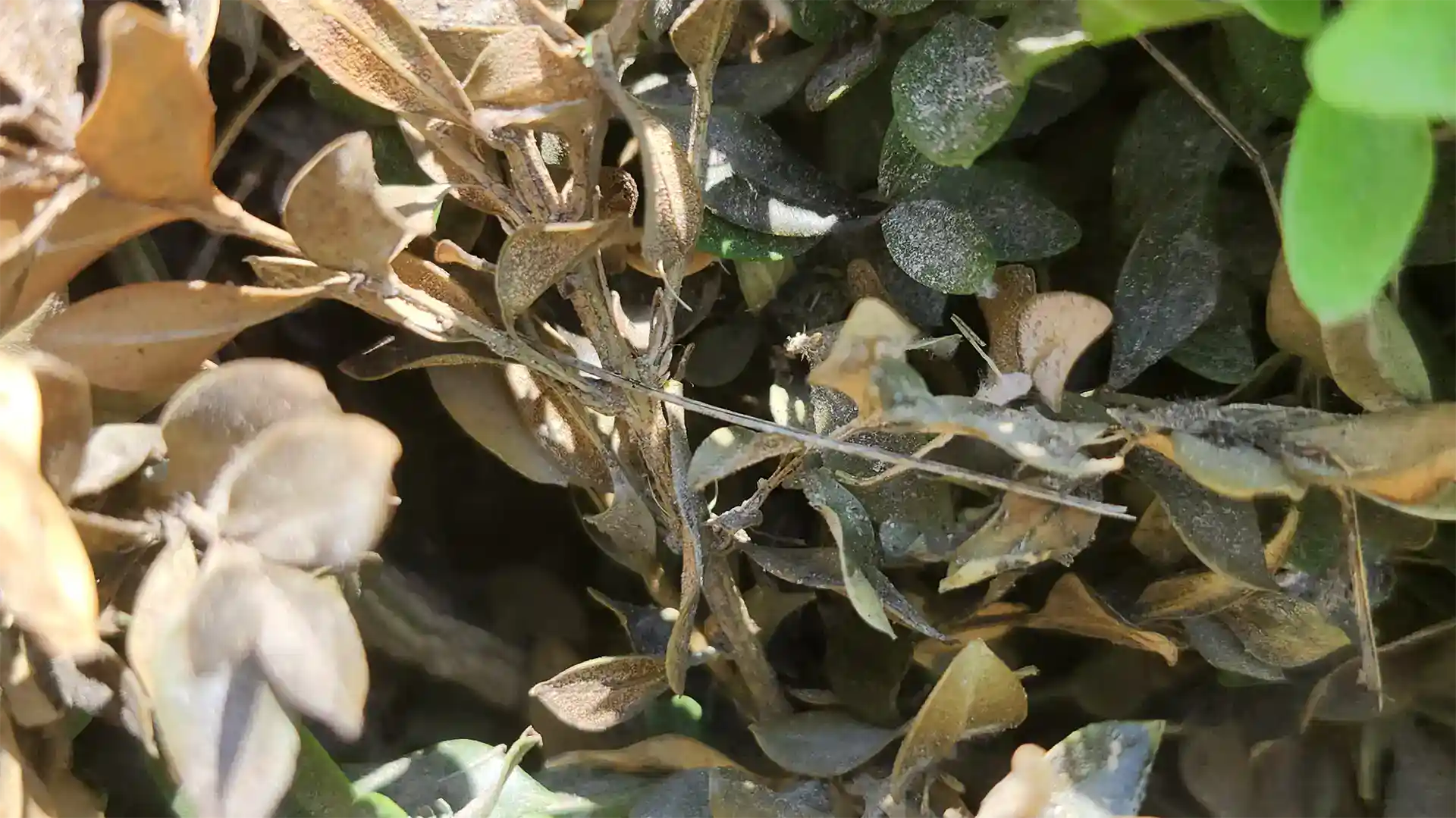
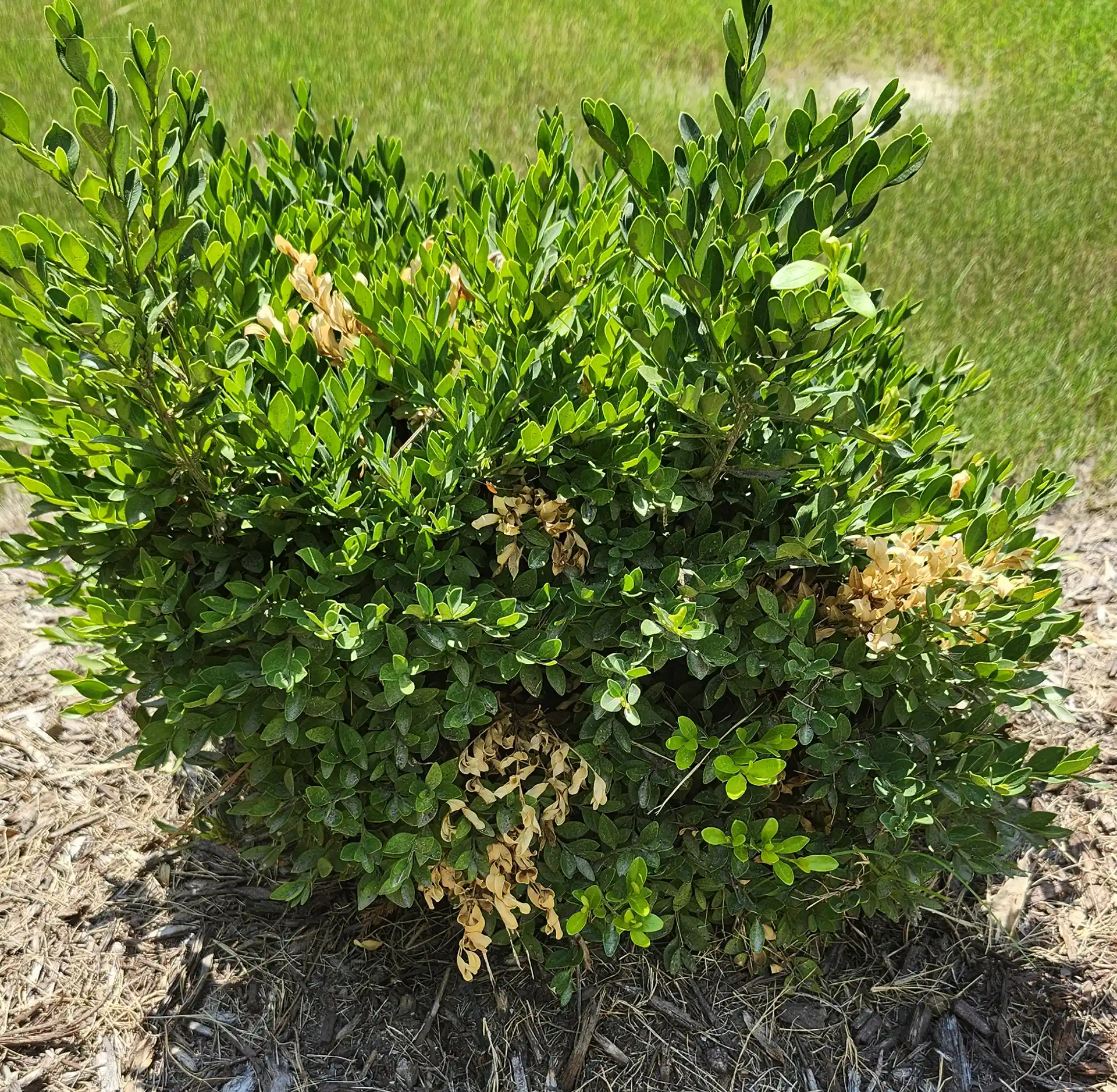
The first thing most people notice is round leaf spots, light or dark brown, usually with a darker ring around the edge. As the disease progresses, those spots grow and run together, and the leaves turn brown or straw-colored and fall off. The most distinctive sign is on the stems: dark, elongated black lesions or streaks running along the green twigs, which you will not see with most other boxwood problems. Defoliation typically starts low on the plant and works its way up, and it can be dramatic – a shrub can drop most of its leaves in just a few days. Under humid conditions you may also see fuzzy white spore masses on the undersides of leaves and along the stem lesions. If you have leaf spots plus those black stem streaks plus rapid leaf drop from the bottom up, that combination points strongly to blight.
Problem | On the leaves | On the stems | Key tell / does it defoliate? |
|---|---|---|---|
Boxwood blight | Round brown spots with dark borders; rapid browning | Dark black streaks and lesions on green twigs | Heavy, fast leaf drop from the bottom up – black stem streaks are the giveaway |
Volutella blight (dieback) | Tan-to-brown leaves that tend to stay attached | Loose bark; pinkish-salmon spore masses | Slower dieback following injury or stress; leaves cling. Spore color is pink, not white |
Colletotrichum dieback (boxwood dieback) | Light tan foliage on scattered branches; leaves stay attached | Blackened stems and black flecks; black under the bark when you scrape it | Whole branches flag tan while the rest of the plant looks fine. Scrape a dead stem – black underneath is the tell |
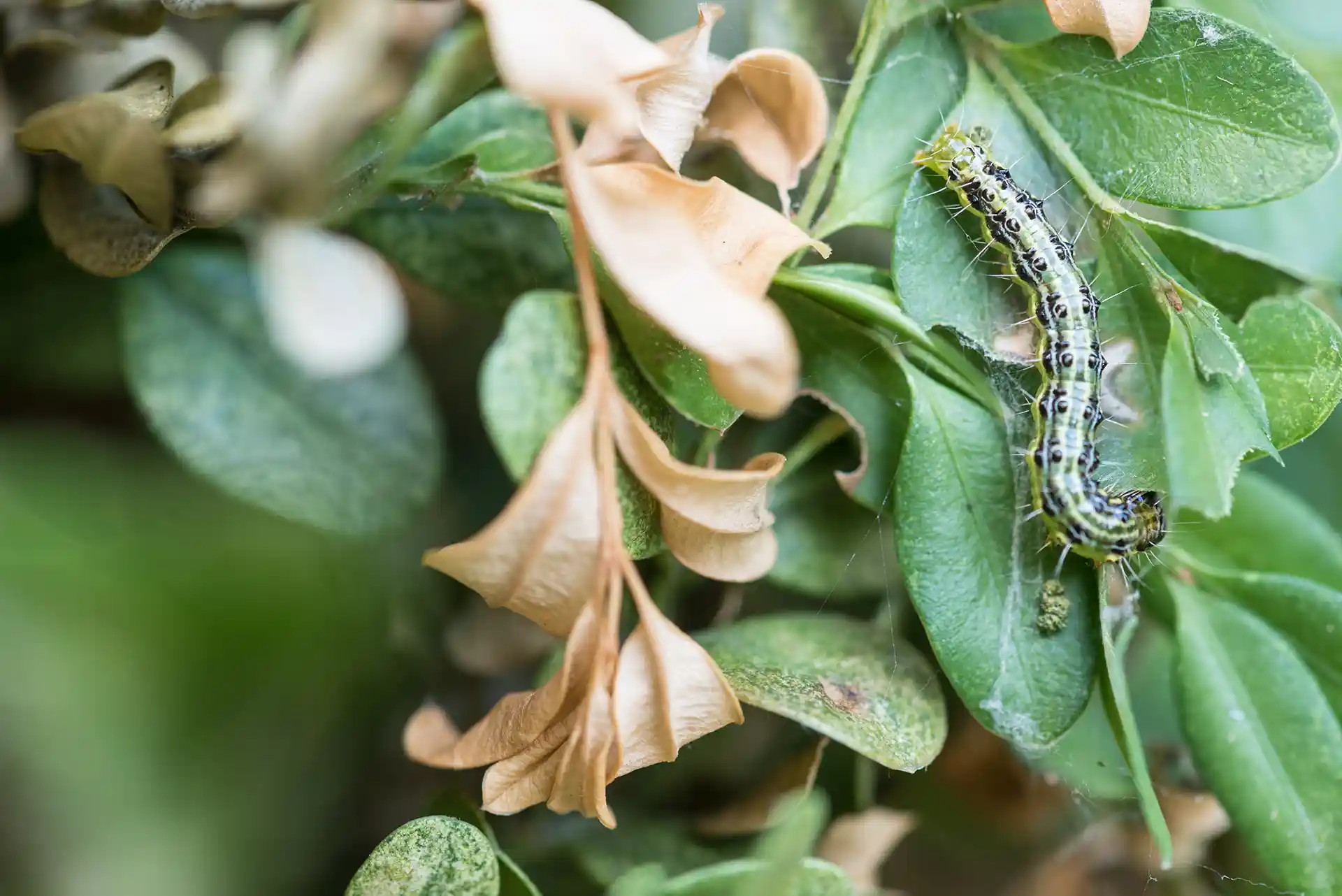
Boxwood leafminer | Yellow-brown blotches and blistered pouches | Stems generally unaffected | Look for the tiny larva inside the leaf pouch – it is an insect, not a fungus |
Winter injury | Straw-colored burn, worst on the windward side | Stems stay intact | Appears all at once after cold or wind; leaves stay attached |
Root/crown rot | Overall wilting, yellowing, upward-curling leaves | Discoloration at the base near the soil; dying roots | Declines from the roots up in wet soil – a root problem, not a leaf-spot disease |
How does boxwood blight spread?
Boxwood blight spreads through sticky spores that cling to almost anything that touches an infected plant. Splashing water is a major carrier – rain and overhead sprinklers bounce spores from leaf to leaf and plant to plant. The spores also travel on pruning shears, shovels, gloves, clothing, shoes, and even the tires of a mower or vehicle. Wind can carry infected leaf debris short distances, and the disease is frequently introduced on new nursery plants that were already infected before you bought them. One route people never expect is holiday greenery – boxwood wreaths, garlands, and centerpieces can be infected, and setting them near your living boxwoods can start an outbreak. Because the spores are so easily moved around, one careless pruning session with dirty tools can spread the disease down an entire hedge.
How do you prevent boxwood blight?
Prevention starts at the nursery: buy boxwoods only from reputable suppliers, ideally ones enrolled in North Carolina’s boxwood blight compliance program, and inspect every plant before it goes in the ground. Give your boxwoods good airflow – proper spacing and light pruning let the leaves dry out quickly, and dry leaves are much harder for the fungus to infect. Water at the base of the plant rather than overhead, and avoid working around boxwoods when the foliage is wet, since that is when spores move most easily. Keep the ground under your shrubs clean, raking up and removing fallen boxwood leaves, because the fungus can survive in that debris and in the soil for years. Sanitize pruning tools between plants, and be extremely careful with holiday greenery – keep boxwood wreaths and garlands well away from your landscape plants. Where you are replanting, consider the more blight-resistant types instead of the highly susceptible English boxwood.
Can boxwood blight be cured, or only managed?
I will be straight with you: there is no cure for boxwood blight. Once a plant is infected, no treatment brings it back to fully healthy, and the honest goal is containment, not a cure. Management means removing and disposing of infected plants and leaf litter to stop the spread, and protecting the healthy boxwoods that remain. Even after you pull an infected shrub, the fungus can persist in the soil for five to six years, so that spot should not be replanted with susceptible boxwoods for a long time. Protective treatments exist and are used preventively on healthy plants, but they do not heal an infected one, and they have to be kept up on a strict schedule to do any good. The realistic plan is early identification, decisive removal of what is infected, strict sanitation, and long-term protection of what is left.
What else looks like boxwood blight?
Boxwood blight gets blamed for a lot of browning it isn’t causing — and the fixes are completely different, so rule these out before you reach for a fungicide:
Volutella blight — straw-colored leaves that cling to the plant, plus salmon-pink spore pustules on the dead twigs and leaf undersides. It’s a different fungus, usually moving in after winter or drought stress, and it’s managed by pruning out the dead wood alongside fungicide.
Spider mites — fine webbing and a stippled, dusty, bronzed look on the leaves. This is a pest, not a disease, so a fungicide does nothing. Tap a branch over white paper to confirm, then treat with horticultural oil or a miticide — and avoid pyrethroid insecticides, which can flare mites worse.
Root rot from overwatering — whole plants or large sections browning and dying while the soil and roots stay wet and dark. Boxwoods hate soggy feet, and this is one of the most common killers. The fix is drainage and watering, not a leaf spray; check the roots at the base for dark, mushy tissue. See our full root rot guide.
Winter burn — uniform bronzing of exposed foliage after a cold, windy winter, with healthy new growth pushing through in spring. It looks alarming but the plant usually recovers on its own.
Other stress — boxwood leafminer (blistered leaves with larvae inside), plain drought browning, and poor, compacted, or badly drained soil can all mimic blight, and none of them respond to a fungicide.
The signs that point to true boxwood blight and not a lookalike: dark leaf spots (often with rings), black streaks or cankers on the green stems, leaves dropping fast from the bottom up, and no webbing. If you see webbing, salmon-colored pustules, or wet, rotting roots, you’re dealing with something else — treat that instead.
What is the best fungicide for boxwood blight?
Chlorothalonil. That is where the university trial work in North Carolina lands, and it is what I would reach for. You will find it on the shelf under a few different brand names, and it also shows up blended with a second fungicide in a couple of products built for exactly this job.
What matters more than the name is what it actually does. Chlorothalonil is a protectant. It sits on the surface of a healthy leaf and stops spores from getting in. It does not move inside the plant and it does not heal a leaf that is already infected. Every spotted leaf on your boxwood today stays spotted.
So timing is the whole game. It has to be on the plant before the wet weather that spreads the disease, and it washes off, which means going back every week or two through the wet stretches of spring and fall. One spray in April does nothing. And it does not end — Virginia Tech tells professionals outright that fungicide treatment will not eradicate the disease and that applications will be necessary for the lifetime of the planting.
I am not going to write you a mixing chart. Rates and intervals depend on the exact product in your hand and what its label allows on a boxwood, and guessing at that is how people scorch foliage or waste a whole season on a spray that was never going to work. If you buy a jug, read its label and follow it exactly. If you would rather not think about it again, that is what we are for.
The sanitation work matters more than the spray
Here is the part almost nobody does properly, and it costs nothing. Boxwood blight moves on tools, boots, gloves, tarps, truck beds and leaf blowers. Not mainly on the wind. Every one of those is under your control.
This is how we work a property that has it. Healthy boxwood first, infected boxwood last, every single time. That one habit stops more spread than any fungicide, and it is exactly what a crew working straight down a bed gets backwards. We sanitize pruners between individual plants, not between properties. And we do not put a leaf blower anywhere near infected boxwood — NC State warns against it specifically, because you are aerosolizing spores across the whole yard.
The debris rules are strict and they are not negotiable. Infected plants and fallen leaves get burned, buried, or double-bagged and taken to a landfill. Never composted. The fungus survives in leaf litter and soil for years. Rake, sweep or vacuum the ground clean under the plants, then mulch about two inches deep. On a property that is already infected we run disposable gloves and shoe covers, and the truck gets cleaned of soil and plant debris before it leaves.
You can do all of this yourself. It is not complicated work. It is fussy and repetitive, and it only works if you do it every time, on every plant, without shortcuts. If that sounds like more than you want to take on, call us.
Why are my boxwoods turning brown and dying?
Usually it is not blight. That is the honest answer, and it is what I end up saying on most of these calls.
The tell is what the dead leaves do. Boxwood blight puts round brown spots with dark borders on the leaves, black streaks on the green stems, and then drops the foliage — you end up with bare sticks and a pile of leaves on the ground. If your plant went straw-tan and is still holding every leaf it grew, you are almost certainly looking at something else. Volutella, Colletotrichum dieback, root rot, or plain drought and winter injury.
The pattern tells you as much as the symptoms. Blight spreads where leaves touch, so it runs along a hedge. When one plant is dead and the two touching it are perfectly green, the problem is underneath that one plant. In our clay that usually means mulch piled against the crown, a downspout, or a low spot that stays wet. Pull one dead plant and look. Healthy boxwood roots are white and firm. If they are dark and the outer layer slips off in your fingers, that is root rot, and no leaf fungicide on the market will touch it.
While you have that plant out of the ground, scrape the bark on a dead stem. Black underneath points at Colletotrichum dieback rather than a root problem. Two minutes with a pocket knife tells you more than a season of guessing.
DIY or call a licensed pro?
Plenty of boxwood care is genuine do-it-yourself work – proper spacing, base watering, cleaning up leaf debris, and buying clean plants are all things a homeowner can and should handle. Where it gets tricky is diagnosis, because boxwood blight looks a lot like Volutella blight, winter injury, and leafminer damage, and the right response is completely different for each one. Misreading blight as simple winter burn can cost you a whole hedge while you wait for it to grow out. This is where a licensed professional earns their keep: we identify the actual problem, tell you honestly whether a plant can be saved or has to come out, and set up a management plan for the boxwoods worth protecting. I am licensed by the state of North Carolina to work on trees and shrubs. If your boxwoods are browning and dropping leaves and you are not sure why, text us at 984-284-5399 and we will take a look before it spreads. For a professional diagnosis and a boxwood treatment program, see our tree and shrub pest control service, or protect your boxwoods year-round with our tree and shrub maintenance plan.
Frequently Asked Questions
Boxwoods Browning and Dropping Leaves Fast?
Boxwood blight has no cure and spreads fast – and it is easy to mistake for winter burn. We diagnose it and contain it before you lose the hedge. Text us for a look.
Sources
NC State Extension – Boxwood Blight
NC Department of Agriculture – Boxwood Blight Compliance Program
Clemson Cooperative Extension HGIC – Boxwood Diseases and Insect Pests
Virginia Tech Extension – Best Management Practices for Boxwood Blight in the Home Landscape
NC State Extension – The Most Effective Products for Preventing Boxwood Blight
Virginia Tech Extension – Comparison of Boxwood Blight to Other Boxwood Problems
NC State Extension – Got Boxwoods, Have Problems?
