

Fairy Ring in NC Lawns: Circles of Dark Grass, Dead Rings, or Mushrooms
By Ken Erickson · Updated June 2026
If you have spotted a ring of dark green grass, a circle of dead brown turf, or a band of mushrooms popping up overnight in your Fuquay-Varina, Holly Springs, Apex, Cary, or Garner lawn, that is fairy ring, and it is one of the more common calls we get after wet weather here in Raleigh’s southern suburbs. It looks alarming, but the fungus behind it is not attacking your grass the way brown patch or large patch does. In this guide I will walk through what fairy ring actually is, why it forms those circles, whether the mushrooms are dangerous, and exactly how we manage it in North Carolina lawns.
Key takeaways
- Fairy ring is caused by soil-inhabiting fungi feeding on buried organic matter, decaying wood, old tree roots, and thatch – not by a disease that infects the grass itself.
- It shows up three ways: a ring of dead brown grass (Type 1), a ring of dark green fast-growing grass (Type 2), or a ring of mushrooms and puffballs (Type 3), and one ring can shift types with the weather.
- The dead ring happens because the fungus makes the soil water-repellent (hydrophobic), so rain and irrigation run off instead of soaking in, and the grass dries out even when the yard around it is moist.
- Fairy ring is almost always cosmetic and rarely kills a whole lawn, but you should knock down the mushrooms if you have kids or dogs, because some lawn mushrooms are toxic if eaten.
- You can mask and manage fairy ring with nitrogen, core aeration, a wetting agent, and deep watering, but it is very hard to eradicate for good, and severe cases call for a licensed pro and the right fungicide.
What is fairy ring, and what causes it?
Fairy ring is a lawn problem caused by soil-inhabiting fungi, not by an infection of the grass blades themselves. More than 60 species of fungi have been associated with fairy ring in turf, and most of them are wood-rotting or thatch-feeding fungi that live on decaying organic matter in the soil. That organic matter is usually buried wood, old stumps, dead tree roots, waste lumber left from construction, or a thick thatch layer. As the fungus grows outward through the soil in a circle feeding on that material, it produces the ring you see on the surface. Because it is a soil-driven problem, fairy ring can affect any turf type, which is why we see it on both the fescue lawns and the bermuda and zoysia lawns across the Triangle.
What does fairy ring look like? The three types
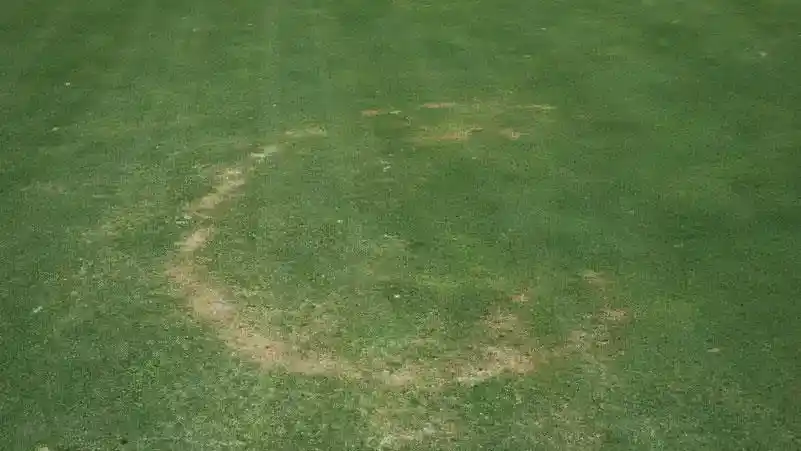
Fairy ring shows up in patches, rings, or arcs that usually start a foot or less across and expand year after year, sometimes reaching many feet in diameter in older lawns. Turf pathologists sort it into three types by what you actually see on the grass. A Type 1 ring is a band of dead, brown, drought-stressed turf. A Type 2 ring is a band of dark green grass that grows faster and greener than the lawn around it. A Type 3 ring produces mushrooms or puffballs in a circle or arc, sometimes with no grass symptom at all. The same ring can switch types through the season: Type 3 mushrooms show up during long wet stretches, while Type 1 dead rings and Type 2 green rings are most common in the hot, dry part of a Carolina summer.
Type | What you see | Cause | What to do |
|---|---|---|---|
Type 1 | A ring of dead, brown, drought-stressed grass | Fungus makes the soil water-repellent, so water runs off | Aerate, apply a wetting agent, and deep-water to re-wet the soil; fungicide if severe |
Type 2 | A ring of dark green, fast-growing grass | Fungus releases nitrogen, fertilizing the grass above it | Fertilize the whole lawn with nitrogen or iron to even out the color |
Type 3 | A ring of mushrooms or puffballs | Fungus fruits above ground, usually after heavy rain | Mow or rake off the mushrooms and dispose of them, especially with kids or pets |
Why does fairy ring form a circle, and why does the grass die?
The ring shape comes from how the fungus grows. It starts at one point and spreads outward evenly in every direction, like ripples from a stone, feeding on organic matter as it goes, so the active edge traces a circle. The dark green Type 2 ring happens because the fungus releases nitrogen and other nutrients into the soil as it breaks down organic matter, and that nitrogen fertilizes the grass right above it. The dead Type 1 ring is the more damaging one, and it comes down to water. As the fungus grows through the soil it leaves behind water-repellent (hydrophobic) residues that make the soil and thatch shed water instead of absorbing it. The result is a drought-stressed, dying ring even when the surrounding soil has plenty of moisture.
Are fairy ring mushrooms dangerous to kids and pets?
The mushrooms and puffballs in a Type 3 ring are just the fruiting bodies of the fungus, the visible tip of an organism that mostly lives underground in the soil. The fairy ring fungus itself is generally not harmful to your lawn beyond the cosmetic ring. The real caution is around children and pets, because you often cannot tell a harmless lawn mushroom from a toxic one by looking, and some mushrooms that pop up in yards are poisonous and can cause serious digestive illness if eaten. If you have kids or dogs, the safe move is to knock the mushrooms down by mowing or raking them off and disposing of them, and keep an eye out for regrowth after rain. Picking or mowing the mushrooms does not kill the fungus, since the main organism stays in the soil, but it removes the immediate hazard.

How do you get rid of fairy ring in North Carolina?
Fairy ring is hard to eliminate completely, so the honest goal is usually to manage and mask it rather than promise it is gone forever. For a Type 2 dark green ring, the simplest fix is to fertilize the rest of the lawn with nitrogen or iron so the whole lawn greens up and the ring stops standing out. For a Type 1 dead ring, the key is getting water back into that water-repellent soil: core aeration, spiking, a soil wetting agent or surfactant, and deep, thorough hand-watering of the affected area all help re-wet the hydrophobic layer. Keeping thatch under control with regular aeration and dethatching reduces the fungus’s food supply over time. In severe cases a fungicide such as azoxystrobin or flutolanil can suppress the fungus, but it has to be watered in heavily and works best preventively, since it changes the fungus and not the soil. As a last resort, digging out and replacing the infested soil can work short-term, though the ring often returns over the years.
Fairy ring: DIY vs. hiring a licensed pro
Plenty of fairy ring cases you can handle yourself. Mowing off the mushrooms, aerating, applying a wetting agent, deep watering the dead ring, and feeding the lawn with nitrogen are all reasonable do-it-yourself steps, and for a mild Type 2 green ring that may be all you ever need. Where it makes sense to bring us in is the stubborn Type 1 dead ring that keeps coming back, or a case bad enough to justify a fungicide. Fungicide control of fairy ring is genuinely site-specific, the effective products are expensive and have to be applied at the right volume and timing, and many of the strongest ones are not labeled for homeowner use. We are licensed by the state of North Carolina to apply on turf, so we can diagnose which type you have, correct the soil moisture problem, and apply the right product legally and at the right rate. If you want a straight read on your rings, text us at 984-284-5399.
Frequently Asked Questions
Rings or Mushrooms Showing Up in Your Lawn?
Fairy ring is stubborn, and the dead-ring type is really a water problem in the soil. We diagnose the type and fix what is actually causing it. Text us for a look.
Sources
NC State Extension TurfFiles – Fairy Ring in Turf
NC State Turf Pathology – It’s No Fairy Tale, It’s Fairy Ring
NC State Extension TurfFiles – Diseases in Turf
Clemson Cooperative Extension HGIC – Mushrooms in Lawns
