

Fire Blight in NC: How to Spot, Prune Out, and Stop It on Pears and Crabapples
By Ken Erickson · Updated June 2026
Fire blight treatment is mostly timing and clean cuts — it is bacterial, not fungal. If you have a pear, crabapple, or a row of pyracantha here in Raleigh’s southern suburbs, you have probably watched a branch suddenly turn black in late spring and wondered what hit it. Nine times out of ten around Fuquay-Varina, Holly Springs, Apex, and Cary, that scorched, burnt-looking shoot is fire blight – one of the most destructive diseases we see on rose-family plants in central North Carolina. Our warm, wet springs are exactly what this bacterial disease wants, and it moves fast once trees start to bloom. I am licensed by the state of North Carolina to work on trees and shrubs, and I want to walk you through what fire blight actually is, how to recognize it, and the pruning-and-sanitation approach that actually keeps it in check. Get it wrong and you can spread it across your whole yard with a single pair of shears – so it pays to understand this one before you start cutting.
Key takeaways
- Fire blight is a bacterial disease, not a fungus – so fungicides do not cure it. It hits plants in the rose family: pear, apple, crabapple, pyracantha, hawthorn, and quince.
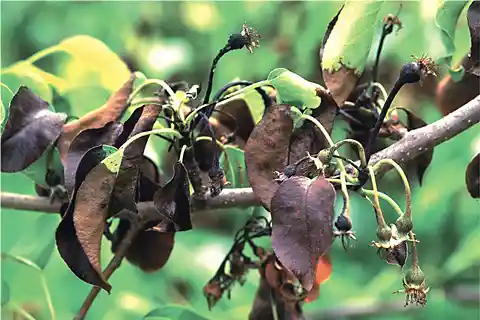
- The tell-tale sign is a blackened, scorched shoot that bends into a shepherd’s crook, with dead leaves that stay clinging to the branch instead of dropping.
- It spreads fastest during warm, humid spring bloom – carried by bees and other insects, splashing rain, and dirty pruning tools moving from cut to cut.
- There is no cure – only control. The core of management is pruning well below the infection, sterilizing tools between every cut, and avoiding heavy nitrogen that pushes soft, easily-infected growth.
- Catch it early and most trees pull through. Once the bacteria reach the main trunk, the tree usually cannot be saved. A licensed pro removes infected wood the right way without spreading it.
Fire Blight Treatment: What is fire blight? It’s a bacterial disease, not a fungus
Fire blight is a bacterial disease that attacks trees and shrubs in the rose family, and that one fact changes everything about how you treat it. Because the culprit is a bacterium and not a fungus, the fungicides most people reach for will not cure it – they simply do not work on a bacterial infection. The disease gets its name from the way it makes leaves and shoots look burned, as if someone ran a torch down the branch. It thrives in the warm, humid, rainy weather that lines up with spring here in the Triangle, when temperatures climb above the low 60s and trees are pushing new bloom. Left alone, it moves down from the blossoms into twigs, then branches, and eventually the trunk. Understanding that it is bacterial is the reason our whole strategy centers on cutting it out and keeping tools clean rather than spraying it away.
What does fire blight look like? Blackened shoots and the shepherd’s crook
The signature symptom is a young shoot that turns dark brown to black and curls over at the tip into a shape people call a shepherd’s crook – an upside-down J. Infected flowers turn black and die first, then the blight runs down the twig, wilting and scorching the leaves as it goes. A key clue is that those dead, blackened leaves stay attached to the branch through summer and even into winter instead of falling off, giving the plant a fire-scorched look. As the disease moves into larger wood, it forms sunken, discolored patches called cankers, and the bark may crack around them. In warm, wet weather you will sometimes see a milky, sticky ooze seeping from infected spots – that ooze is loaded with bacteria and is exactly how the disease gets carried to healthy plants. If you spot a black, hooked shoot on a pear or crabapple, treat it as fire blight until proven otherwise.
Feature | Fire blight (bacterial) | A fungal leaf/twig disease | Drought or heat scorch |
|---|---|---|---|
Cause | Bacteria, in the rose family | A fungus | Environmental stress, no pathogen |
Signature look | Black, hooked shepherd’s-crook shoots; leaves stay attached | Spots, fuzzy growth, or blotches on leaves | Uniform brown leaf edges, no ooze |
Does a fungicide cure it? | No – it is bacterial, so fungicides do not work | Often yes, if applied correctly | No – it is not a disease |
Main control | Prune deep, sanitize tools, resistant varieties | Treat and sanitize | Water and mulch correctly |
Spread by | Bees, rain, and dirty pruning tools at bloom | Wind and splashing spores | Not contagious |

What plants get fire blight? Pear, crabapple, pyracantha, and more
Fire blight only attacks plants in the rose family, but that family covers a lot of common North Carolina landscape plants. Pears are the most susceptible of all – both edible pears and the ornamental Bradford-type callery pears you see everywhere, which can carry and spread the disease along field edges. Apples and crabapples are hit hard too, and among shrubs the big ones are pyracantha (firethorn), hawthorn, and quince. Other rose-family plants like photinia, cotoneaster, serviceberry, spirea, and loquat can catch it as well. If a plant is not in the rose family, it is not going to get fire blight, so a blackened branch on, say, a maple or an oak is something else entirely. Knowing which of your plants are at risk tells you where to watch each spring.
How does fire blight spread? Bloom, bees, rain, and pruning tools
Fire blight spreads through several routes, and almost all of them peak during bloom in warm, humid weather. The bacteria overwinter in cankers on the plant, then ooze out in spring as that sticky liquid. Bees and other insects visiting flowers pick it up and carry it straight into open blossoms as they pollinate, which is why bloom is the most dangerous window. Splashing rain and irrigation move it from branch to branch, and the bacteria enter through flowers, natural openings, and any fresh wound. The route people most often overlook is their own pruning tools: cut through an infected branch, then cut a healthy one, and you have just planted the disease with your own shears. That is why sanitizing tools between cuts is not a nice-to-have – it is central to keeping fire blight from racing through a yard.

How do you manage fire blight? Pruning, sanitation, and prevention
Since there is no cure, managing fire blight comes down to removing infected wood and preventing new infections. The first rule is to prune well past the visible damage – cut a minimum of 8 to 12 inches below any sign of infected tissue, into clean, healthy wood, so you get all the bacteria. Sterilize your pruning tool between every single cut with a household-bleach solution or rubbing alcohol, and prune during the dormant winter season whenever possible, because cutting during active growth tends to spread it. Destroy the prunings by burning or burying them, and remove any suckers at the base of the tree, since those get infected fast and give the disease a shortcut into the trunk. Go easy on nitrogen fertilizer – heavy feeding forces soft, succulent growth that fire blight infects easily. Finally, when you plant new trees, choose fire-blight-resistant varieties; it is the cheapest control there is.
What else looks like fire blight?
Not every blackened branch is fire blight, and the treatment is different for each — rule these out before you start cutting:
Frost or freeze damage — blackened blossoms and shoot tips after a late-spring cold snap. It shows up all at once across the plant and stops there, while fire blight keeps advancing down the branch over days and weeks.
Other cankers and diebacks — black rot, Botryosphaeria, and bacterial canker also kill branches, but they lack the fast, wilting shepherd’s-crook of active fire blight and don’t ooze amber in warm, wet weather.
Drought and scorch — brown, crispy leaf margins from dry spells or root stress, without the blackened bark, sunken cankers, or ooze that come with fire blight.
The tells that separate fire blight from all of these: a wilting shoot tip curled into a shepherd’s crook, blackening that spreads downward, sunken cankers on the bark, and amber ooze in warm, humid weather.
Fire-blight-resistant pears and crabapples
If you’ve lost a tree to fire blight, the smartest long-term fix is replacing it with a resistant variety — the disease is far easier to avoid than to cure.
Resistant pears include ‘Kieffer,’ ‘Moonglow,’ and ‘Seckel,’ plus Asian pears like ‘Shinko.’ The popular ‘Bartlett’ and ‘Bosc’ are highly susceptible and best avoided in blight-prone spots.
For crabapples, look for resistant cultivars like ‘Prairifire,’ ‘Adirondack,’ ‘Sugar Tyme,’ and ‘Donald Wyman.’ Many older crabapples, ornamental ‘Bradford’/Callery pears, and pyracantha are fire-blight magnets — worth knowing before you plant.
Fire blight: when to DIY vs. call a licensed pro
Light fire blight on a small, reachable shrub is a reasonable do-it-yourself job if you prune deep, sanitize between cuts, and destroy what you remove – and honestly, if that is all you have, I would tell you to handle it yourself. Where it is worth calling a licensed professional is when the disease is widespread, the tree is large enough that you cannot reach or fully cover it, or you are not confident where healthy wood begins. Improper pruning is one of the fastest ways to spread this disease, so a bad DIY job can make things worse rather than better. Our education and background controlling diseases on trees and ornamental plants is extensive, and we are licensed by the state of North Carolina to work on trees and shrubs. We will identify how far the infection has traveled, remove it cleanly without spreading it, and set up a plan to protect the rest of your landscape. Text us at 984-284-5399 for a look. For a professional diagnosis and treatment, see our tree and shrub pest control service, or protect your trees year-round with our tree and shrub maintenance plan. Fire blight is one of several problems covered in our shrub and tree disease treatment guide.
Frequently Asked Questions
Branches Turning Black on Your Pear or Pyracantha?
Fire blight is bacterial – fungicides do not touch it, and bad pruning spreads it. We remove it cleanly and protect the rest of your yard. Text us for a look.
Sources
Clemson Cooperative Extension HGIC 2208 – Fire Blight of Fruit Trees
NC State Extension – Fire Blight
NC Cooperative Extension (Onslow County) – Fire Blight
NC State Extension Gardener Plant Toolbox – Pyracantha
