

Loropetalum Care: Growing Chinese Fringe Flower in NC
By Ken Erickson · Updated July 2026
Loropetalum care is easy once it is established — Chinese fringe flower is one of the toughest shrubs we plant. I’ve got loropetalum all over my own yard — well, I did. Chinese fringe flower is one of the best-known shrubs in the Raleigh area, and if you bought a new house here you probably already have some whether you picked them or not. Builders plant it in almost every new yard down here because it’s cheap, plentiful, and stupid-proof in our clay: it survives, it doesn’t die, and it doesn’t need replacing. It’s evergreen, holds a purple color year-round, and throws hot-pink fringe flowers in late winter when nothing else is doing a thing. The catch is builders often plant a variety that gets big in a little foundation bed, so step one on a new house is figuring out which one you’ve got. Here’s how to grow it, pick the right one, and decide whether it’s the shrub for you.
Key takeaways
- Loropetalum is the Raleigh “builder shrub” — cheap, tough in clay, and in nearly every new yard. If you just bought a house, figure out which cultivar you have, because some get big.
- Hardy and evergreen here (zone 7b-8a), and our clay is naturally acidic, which it loves — what kills it is poor drainage, so plant it high.
- Purple stays purple in sun; if it turned green, it’s too much shade. Don’t shear it into a meatball — prune right after the spring bloom.
- The honest downside: it grows fast and needs trimming several times a season, and the dead leaves cling to fleece and fluffy dogs. Good plant, just not low-effort.
Loropetalum Care: What is loropetalum (Chinese fringe flower)?

Loropetalum chinense — Chinese fringe flower — is a broadleaf evergreen in the witch-hazel family. The flowers give it away: little strap-like fringe petals, like a witch hazel, in white on the old species or pink to fuchsia to red on the purple-leaf types (the var. rubrum cultivars everybody plants now). The foliage runs burgundy to nearly black and holds that color through the year in enough sun. Main bloom is late winter into early spring — here in the Triangle, roughly late February through April — and some cultivars throw a lighter second flush in fall.
Cultivar | Mature size | Foliage / flower | Best for |
|---|---|---|---|
Purple Pixie | 1.5-3 ft, weeping | Dark purple / pink | Groundcover, low foundation |
Jazz Hands Mini | 1 x 3 ft | Purple / pink | Edging, small beds |
Ever Red | ~6 ft | Dark burgundy holds / red | Purple hedge |
Darkfire | 5-6 ft | Purple in summer heat / pink | Hedge |
‘Ruby’ | ~12 x 10 ft | Red new, greens with age / pink | Large shrub |
Purple Diamond | ~15 ft | Purple all season / pink | Screen, large accent |
Zhuzhou | ~30 x 20 ft, most cold-hardy | Maroon / deep pink | Tall privacy screen |
Jazz Hands Dwarf White | 3 ft | Green / white | White-flower foundation |
Is loropetalum hardy in North Carolina?
Yes. Loropetalum is rated for USDA zones 7b through 9b, and the Raleigh suburbs sit at 7b to 8a, so it’s reliably hardy and stays evergreen through most of our winters. The catch is the coldest, most exposed sites: a hard winter or an open, windy new-build lot can brown some foliage or nip tender tips. If you’re planting in a cold pocket or out in the open, give it a little winter-wind protection, mulch the roots, and plant in spring so it’s established before its first winter. Of the purple types, ‘Zhuzhou’ is the most cold-hardy if you’re nervous about it.
How big does loropetalum get?
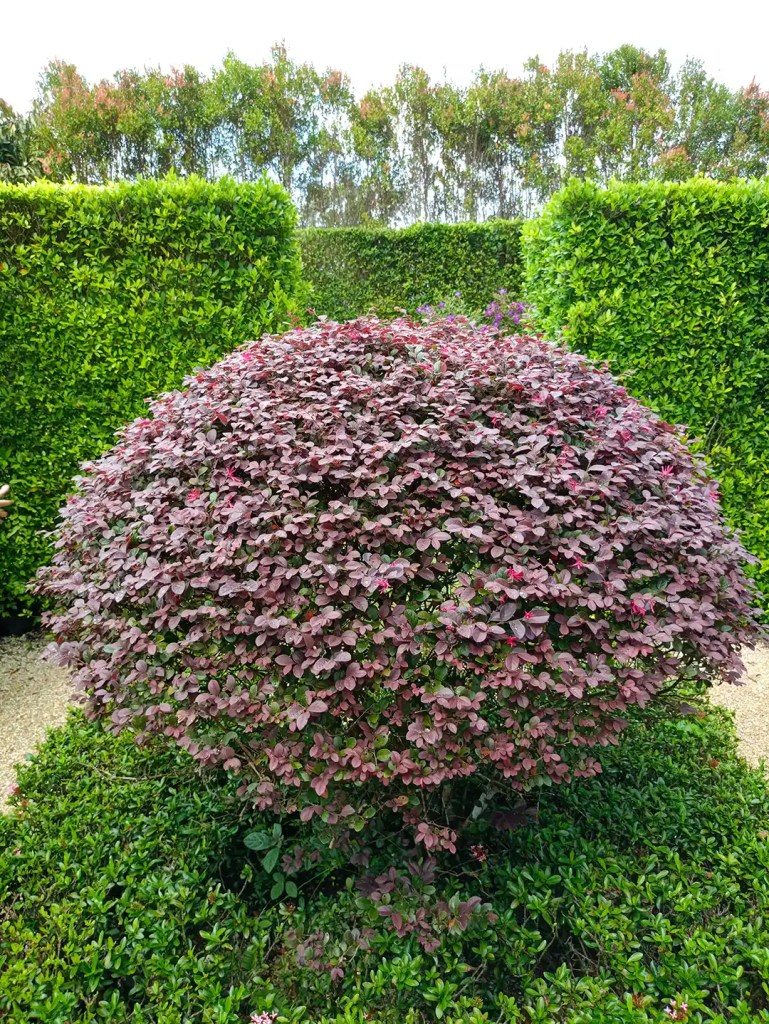
This is where people get burned, so pay attention: size depends entirely on the cultivar, and the retail tags lie. The old species gets big — 10 to 20 feet. Modern named cultivars run anywhere from a 1-foot groundcover to a 30-foot small tree. A dwarf loropetalum like Purple Pixie tops out around 1.5 to 3 feet and weeps; Ever Red and Darkfire sit around 5 to 6 feet and make great hedges; but Purple Diamond (about 15 feet) and ‘Ruby’ (about 12 feet) are big shrubs. Builders love to tuck a big variety into a 3-foot foundation bed and it’ll swallow the walkway in a few years — that’s on your builder. If you just bought the house, figure out which cultivar you have from the table below and move it now, while it’s small, if it’s in the wrong spot.
Where and how to plant loropetalum
Plant in spring or fall. Space them 3 to 6 feet apart depending on the cultivar’s mature width — for a hedge, use the mature width, not the pot size, or you’ll be digging half of them out in three years. Dig the hole as deep as the root ball and two to three times as wide, set the plant a hair high, backfill with the native soil mixed with a little compost, and mulch with 2 to 3 inches of pine bark or pine straw kept off the stem. Water it in deeply and keep it moist — not soggy — the first year, about an inch a week counting rain, then back off; established, it’s drought-tough. Feed lightly in early spring with a slow-release shrub fertilizer and go easy on the nitrogen, or you get leaves instead of flowers.

Soil and pH: why it likes our clay
Good news for us: loropetalum wants rich, acidic, well-drained soil, and our Piedmont red clay is already acidic. It likes a pH around 5.0 to 6.5, which most Triangle yards already have, so pH is rarely the problem here. Drainage is. Loropetalum will not tolerate wet feet, and root rot in soggy clay is the number-one way people kill it. If your spot holds water after a rain, plant high — set the root ball an inch or two above grade and mound the soil up to it, or berm the whole bed — and work pine-bark fines into heavy clay for structure. Keep it away from irrigation heads, downspouts, and the alkaline wash-out around fresh concrete, or you’ll get yellow, chlorotic leaves.
When and how to prune loropetalum (without butchering it)
The biggest mistake I see in the Triangle is somebody shearing a loropetalum into a tight ball. It fights the plant’s natural fountain shape, and — worse — it cuts off next spring’s flowers, because loropetalum blooms on last year’s wood. So when to prune loropetalum? Right after the spring bloom finishes — that’s your window. Use thinning cuts to shape it, not a hedge trimmer scalping the outside. If a plant is overgrown, you can renovate it hard, cutting stems back to within 6 to 12 inches of the base, and it’ll come back. Stop any heavy pruning by early September so new growth hardens off before frost.
The honest downside: why I pulled mine out
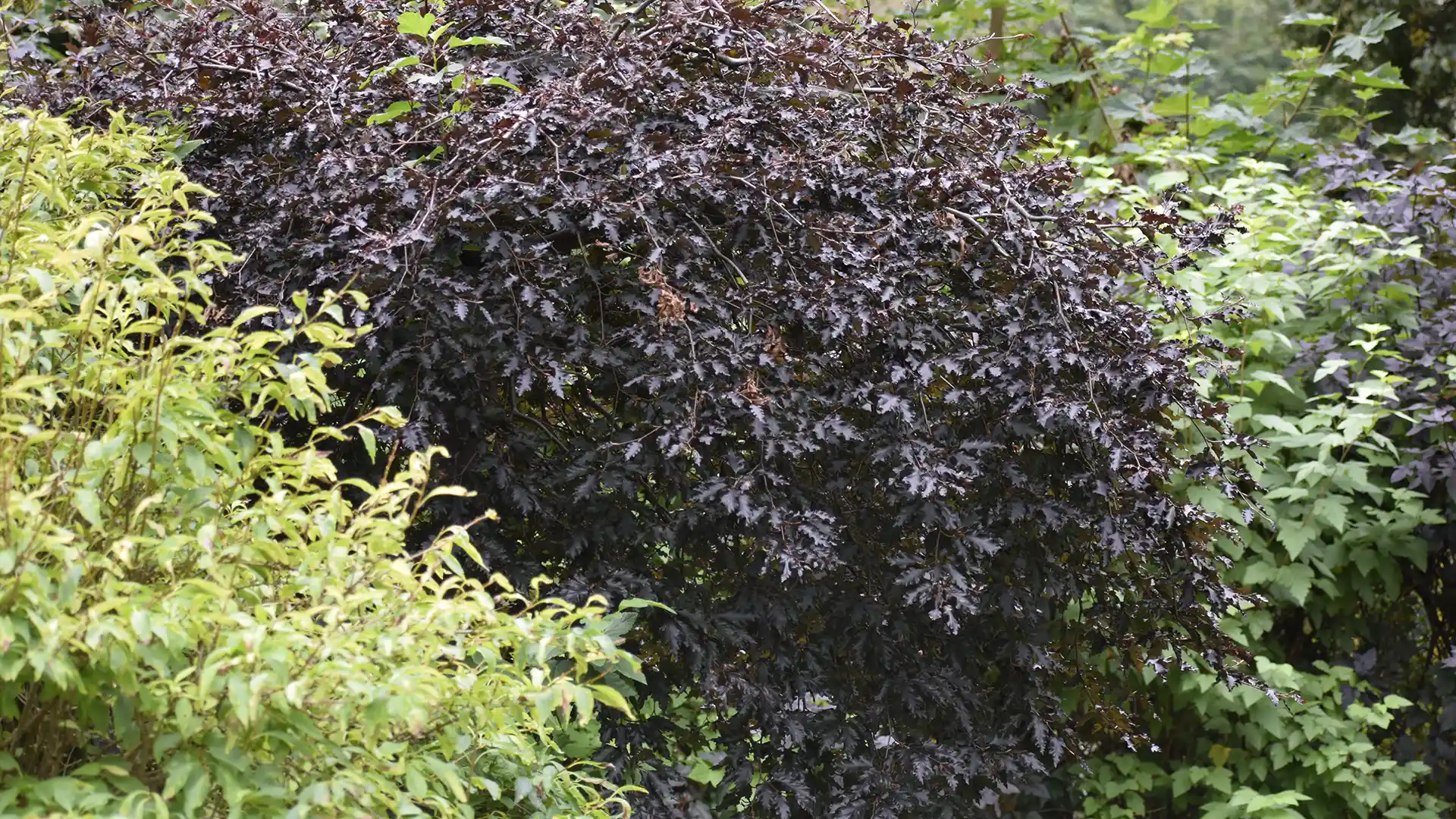
I’ll be straight with you, because most guides won’t: loropetalum is my least favorite of the common shrubs, and I’ve pulled six or eight of them out of my own yard as I’ve landscaped it. The trouble isn’t that they’re hard — it’s that they’re too easy. They grow so fast that they look scraggly most of the year and need trimming three or four times a season to stay neat, which is exactly why you see so many sheared into hard round balls up and down every street. Then there are the dead leaves: they drop under the shrub and stick like Velcro to a fleece jacket or a curly-haired little dog — a bichon or poodle comes back looking like it’s wearing a ghillie suit. None of that makes it a bad plant, and plenty of people love the year-round purple. But if you want low maintenance and you don’t love constant trimming, there are other dark-red shrubs worth a look. I left mine in while they were establishing and pulled them as I upgraded the beds — your call, and at least now you’re making it with eyes open.
Best loropetalum varieties (and which to use where)
Match the plant to the job. Here are the ones worth knowing, with real mature sizes (from Clemson, not the retail tag). For a low foundation row or edging, use a dwarf loropetalum — Purple Pixie or Jazz Hands Mini. For a loropetalum hedge that stays in bounds, Ever Red and Darkfire hold their color. For a tall evergreen privacy screen, the big loropetalum varieties — Zhuzhou, ‘Burgundy,’ Purple Diamond — do the work. Want white flowers and green leaves instead of purple? Jazz Hands Dwarf White or Emerald Snow.
Why is my loropetalum turning green?
This is the question I get most: “why did my purple loropetalum turn green?” Nine times out of ten it’s shade. The purple cultivars need six or more hours of sun to hold their color; put them under a tree or on the north side of the house and they fade to green and get leggy, reaching for light. Move it to more sun, or if you can’t, swap to a cultivar that holds color better. A couple of varieties (like ‘Blush’ and the older ‘Ruby’) also just age from purple to green on their own — that’s the plant, not you. And if it’s leggy and not blooming, same fix: more sun, and lay off the high-nitrogen fertilizer.
Common loropetalum problems
Loropetalum is one of the easier shrubs — deer mostly leave it alone and it’s generally pest-free — but a few loropetalum problems get it here. Root rot in wet soil is the big one; fix drainage. Chlorosis, the yellowing you see if the soil goes alkaline, is the second. And the one real disease is a bacterial “olive gall” that makes knotty galls on the stems and can girdle and kill the plant — buy clean plants, prune several inches below any gall, and wipe your pruners with a 10% bleach solution between cuts so you don’t spread it. Keep half an eye out for mites and aphids, but those are rare.
Loropetalum FAQ
Want a loropetalum hedge or foundation done right — or the builder’s pulled out?
We design, plant, prune, and swap out shrubs across the Raleigh suburbs — the right cultivar, proper spacing, drainage fixed so it doesn’t rot, and pruning that keeps the blooms. Call or text 984-284-5399 for a free quote.
Sources
Clemson HGIC — Loropetalum (Chinese Fringe-Flower) Care, Cultivars and Growing Guide: hgic.clemson.edu
NC State Extension Plant Toolbox — Loropetalum chinense: plants.ces.ncsu.edu
NC State Extension Plant Toolbox — Loropetalum chinense var. rubrum: plants.ces.ncsu.edu Keep your shrubs thriving with our tree and shrub maintenance plan and tree and shrub pest control.
