

Storm and Hurricane Prep for Your Landscape and Trees in North Carolina
By Ken Erickson · Updated June 2026
Good storm prep for trees starts long before the forecast. We do not get direct hurricane hits out here in the Triangle, but we get the remnants – the heavy rain and gusty wind bands that come inland – plus severe summer thunderstorms and winter ice storms. Every one of those can put a limb through your roof or a whole tree across your driveway. The good news is that most storm damage is preventable, and it is a lot cheaper to handle a hazard tree on your schedule than as an emergency at 2 a.m. Here is how to get your landscape and trees ready.
Key takeaways
- Prep in advance, not during a warning. The best time to inspect and prune is late winter to early spring, months before hurricane season, so trees heal and re-anchor before the wind hits.
- Thin, do not top. Proper pruning removes dead and weak limbs and lets wind pass through. Topping a tree makes it MORE hazardous by triggering weak regrowth.
- Some trees are built to fail – Bradford pear, water oak, willow, Leyland cypress, and any leaning or shallow-rooted tree. Deal with them before storm season.
- Our real threat is saturated clay plus wind plus ice. Days of rain soften our heavy clay, then wind uproots whole trees; winter ice loads limbs to the breaking point.
- After a storm, safety first. Treat every downed line as live, stay well back, and call a pro for hanging limbs, split trunks, or anything near power lines.
When is storm season in North Carolina?
It is really a year-round job here. Atlantic hurricane season runs June through November, peaking August into October, and while we sit well inland, we regularly catch the remnants – think of the rain and wind from storms like Fran, Floyd, Matthew, and Florence. Then in winter, zone 7b brings ice storms that load limbs until they snap. Add in nor’easters and summer severe weather and the lesson is clear: do not wait for a named storm in the forecast to think about your trees. The prep that protects you gets done months ahead.
How do I inspect my trees for storm hazards?
Walk your property and look up. The warning signs of a tree likely to fail in a storm are usually visible from the ground:
What to check | When | Why it matters |
|---|---|---|
Dead or hanging limbs, cracks, cavities, leaning trunks | Late winter, before June | Weak points fail first – catch them before a limb comes down |
Co-dominant leaders with tight, included bark | Annually and after storms | V-shaped, bark-trapped unions split first in high wind |
Structural prune – thin canopy, remove deadwood (never top) | Dormant season, ahead of storms | Lets wind pass through; topping causes weak regrowth |
Remove or replace high-risk trees | Before storm season | Cheaper and safer than emergency cleanup |
Secure objects, clear gutters, stake young trees | 24 to 48 hours before a storm | Furniture and brush become projectiles; clogged drains flood |
After the storm: check for downed lines, then assess | Immediately, from a safe distance | Downed lines can be live; split trunks usually mean removal |
Also look for mushrooms or fungus at the base, heaving soil around the roots, and any tree leaning more than it used to. When it is beyond a ground-level look, a certified arborist can do a real risk assessment.
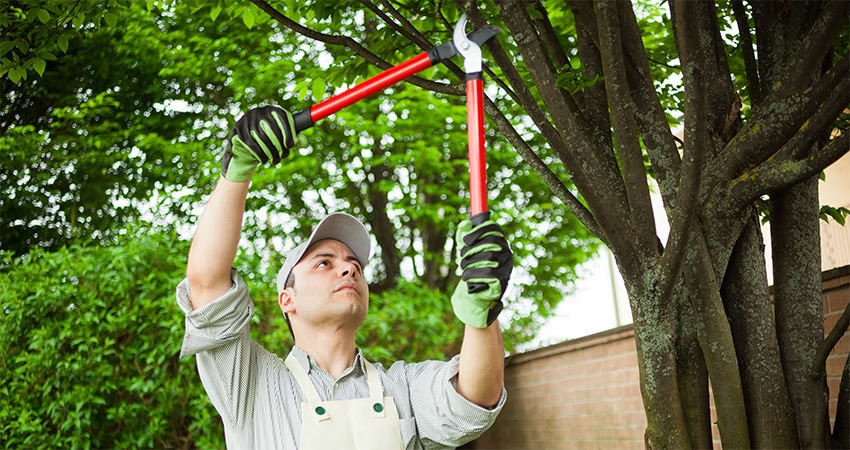
Proactive pruning that helps – and the topping mistake that hurts
This is the most important section, so let me be blunt: never top a tree. Cutting the crown back to stubs – topping, hat-racking, whatever you call it – does not make a tree safer. It triggers a flush of weakly attached new growth that breaks off in the very next storm, and it leaves big wounds that rot. What actually reduces storm risk is proper structural pruning: removing dead, diseased, cracked, and overhanging limbs, and thinning the canopy so wind passes through instead of pushing against a solid sail. The rule of thumb is to never remove more than about a quarter of the canopy at once, and to do it in the dormant season, well ahead of any storm – not during a warning. Weak unions that cannot be pruned out can sometimes be cabled or braced by a pro.
Which trees fail most in storms?
Some trees are simply built to come down. The usual casualties are the fast-growing, weak-wooded, and shallow-rooted ones: Bradford and Callery pear (those tight, included-bark unions split predictably), water oak, willow, silver and red maple, Leyland cypress, and tall slender pines left standing after a lot was cleared around them. Recently planted trees are vulnerable too, because they have not anchored their roots yet, and any old, decayed, or leaning tree is a candidate. If you have got one of these threatening the house, addressing it before storm season – not after it is lying across your car – is the smart money. The storm-resilient trees are the opposite: a single strong trunk, deep roots, and a low center of gravity, planted well back from the house.
Storm prep for trees: securing your yard before a storm
When a storm is actually in the forecast, the yard has a checklist of its own. Bring in or tie down anything that can become a projectile – patio furniture, planters, grills, trash cans, hanging baskets, and yard decor. Move potted plants to shelter. Stake any young trees. Clear your gutters, downspouts, and storm drains so the rain actually drains away instead of flooding. And if you have done any pruning, get the cuttings and brush hauled off before the wind arrives – a brush pile is just a stack of projectiles waiting to happen. None of it takes long, and it is the difference between a stressful night and an expensive one.


What to do after the storm – safety first
When it is over, safety comes before cleanup, and one rule matters most: treat every downed or drooping power line as live. Stay at least 25 feet back, do not touch the line or anything it is contacting – including a tree lying on it – and call 911 and your utility. Assess damage from a distance first, and photograph it for insurance before you move anything. Watch for hanging limbs still caught in the canopy and for bent limbs under tension that can snap back when cut. If it needs a ladder, a chainsaw overhead, or it is anywhere near a power line, that is a pro’s job, not a Saturday project.
Can a damaged tree be saved, and when do I call a pro?
Not every damaged tree is a goner. A small tree that was recently uprooted can sometimes be straightened, replanted, and staked right away. A tree that kept its central leader and most of its main branches will often recover. But a large tree that was wind-thrown or is now badly leaning, one with a split trunk, or one that lost more than about half its canopy usually needs to come out. When you are not sure, you can often wait a few months and re-evaluate rather than removing in a panic – and do not fertilize a storm-damaged tree; just remove the broken wood and let it recover. For anything involving power lines, a crane or chainsaw work overhead, or a high-value tree you want saved, get a certified arborist out. That assessment – and the pruning and removals that prevent the damage in the first place – is exactly the kind of tree work we do. Text us at 984-284-5399.
Frequently Asked Questions
Got a Tree That Worries You Before Storm Season?
We inspect and structurally prune hazard trees, remove the high-risk ones on your schedule, and handle post-storm cleanup safely. Text us before the next storm, not after.
Sources
NC State Extension – Preventing and Managing Storm Damage to Trees
UF/IFAS Gardening Solutions – Preparing Trees for Hurricanes
Ready.gov (FEMA) – Hurricanes
NC Historic Preservation Office – Hurricane Preparedness
