

Pre-Emergent for Flower Beds: How to Stop Weeds in NC Landscape Beds
By Ken Erickson · Updated July 2026
The answer is a good pre-emergent for flower beds, laid down before the weeds ever break the surface. Every spring we get the same question from homeowners across Fuquay-Varina, Holly Springs, Apex, Cary, and Garner: how do I keep weeds out of my mulch beds without pulling them all summer? The answer is a pre-emergent herbicide made for landscape beds – not the same product you or your lawn company puts on the grass. We are licensed by the state of North Carolina to apply herbicides and pesticides on turf and ornamental plants such as shrubs and trees, and the distinction between the two matters, because the wrong product in the wrong place either fails or damages your shrubs.
Pre-Emergent for Flower Beds: What It Is and How It Works
A pre-emergent is a herbicide that forms a thin chemical layer at the soil or mulch surface and stops weed seeds from developing roots as they germinate. It does not touch the plants you want – established shrubs, perennials, and trees – and, just as importantly, it does not kill weeds that have already emerged. If your bed is already weedy, you pull or spot-treat those weeds first, then apply the pre-emergent to prevent the next flush of seeds. It works on small-seeded annual grasses and broadleaf weeds like crabgrass, chickweed, spurge, and bittercress, but not on large-seeded weeds like morning glory or established perennials like nutsedge. Think of it as a barrier that has to be down and activated before the seeds wake up – timing is everything.
Flower bed pre-emergent vs. lawn pre-emergent: are they the same thing?
No – and this is the mistake we correct most often. Lawn and turf pre-emergents are built around actives like prodiamine (Barricade), dithiopyr (Dimension), and pendimethalin (Halts), and those labels are written for turfgrass. Ornamental-bed products are built around actives labeled for landscape beds: trifluralin (the active in consumer Preen), isoxaben (Gallery), and oryzalin (Surflan), plus combination products like Snapshot (trifluralin plus isoxaben) and Freehand (dimethenamid-P plus pendimethalin). The molecule alone does not tell the whole story – some actives appear on both turf and bed labels in different formulations – but the label is what governs. A product labeled only for turf should never be assumed safe over your shrub roots, and a bed product is not a lawn product. The lawn is a separate job with separate chemistry — that is what our weed control and fertilization program covers, including weed control in Fuquay-Varina. Read the label and match the herbicide to the site; in North Carolina, the label is the law.
Product | Active ingredient | What the label covers | OK in a bed of annual flowers? |
|---|---|---|---|
Barricade | prodiamine | Turf and listed ornamentals – NC State notes only a few bedding plant species are on the label | No for most annual beds. Check the label; very few annuals are listed. |
Preen Garden Weed Preventer | trifluralin | Ornamental beds; 200-plus listed established plants | Yes, around established plants on the tolerant list. NC State calls trifluralin the safest of these on herbaceous ornamentals. |
Surflan | oryzalin | Established woody ornamentals, soil settled firmly around the roots | No. NC State: injurious to many bedding plants. |
Gallery | isoxaben | Woody ornamentals; broadleaf weeds only | No. This is a shrub and groundcover product, not an annual-bed product. |
Snapshot | trifluralin plus isoxaben | Landscape ornamentals, groundcovers, perennials | No. The 2.5 TG label bans bedding plants, and ground where bedding plants go in within a year. |

How do you apply pre-emergent in flower beds?
Start by clearing the bed: pull or spot-spray any existing weeds, because the pre-emergent will not kill them. Make sure the plant foliage is dry, then spread the granular product evenly at the label rate over the soil or mulch surface – a handheld or broadcast spreader gives you even coverage on larger beds. Water it in with about a quarter-inch of irrigation soon after applying (do not wait more than about five days), which dissolves the granules and settles the active into the top layer where seeds germinate. If you are mulching too, the general rule is to lay mulch first and apply on top, so weed seeds cannot establish in the fresh mulch; if your mulch is already deeper than a couple of inches, apply and gently rake it in. Clemson’s quarter inch is enough to wash the granules off the mulch surface, but the professional labels ask for more – Snapshot’s own label calls for a single rainfall or irrigation of half an inch or more to activate it. Go by the bag in your hand. One application typically holds for about three months, so plan on reapplying to keep beds clean through the season.
When should you apply pre-emergent in NC?
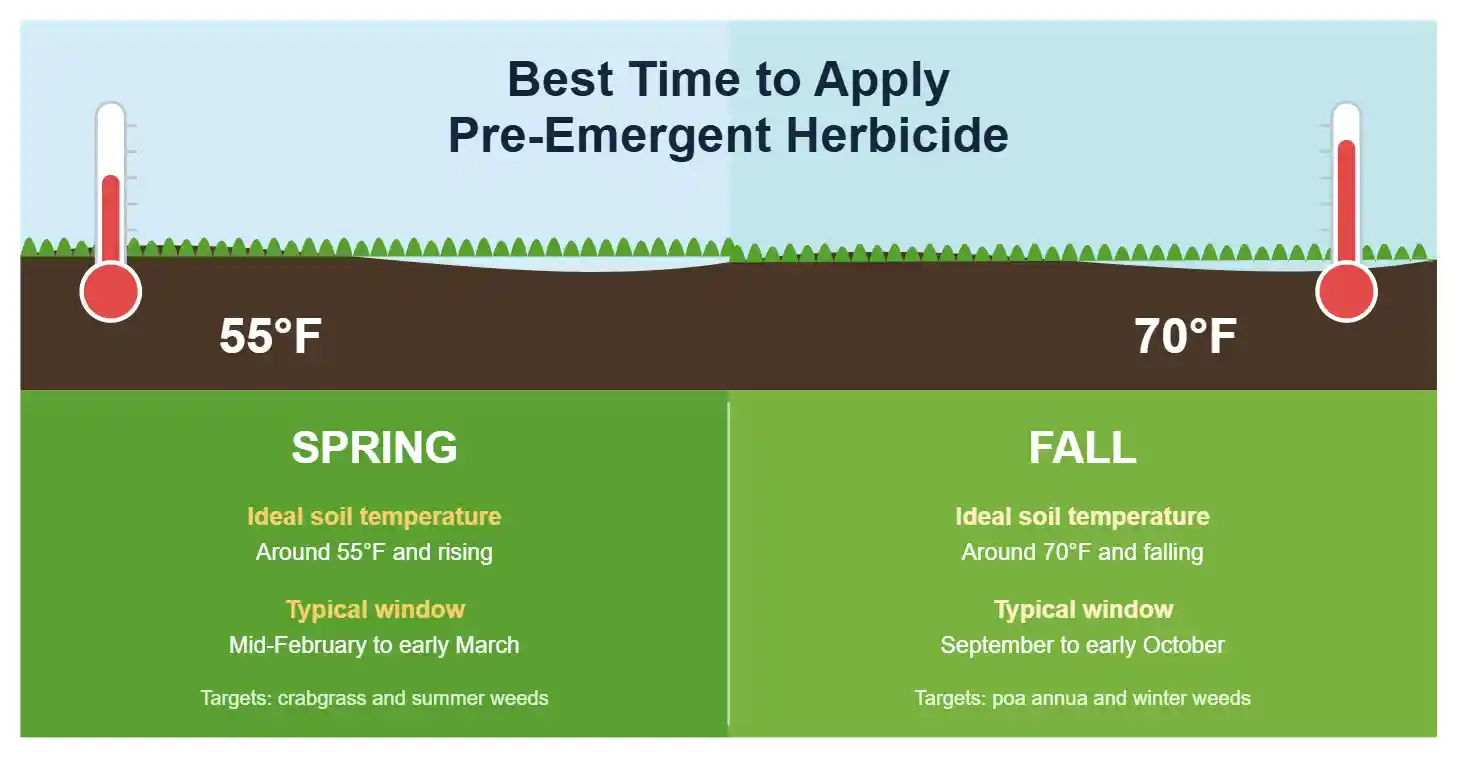
North Carolina sits in the transition zone, so we run two applications a year. The spring application targets summer weeds like crabgrass and goes down when soil temperatures at the top two inches hold around 50 to 55F for several days – in our Raleigh-suburb area that is typically late February into early March, and it has been trending earlier, so we do not wait. Crabgrass germinates as soil crosses roughly 55F, so the barrier has to be down and watered in before then. The fall application targets winter annuals – chickweed, henbit, annual bluegrass, Carolina geranium – and goes down in September as soil cools below about 70F. Miss the window on either end and the seeds are already up, at which point a pre-emergent cannot help.
Where do you buy flower bed pre-emergent, and what does it cost?
Homeowner bed pre-emergents are easy to find: big-box stores like Lowe’s and Home Depot, local garden centers, and farm and ag supply stores all carry them, and the consumer standard is Preen Garden Weed Preventer (trifluralin). As a market range, expect roughly $10 to $15 for a small shaker bottle (about 900 sq ft), $20 to $28 for a 13-pound bag (about 2,080 sq ft), and $35 to $45 for a 30-pound-plus bag (about 5,000 sq ft) – prices vary by store, size, and season, so treat these as ballparks, not fixed numbers. Professional-grade products like Snapshot run higher, often $70 to $100 or more for a 50-pound bag, and are sold through ag and turf suppliers. The product cost is the easy part; the real cost of DIY is buying the wrong product, applying it at the wrong time, and pulling weeds all summer anyway.
Should you DIY flower bed pre-emergent or hire us?
If you have a small bed, you are comfortable reading a herbicide label, and you can nail the late-February timing, DIY Preen is a reasonable weekend job – we will tell you straight when a job does not need us. Where homeowners struggle is timing (the spring window is short and moving earlier every year), product selection (matching the right labeled active to your specific plants), and even coverage across larger or mixed beds. When we handle it, we apply a professional-grade bed pre-emergent labeled for your ornamentals, hit both the spring and fall windows, and pair it with the rest of your bed maintenance so you are not chasing weeds. Bed pre-emergent is priced by the square footage of the beds, so I quote it after I look at what you actually have. No contracts – text us at 984-284-5399 for a quote and we will tell you whether you even need us.
Frequently Asked Questions
Want Your Beds Weed-Free Without Pulling All Summer?
We apply the right bed pre-emergent, labeled for your plants, at both the spring and fall windows. Licensed in NC on turf and ornamentals. No contracts. Text us for a quote.
Sources
Clemson Cooperative Extension HGIC 2335 – Weed Control in Landscapes: Herbicides
NC State Extension TurfFiles – Timing of Preemergent (PRE) Herbicide Applications
NC State Extension – Weed Management in Annual Color Beds
Clemson Cooperative Extension – Weed Control in Landscapes: Non-Chemical Measures When you would rather hand it off, see our flower bed and crack weed control service.
