

Brown Patch in Your Lawn: Why NC Fescue Gets It and How to Fix It
By Ken Erickson · Updated June 2026
Brown patch fescue is the round, straw-colored disease that hits Raleigh lawns every humid July. If you’ve got a fescue lawn in the Raleigh area and it breaks out in round brown patches every July, you’ve met brown patch. It is the most common lawn disease we deal with here, and it shows up like clockwork in the worst of the summer heat.
Most people treat it like bad luck or blame the weather. It is not luck. Brown patch is a fungus that needs a few specific conditions to take hold, and once you understand what those are, you can do a lot to keep it from wrecking your lawn — usually without spraying a thing.
It’s one of the two usual suspects when a lawn browns out. See our guide on what’s wrong with my lawn for the full diagnosis rundown. Not sure what is hitting your lawn? Start with our lawn diagnosis guide.
Key takeaways
- Brown patch is the number one summer disease on North Carolina fescue lawns.
- It’s driven by hot days, warm humid nights, and grass blades staying wet for hours — not just “bad weather.”
- The fixes are mostly cultural: mow tall, water at dawn only, and ease off spring nitrogen.
- Most store-bought “brown patch” fungicides don’t actually control it. Research found several didn’t beat doing nothing.
- Your fescue almost always recovers when nights cool down. Fill thin spots by overseeding in the fall.
Brown Patch Fescue: What is brown patch?
Brown patch is a lawn disease caused by a fungus called Rhizoctonia solani. It hits cool-season grasses, and here that means tall fescue — the grass most Triangle lawns are built on. It is the number one disease of home lawns in North Carolina.
Here is the thing about the fungus: it is already in your lawn. It lives in the soil and thatch of basically every fescue lawn. It doesn’t blow in on the weather. It flares up when the grass gets stressed and the leaves stay wet long enough for it to infect. That is the whole game — stress plus leaf wetness.
How to spot brown patch
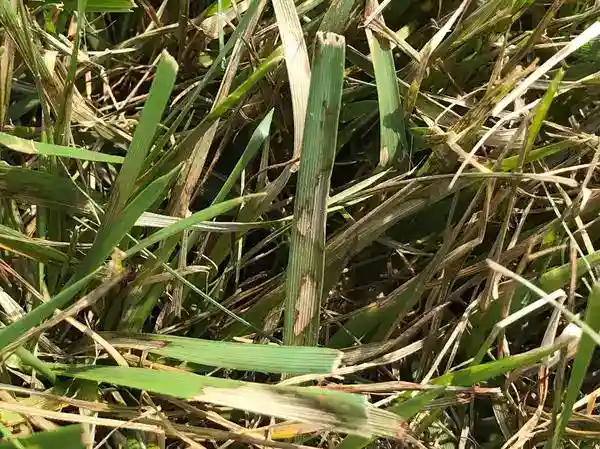
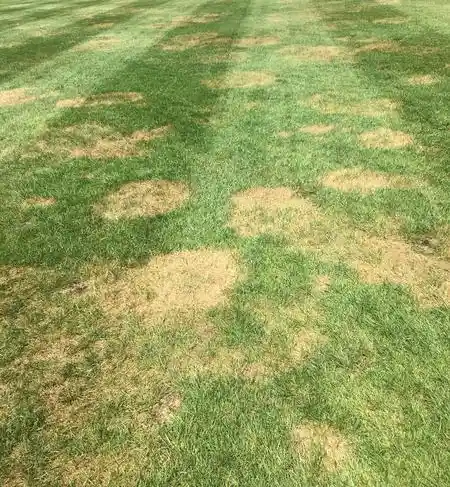
Brown patch shows up as roughly circular patches, tan to brown, anywhere from six inches to several feet across. The blades usually stay standing up rather than matting down.
Look closer at an individual blade and you’ll see the tell: an irregular tan lesion with a dark brown border. That border is what separates brown patch from drought or other problems.
Early on a humid morning, before the dew burns off, you might catch a “smoke ring” — a grayish, cottony ring of fungus around the edge of a patch. That is the disease actively growing. It disappears once the grass dries.
How to tell it apart from other things:
• Drought browns the whole area evenly, and there’s no bordered lesion on the blade.
• Grubs eat the roots, so grub-damaged turf lifts up like a loose carpet. Brown patch grass stays rooted.
When in doubt, that bordered leaf lesion and the humid-morning smoke ring are your confirmation.
Brown patch vs. large patch — know the difference
This trips up a lot of homeowners and even some lawn services. Brown patch and “large patch” are the same fungus, but they behave differently depending on your grass:
Brown Patch | Large Patch | |
|---|---|---|
Grass | Cool-season (tall fescue) | Warm-season (zoysia, centipede, St. Augustine) |
Season | Hot, humid summer | Cool, wet spring and fall |
Fungus | Rhizoctonia (brown-patch strain) | Rhizoctonia (large-patch strain) |
• Brown patch hits cool-season grass — your fescue — in the summer heat.
• Large patch hits warm-season grass — zoysia, centipede, St. Augustine — in the cool, wet parts of spring and fall.
So if your fescue browns out in July, that’s brown patch. If your zoysia comes out of winter with big dead rings in April, that’s large patch. Same organism, different timing, different fix. Getting this right matters, because treating your zoysia for “brown patch” in July is chasing a problem that isn’t there.
What triggers brown patch in NC
Brown patch is a summer disease here, and it is tied to a few specific conditions:
• Warm nights. When nighttime lows stay above about 60 degrees — and it really gets going when highs top 90 and nights sit in the 70s — the fungus is happy.
• Long leaf wetness. The blades have to stay wet for roughly 10 to 12 hours for the fungus to infect. Evening watering, heavy dew, poor airflow, and shade all keep the grass wet longer.
• Too much nitrogen. Lush, soft growth from summer feeding is exactly what the disease wants.
In the Raleigh area that lines up to about mid-July through August for the worst of it, sometimes running into September.
How to actually fix brown patch
The real fix is cultural, and most of it is free. Do these before you even think about a fungicide.
Mow tall. Keep fescue at about 3 to 3.5 inches. Cutting it short stresses the grass and makes brown patch worse.
Water at dawn, and only at dawn. The goal is to get the blades dry as fast as possible. Water in the pre-dawn hours so the sun dries the lawn quickly. Never water in the evening — that leaves the grass wet all night, which is exactly what the fungus needs. Water deeply and less often, not a little every day.
Ease off the nitrogen. Don’t push fescue with fertilizer in late spring and summer. Feed fescue in the fall instead, when the disease isn’t active. If you fertilize into the summer heat, you’re feeding the disease as much as the lawn.
Open it up. Improve airflow — prune back trees and shrubs crowding the lawn so it dries faster. Core-aerate to relieve compaction and cut down thatch, which holds moisture and harbors the fungus. If a low spot stays wet, fix the drainage.
Do those things and a lot of fescue lawns never need a fungicide at all.
Do fungicides actually work?
This is where I’ll say something the store shelf won’t.
Most of the “brown patch” fungicides sold to homeowners don’t do much. In a multi-year university study, several of the common ready-to-use homeowner products — the myclobutanil and thiophanate-methyl types — didn’t control the disease any better than doing nothing, and a couple actually made it worse. That is not me being cynical; that is the research.
The active ingredient that does hold up is azoxystrobin (it’s in a few consumer products, like Scotts Disease EX). But here’s the catch: fungicides work best preventively, on a schedule, before the disease takes off — not sprayed on after your lawn is already covered in patches. In peak summer heat, cool-season grass grows too slowly to recover, so a curative spray often disappoints even when it’s the right product.
So my honest take: fix the culture first. If you’ve got a high-value lawn and you want disease protection through the summer, that’s a preventive program with the right product on the right timing — exactly the kind of thing a licensed applicator sets up. We’re licensed to apply on turf in North Carolina, and a preventive schedule timed to the NC calendar beats chasing brown patch after it has already scarred the lawn.

Will your lawn recover?
Yes, in most cases. Brown patch is a leaf disease — it doesn’t kill the roots or the crown of an established fescue plant. Once the nights cool off, usually by early September, the lawn starts growing out of it on its own.
The exception is young grass. Fescue less than a year old, and spring-seeded fescue especially, can actually be killed by brown patch. That’s one more reason we seed fescue in the fall around here, not the spring — fall-seeded grass is tougher, and it isn’t walking straight into disease season.
For thin spots left behind, the fix is a fall overseed. Don’t reseed in the summer heat; you’ll just feed the next round of disease. Wait for fall, overseed the bare areas, and the lawn fills back in.
When to call a pro vs. do it yourself
Most brown patch is a do-it-yourself fix, and it’s mostly about how you mow and water. Raise the mower, switch your irrigation to pre-dawn, stop fertilizing in the heat, and let the lawn grow out of it when the weather breaks. You don’t need to hire anyone to do that, and you probably don’t need to spray.
Where a call makes sense: a premium lawn you want to keep spotless through the summer, a bad case that comes back every year, or a new fescue lawn you can’t afford to lose. That’s when a preventive fungicide program — right product, right timing — earns its keep. And if you’re not even sure it’s brown patch, that’s worth a look before you spend money on the wrong treatment.
Not sure if it’s brown patch, drought, or grubs? Text us a photo — text is the fastest way to reach us, at 984-284-5399 — and we’ll tell you what you’re looking at and whether it needs treatment.
Frequently Asked Questions
Want a Pro to Handle It?
We are licensed to treat turf and ornamental plants across the Raleigh southern suburbs. Tell us what your lawn is doing and we will take it from there.
Sources
NC State Extension / TurfFiles — Brown Patch in Turf
NC State Extension / TurfFiles — Large Patch in Turf
Clemson HGIC 2150 — Brown Patch & Large Patch Diseases of Lawns
K-State Research & Extension — Brown Patch in Tall Fescue Lawns For season-long protection, our Fescue lawn maintenance plan and weed control and fertilization program keep disease pressure down.
