

What’s Wrong With My Lawn?
Bugs, Grubs, and Disease in NC
By Ken Erickson · Updated June 2026
What’s Wrong With My Lawn: Step One: Diagnose, Don’t Guess
This is where experience earns its keep. Our education and background controlling pests on turf and ornamental plants is extensive, and we’re licensed by the state of North Carolina to apply herbicides and pesticides — so before anything gets sprayed, we identify what’s actually killing the grass. In our area it comes down to two main culprits: insects and fungal disease. Drought and overwatering cause some browning too, but they’re a distant third. Each leaves a different fingerprint: insects you confirm with a physical test that brings them to the surface; fungus breaks out where the grass is stressed and the leaf stays wet; drought follows the sun and recovers with water. Get the diagnosis right and the treatment is easy. Get it wrong and you can pour product on a lawn for a month with nothing to show for it. If you’re not sure what you’re seeing, it costs you nothing to have us look before you spend a dime on the wrong product. If your turf feels spongy with shallow tunneling, check for mole crickets. Small straw-colored spots the size of a silver dollar point to dollar spot.
A brown patch shows up in the lawn and the first instinct is to grab a bag of bug killer. Half the time that’s the wrong move — because in North Carolina a dying patch of grass can be an insect, a fungal disease, or just drought, and each one is treated completely differently. Spray insecticide on a fungus and you’ve wasted the money and lost a week while the real problem spreads. So if you’re asking what’s wrong with my lawn, the first job isn’t treatment — it’s diagnosis. Here’s how to tell the three apart, what causes each, and the right fix for each. If your bermuda or zoysia has dead rings at spring green-up, see our guide to large patch.
Key takeaways
- In NC, a struggling lawn is usually insects or fungus — not always what it looks like. Diagnose before you spray.
- Grubs and armyworms lift or strip turf fast — confirm with a tug or a soapy-water test.
- Fungus is already in your lawn; it flares when the grass is stressed and the leaf stays wet, not just when it’s humid.
- Watering, mowing, or a dog spot you can handle yourself; a spreading pest or disease is worth a pro’s eye.
Fall Armyworms: Caterpillars That Strip a Lawn Overnight
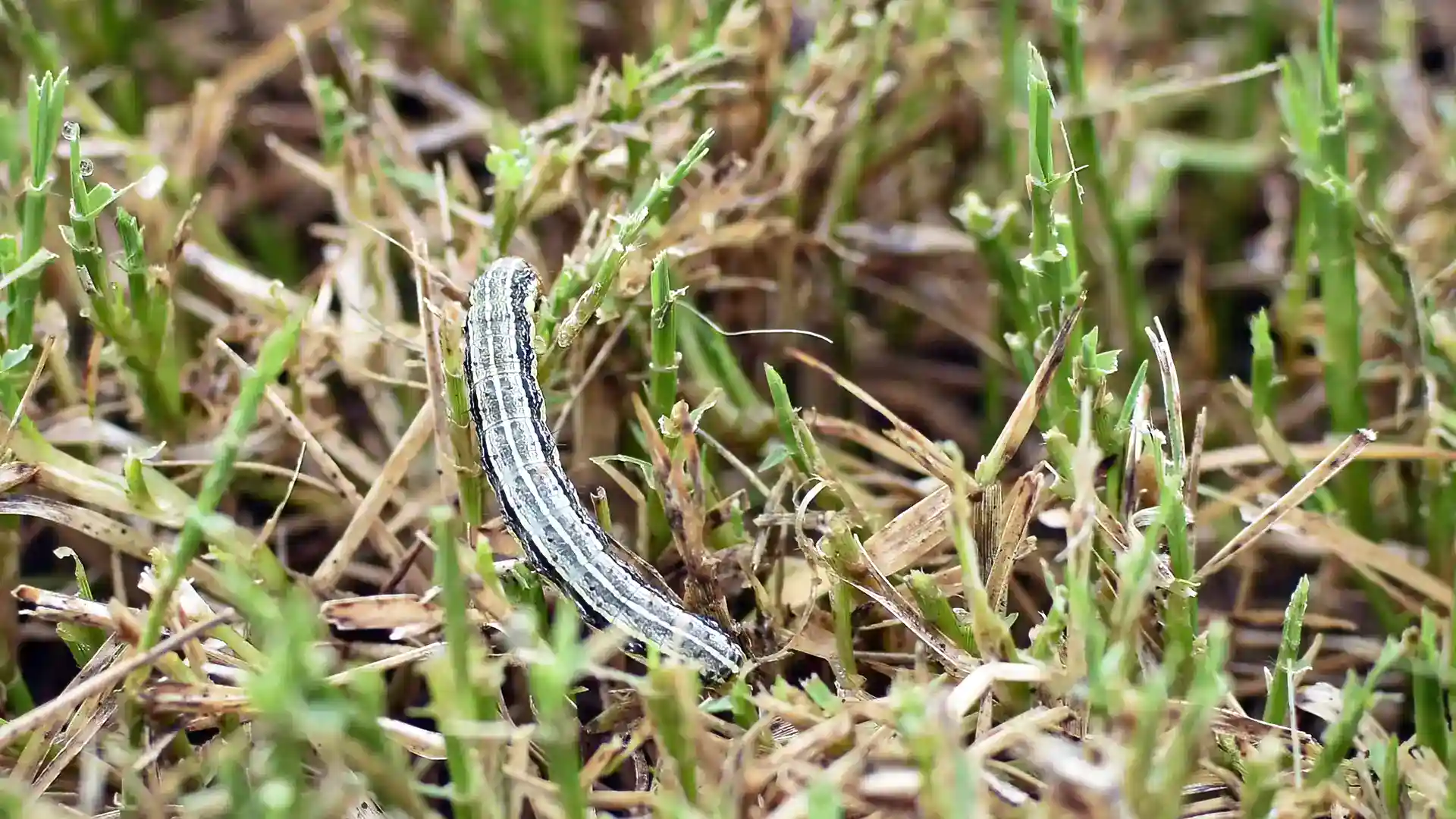
Armyworms are the larvae of a moth — small tan moths that don’t even overwinter here. They blow up from the Gulf Coast on summer storms, and a single female lays around a thousand eggs, so an outbreak explodes fast. The caterpillars are green to brown to nearly black, about an inch and a half long, with an upside-down Y on the head. They feed at the cool ends of the day and skeletonize the grass blades, so the damage seems to appear overnight — worst in August and September. And if pale little moths fly up out of the turf as you mow, that’s not an early warning — it means you already have them. Those moths hatched from armyworms living in your lawn right now, and they’re laying the next round of eggs as they go. If your fescue browns out in circular patches in summer, see our guide to brown patch. If your fescue is thinning fast in late-summer heat, it may be gray leaf spot.
Armyworms blow into North Carolina on southern storms, and once your turf becomes their breeding ground the population explodes — they can strip an entire lawn in about a week. If you’re flushing moths when you mow, call us fast — this one moves quickly.
The Soap Test
The soap test finds them in ten minutes. Mix one to two tablespoons of dish soap (any kind — the soap is the irritant, the scent doesn’t matter) into a gallon or two of water and pour it over a square yard at the edge of the damage. The caterpillars come to the surface within about ten minutes. Bermuda and Zoysia regrow from their runners and usually recover; fescue has no runners, so armyworm damage to fescue is often permanent thin spots that need fall overseeding to fix.
Symptom | Most likely cause | Quick check | DIY or call a pro? |
|---|---|---|---|
Even browning on sunny high spots; footprints linger | Underwatering / drought | Soil dry 2–3 in. down | DIY — water deep, early morning |
Brown spot with a dark-green ring | Dog urine | Lush ring around a dead center | DIY — flush with water, reseed |
Yellow stripes in a grid pattern | Uneven fertilizer pass | Lines match your spreader path | DIY — overlap each pass |
Spongy turf that rolls back like carpet | White grubs | Peel sod, look for C-shaped larvae | Pro — timing is everything |
Patches stripped overnight; green frass | Fall armyworms | Soapy-water flush brings them up | Pro — act within days |
Circular tan patches, smoke-ring edge, summer | Brown patch (fescue) | Hot, humid, watered in the evening | Pro — preventive fungicide |
Whole lawn straw-brown in winter (Bermuda) | Dormancy — normal | Crown at the base still cream-colored | Nothing — it’s just asleep |
Thin grass with moss in shade | Too much shade / low pH | Moss plus poor light | DIY — prune limbs, raise pH |
White Grubs: Beetle Larvae That Eat Roots From Below
Grubs are the C-shaped larvae of scarab beetles, and several kinds matter in North Carolina — Japanese beetle, the northern and southern masked chafers, green June beetle, May-June beetles, and the Asiatic garden beetle. They live in the soil and chew grass roots, so grub-damaged turf pulls up like a loose carpet — grab a brown patch and if it rolls back with no roots holding it, think grubs.
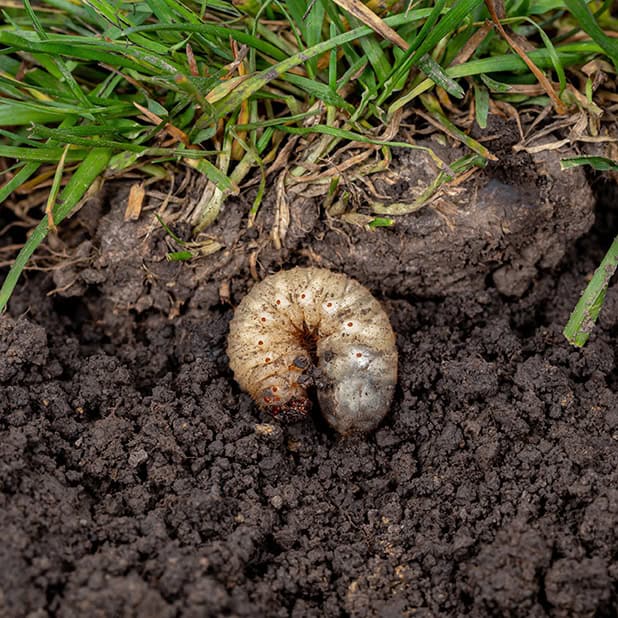
Two things people get wrong about grubs. First, moles aren’t proof. Moles do eat grubs, so they can be a hint — but moles love earthworms just as much, and a mole tunneling a healthy, earthworm-rich lawn may have no grubs at all. Confirm before you treat. Second, grubs run on a multi-year cycle — depending on the species, the larvae can take one to four years to mature, and a single treatment never gets every one. The professional rule is to treat two years in a row, three to be safe, to break the cycle instead of knocking it back and watching it return. The beetles tell the same story in reverse: those masked chafers and Japanese beetles bumbling around your porch light on summer nights hatched from grubs that were already in your lawn. Now they’ll mate and lay the eggs for the next batch — so seeing the adults means the cycle is already turning under your turf, and it’s time to break it with prevention.
Mole crickets tunnel through the root zone of sandy, warm-season lawns, leaving spongy turf and raised surface trails. The same soap flush finds them — they surface in two or three minutes — and like grubs they’re easiest to stop in June and July while they’re immature.
Chinch bugs are the deliberate exception. They’re tiny insects that suck the juice out of grass in hot, dry, sunny spots, and their damage looks exactly like drought — which is why people water harder and watch the patch grow. You can’t water your way out of chinch bugs. The soap flush is unreliable for them; the test that works is the can-float method: cut both ends off a coffee can, push it into the turf at the edge of a dying patch, fill it with water, and the chinch bugs float up in about ten minutes.
The Other Suspect: Lawn Disease
When it isn’t an insect, it’s usually a fungus — and here’s the part most homeowners get wrong: the fungal spores are already in nearly every lawn. Disease doesn’t just blow in with the weather. It breaks out when the grass is stressed and the leaf stays wet long enough for the fungus to take hold — mowing too short, too much nitrogen, watering in the evening, heavy thatch, shade, and poor airflow all push a lawn over the edge. Three diseases matter most here:
Brown patch
Brown patch hits tall fescue in summer. It needs warm nights (above 60°F) and long periods of leaf wetness, so it flares in humid July and August, especially on lawns watered in the evening. It shows as roughly circular tan patches, sometimes with a darker “smoke ring” edge in the morning. See NC State’s TurfFiles profile on brown patch for the full rundown.
Large Patch
Large patch is the warm-season version, worst on Zoysia (and centipede and St. Augustine), and it appears in the cool, wet windows of spring and fall — big circular patches, often orange at the advancing edge. Clemson’s extension fact sheet covers large patch in detail.
Spring Dead Spot
Spring dead spot is Bermuda’s worst disease. The infection happens in fall but the symptom shows up in spring as circular dead areas that are slow to green up. Because the damage is done before you see it, prevention is the only real control.
The key with all three: fungicides are preventive, not curative. They protect healthy grass ahead of the disease window; sprayed on a patch that’s already collapsed, they do little. Timing, again, is everything — and timing depends on correctly reading the weather and the grass.
How a Trained Eye Tells Them Apart
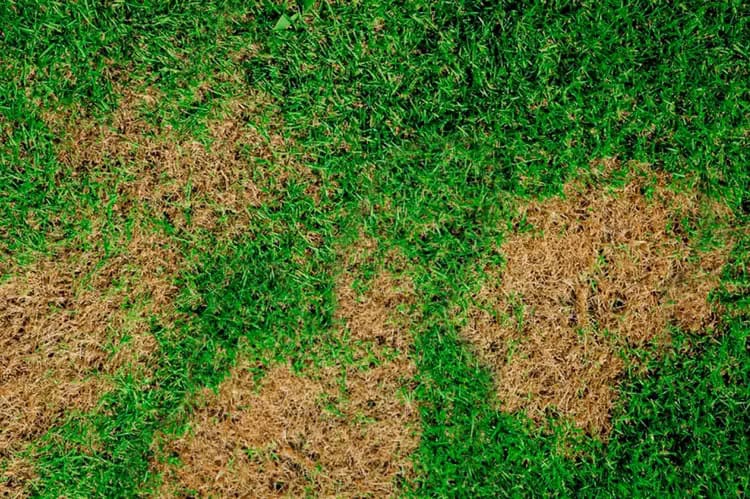
Here’s the diagnostic shorthand we use in the field. Drought follows the sun and the slope — it shows first on south-facing banks, near pavement, and high spots, and it greens back up within a day or two of a good watering. Disease shows up where the leaf stays wet and the grass is stressed — shade, low spots, evening-watered fescue — in roughly circular patches or rings that spread outward over several days. Insects leave chewed, thinning, or lifting turf, and a soap drench or a tug test brings them to the surface. When two overlap — and a stressed lawn invites both — that’s when a second opinion pays for itself, because the wrong call costs a whole treatment cycle.
The Right Product for the Right Problem
Less Often: Just Water, Mowing, or Wear
Sometimes it really is the simple stuff — and it’s worth ruling out before you spend on a product. Underwatering browns the sunny, high spots first. Overwatering plus a dull mower blade invites fungus. Cutting too short scalps it. Compacted clay and heavy thatch choke the roots. And a brown spot with a dark-green ring around it is almost always dog urine, not a disease.
Honest truth: if it’s watering, mowing, or a dog, you don’t need us — fix the habit and the lawn comes back. If the soil is hard as a brick, that’s a core aeration and top dressing job you can rent a machine for. We’re worth calling when it’s a misdiagnosed pest or disease and the wrong product is about to cost you a whole treatment cycle.
Once it’s diagnosed, the chemistry is straightforward — and it’s active-ingredient first, because the brand on the bag matters less than what’s in it:
Grubs and Armyworms
Grubs and armyworms, prevention: chlorantraniliprole (homeowner brand GrubEx; the professional version we run is Acelepryn). One well-timed June-or-July application gives season-long control of grubs and young armyworms, and it’s about as easy as it gets on bees — and it does not kill earthworms, which is exactly why we prefer it over older chemistry. Always read and follow the label.
Grubs
Grubs, after the damage: trichlorfon (Dylox) is the one product that kills grubs already feeding. It works, but it’s harder on earthworms, so it’s a rescue tool, not a routine.
Armyworms
Armyworms, after the damage: bifenthrin or spinosad — but only while the caterpillars are small. Once they’re full-grown they’ve nearly finished feeding and barely respond, so spraying big armyworms mostly wastes product.
Chinch Bugs
Chinch bugs: a different chemistry entirely — a pyrethroid like bifenthrin, since chlorantraniliprole doesn’t touch them. (Chinch bugs have built resistance to pyrethroids in some areas, another reason to confirm and treat deliberately rather than blanket-spray.)
Disease
Disease: preventive fungicides, timed to the grass and the conditions — not sprayed after the lawn is already brown. The active ingredient and the rotation matter for resistance; get those wrong and you breed a fungus the product no longer controls.
When to Treat: Prevent Early, Rescue Late
The cheapest fix is prevention, and prevention is all about timing. We put down chlorantraniliprole (the pro version we run is Acelepryn; the homeowner equivalent is GrubEx) in late spring to early summer — before the grubs ever hatch. One well-timed application gives season-long control of grubs and shields the lawn against young fall armyworms and sod webworms at the same time. That single preventive stops most of the damage we get called about.
Sod webworms are the other caterpillar to watch — the small tan moths you see zig-zagging over the lawn at dusk are laying them, and the larvae chew the blades down to brown patches. If you’ve missed the preventive window — like right now, mid-summer, with damage already showing — prevention won’t help, so we switch to a curative. Trichlorfon (Dylox) is the rescue: it knocks down the grubs feeding below ground and the surface caterpillars — armyworms and webworms — in one shot, while a pyrethroid like bifenthrin cleans up the adult beetles and moths working the surface.
Then next season we move the preventive up — chlorantraniliprole down early, before the hatch — so you never need the rescue again. The hard part is the timing, and that’s the part we take off your plate: we track the soil temperatures and the calendar and put the right product down at the right time, so you don’t have to remember the window. You just get a lawn that doesn’t get eaten.
Different Grass, Different Calendar
Which should you choose?
Fescue and Bermuda don’t get sick or eaten on the same schedule, which is half the diagnosis. Fescue’s big disease is brown patch in the heat of summer; its worst insect hit is armyworms in late summer, and the damage tends to be permanent because fescue can’t self-repair. Bermuda and Zoysia shrug off a lot more — they regrow from runners — but they carry large patch and spring dead spot in the cool, wet shoulder seasons, and grubs feed under both. Grub prevention goes down in June and July regardless of grass; disease prevention tracks each grass’s own danger window.
Lawn Pest and Disease FAQs
Not Sure What You’re Looking At?
That’s the whole point of having a pro look first — the diagnosis comes before the product, instead of guessing with a hose-end bottle. Our education and background controlling pests on turf and ornamental plants is extensive, and we’re licensed by the state of North Carolina to apply herbicides and pesticides on turf and ornamental plants such as shrubs and trees. Lawn Panther scouts, identifies, and treats lawn insects and disease as part of our weed control and fertilization program across the south Raleigh suburbs. Not sure what you’re looking at? Text us a photo at 984-284-5399 — text is fastest — and we’ll tell you straight what it is before you spend a dime on the wrong product..
