

Dollar Spot in NC Lawns: How to Identify, Stop, and Prevent It
By Ken Erickson · Updated June 2026
If you are seeing small, bleached, silver-dollar-sized spots scattered across your fescue, bermuda, or zoysia lawn here in the Triangle, there is a good chance you are looking at dollar spot. It is one of the most common turf diseases we deal with across Raleigh’s southern suburbs – Fuquay-Varina, Holly Springs, Apex, Cary, and Garner – because our warm days, cool nights, and heavy spring and fall dews are exactly what the fungus wants. The good news is that dollar spot is very manageable once you understand what is feeding it, and in most lawns the fix starts with how you fertilize and water, not with a fungicide.
Key takeaways
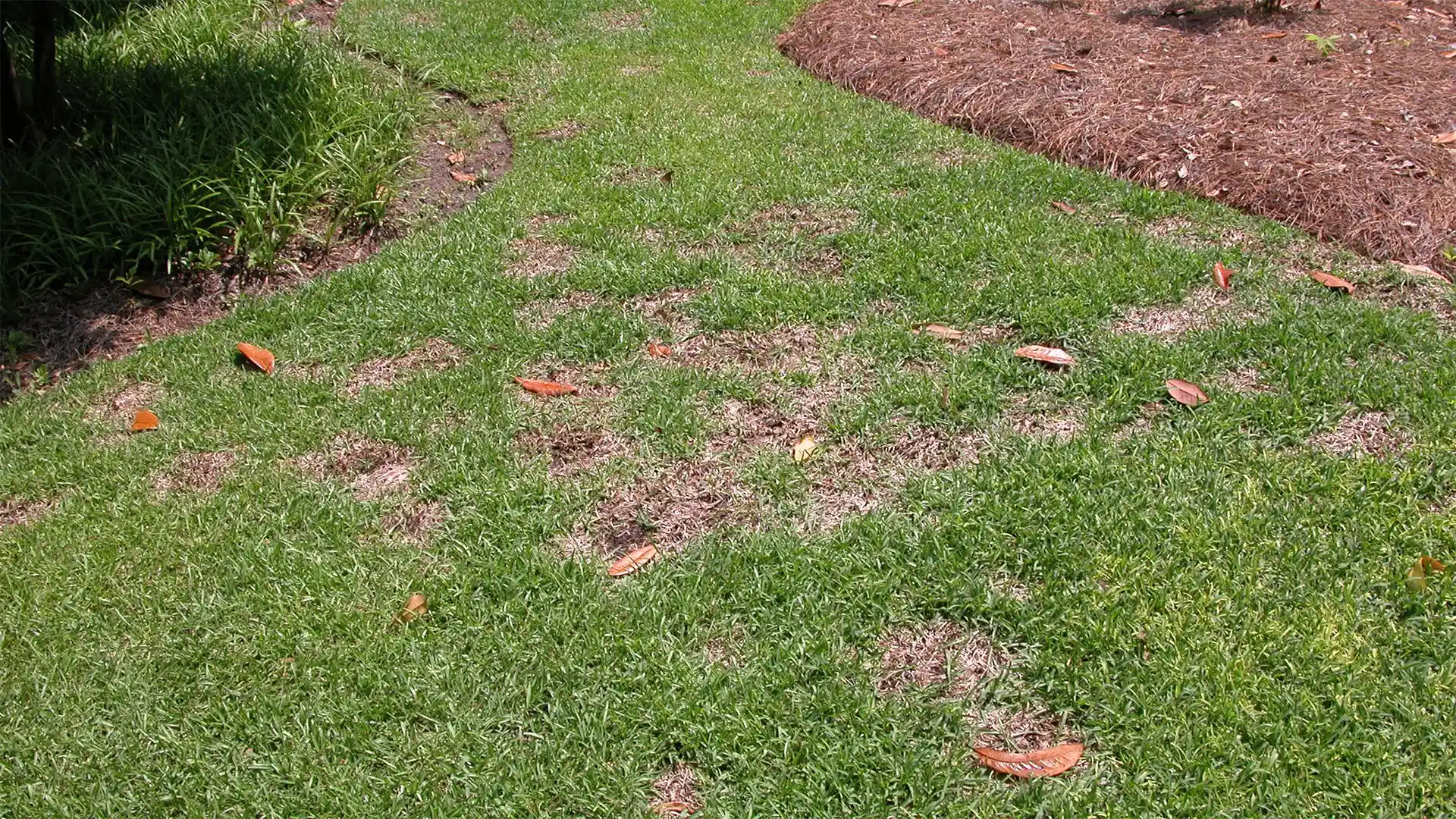
- Dollar spot shows up as small, silver-dollar-sized straw-colored spots, roughly 2 to 6 inches across, that can merge into larger blighted patches.
- It hits nearly every grass we grow here – tall fescue, bermuda, and zoysia – and is most active from late spring through fall.
- The fungus needs 10 to 12 continuous hours of leaf wetness, so heavy dew on warm-day, cool-night cycles is the main trigger.
- Underfed lawns get it worst: turf low in nitrogen is more prone to dollar spot and recovers far slower, which makes proper fertilization the counterintuitive front-line fix.
- Culture beats chemicals – feeding correctly, watering deep and early, and knocking dew off the blades will control most cases before a fungicide is ever needed.
What is dollar spot in a lawn?
Dollar spot is a fungal turf disease caused by Clarireedia species (long known as Sclerotinia homoeocarpa), and it is one of the most common diseases we treat on home lawns across North Carolina. It affects a wide range of grasses, so it shows up on tall fescue, bermudagrass, and zoysiagrass lawns as well as on centipede and ryegrass. The name comes from the classic symptom: on closely mowed turf the dead spots are about the size of a silver dollar. On a home lawn cut higher, those spots spread wider and blur together, but the underlying disease is the same. It rarely kills a healthy, well-fed lawn outright, but left alone it thins the turf and leaves a scarred, patchy surface that takes weeks to recover.
What does dollar spot look like?
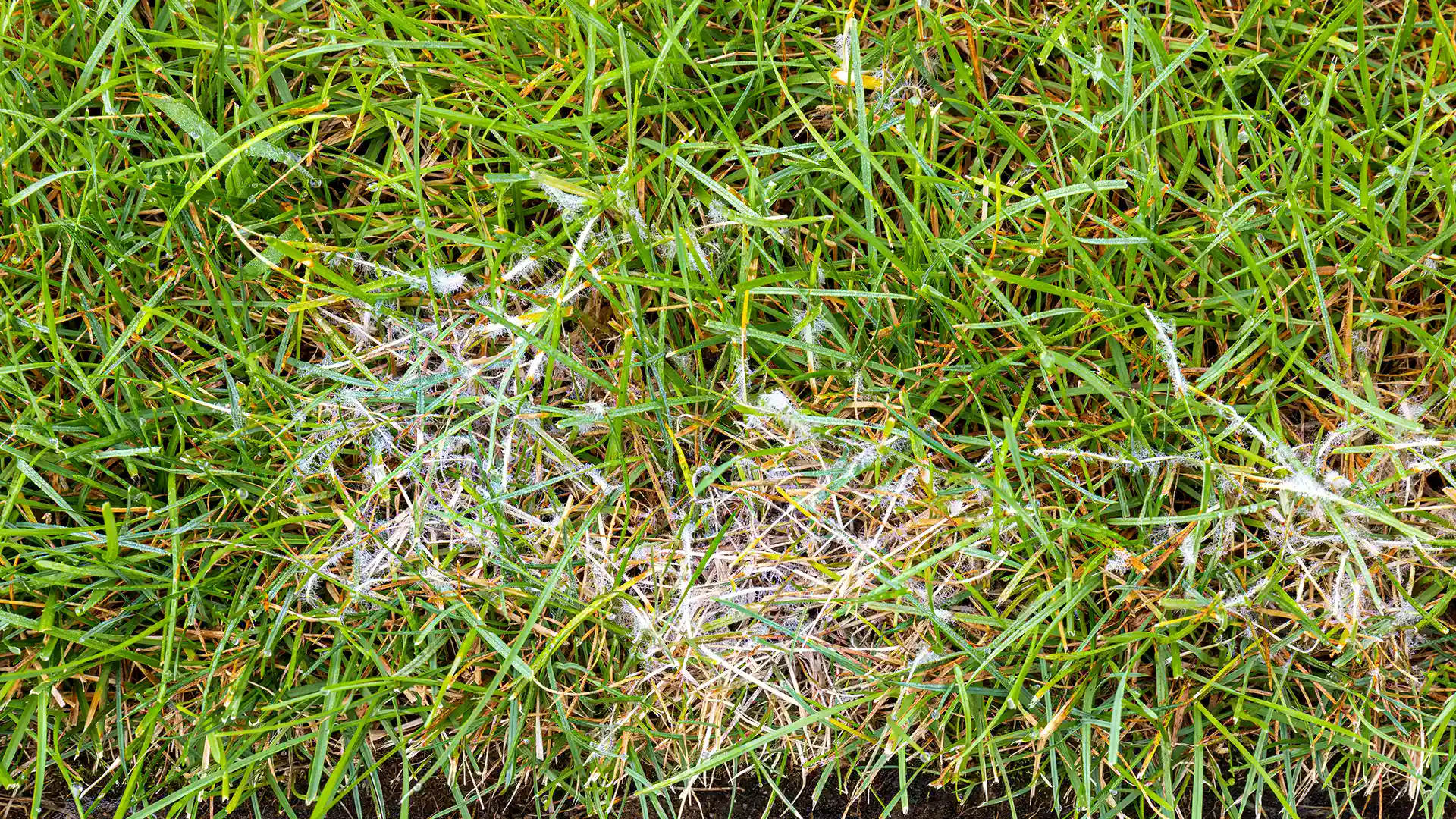
Dollar spot starts as small, round, straw-colored or tan sunken spots – roughly 2 to 6 inches across on a home lawn – that can merge into larger irregular blighted areas as the disease runs. The tell is on the individual grass blades: look for light tan lesions with reddish-brown borders running across the leaf, often shaped like an hourglass or band that girdles the blade. The best time to confirm it is early morning while dew is still down, when you will often see fine, white, cobweb-like fungal growth (mycelium) sitting on top of the affected patches. Once the dew burns off, that webbing disappears, which is why so many homeowners miss it. If you can catch it at dawn, that white mycelium plus the banded, tan-centered blade lesions is a reliable ID.
What causes dollar spot, and what conditions bring it on?
Two things drive dollar spot: extended leaf wetness and an underfed lawn. The fungus needs 10 to 12 continuous hours of leaf wetness to infect, which is why heavy dew is the number one trigger – the warm-day, cool-night pattern we get in NC spring and fall lays down thick overnight dew that sits on the blades until mid-morning. The fungus starts growing once night temperatures climb past about 50F and stays active through humid weather in the roughly 59 to 86F range, slowing only when summer heat consistently tops 90F. Not sure which disease you have? Start with our lawn diagnosis guide.
The second driver is nutrition: turf that is deficient in nitrogen is more prone to dollar spot and recovers from the damage far more slowly than a well-fed lawn. Drought stress, low mowing, heavy thatch, frequent light watering, and poor air movement all stack the deck further in the fungus’s favor.

How do you get rid of dollar spot?
This is where dollar spot surprises people: the single most effective thing you can do is feed the lawn. Adequate nitrogen fertilization both helps prevent dollar spot and pushes the grass to grow through and recover from existing damage – an underfed lawn is what lets it take hold in the first place. From there, attack the leaf wetness. Water deeply and infrequently, early in the morning (ideally before 6 a.m.) so the blades dry fast, and never water in the evening when moisture will sit all night.
Knock the morning dew off by mowing or lightly irrigating once it forms, which shortens the wet window the fungus needs – just avoid dragging equipment through actively diseased turf, because that spreads it. Finally, reduce excess thatch, keep the lawn mowed at the right height for its grass type, and open up air movement where you can. Get a soil test so your fertility is dialed in rather than guessed. Do those things and most lawns never need a fungicide.
When do you need a fungicide, and when should you call a pro?
Fungicides work best on dollar spot as a preventive, applied before the disease takes off, rather than as a rescue after the lawn is already scarred. Curative applications have to go on at higher rates and shorter intervals, and the dollar spot fungus is notorious for developing resistance fast – so products have to be rotated between chemical classes, which is easy to get wrong. Homeowner-labeled active ingredients that give good control include propiconazole, azoxystrobin with propiconazole, and triadimefon, and coverage and timing matter as much as the product itself. That is where we come in. We are licensed in North Carolina to apply on turf, and we identify the disease, correct the underlying fertility and watering problems, and put down the right product on the right rotation only when it is actually warranted. If you are not sure whether you are looking at dollar spot or something else, or you have been fighting it with no result, text us at 984-284-5399 and we will take a look.
Dollar spot vs. brown patch: how do you tell them apart?
These two get confused constantly because both throw circular tan patches, but they are driven by different things and call for opposite fertilizer moves:
Feature | Dollar Spot | Brown Patch / Large Patch |
|---|---|---|
Patch size | Small – silver-dollar to ~6 inches | Large – a foot to several feet across |
Blade symptom | Tan, hourglass-banded lesions with reddish-brown borders | Irregular tan spots with dark borders; smoky ring at edge |
Nitrogen link | Worse on underfed, low-nitrogen turf | Worse with excess nitrogen at the wrong season |
Peak timing | Late spring through fall; warm days, cool nights, heavy dew | Summer (fescue); fall and spring green-up (warm-season) |
First fix | Feed the lawn, remove dew, water early | Ease off nitrogen, improve drainage, water early |
Misreading which one you have – and fertilizing accordingly – can make the problem worse, which is a good reason to get an ID before you treat.
Frequently Asked Questions
Silver-Dollar Spots Scattered Across Your Lawn?
Dollar spot usually means the lawn is underfed – and the fix often is not a fungicide at all. We diagnose it and correct what is feeding it. Text us for a look.
Sources
NC State Extension TurfFiles – Dollar Spot in Turf
Clemson Cooperative Extension HGIC 2152 – Leaf Diseases of Lawns
Clemson Cooperative Extension HGIC 2150 – Brown Patch and Large Patch Diseases of Lawns
NC State Extension TurfFiles – Disease Management in Landscape Turf Prevent it with our Fescue and Bermuda and Zoysia lawn maintenance plans.
