

Dwarf and Shrub Crepe Myrtle Varieties for North Carolina: Pick the Right Size
By Ken Erickson · Updated June 2026
Choosing among the many crepe myrtle varieties comes down to one thing most people overlook — mature size. Drive through any neighborhood in Fuquay-Varina or Apex in late winter and you will see it: rows of crepe myrtles hacked off into ugly knuckled stumps. That is crepe murder, and it is completely avoidable. People do it because they planted a tree-sized variety in a shrub-sized spot, and now they top it every year to keep it in bounds. The fix is not better pruning – it is picking the right size from the start. Here is how to choose a crepe myrtle that fits your space and never needs butchering.
Key takeaways
- Crepe myrtles come in four size classes – dwarf (under about 4 feet), semi-dwarf or shrub (about 4 to 10 feet), medium (10 to 20 feet), and tree-form (20 to 30+ feet).
- Crepe murder – topping a crepe myrtle every winter – is unnecessary. It happens because someone planted a 25-foot variety in a 10-foot spot.
- For small yards and foundation beds, true dwarfs like Pocomoke, Chickasaw, and the Razzle Dazzle series stay 2 to 5 feet.
- The U.S. National Arboretum hybrids with Native American names were bred for powdery-mildew resistance and great bark – the smart pick for our humid summers.
- In zone 7b, crepe myrtles are reliably cold hardy, so your choice is really about mature size and disease resistance, not survival.
Crepe Myrtle Varieties: Why Size Class Matters More Than Color
Everybody shops for crepe myrtles by flower color, and that is backwards. The first thing to decide is mature size, because that is what determines whether the plant works in your spot for the next 20 years or becomes an annual chainsaw project. Crepe myrtles range from ankle-high groundcovers to 30-foot trees, and they are sorted into four size classes. Nail the size to the space and the color takes care of itself – there is a beautiful crepe myrtle in every size.
Crepe myrtle size classes at a glance
Here is the lineup by size, with reliable varieties in each class:
Variety | Size class | Mature height | Bloom color |
|---|---|---|---|
Pocomoke | Dwarf | 2-5 ft | Deep rose-pink |
Chickasaw | Dwarf | 2-3 ft | Lavender-pink |
Cherry Dazzle (Razzle Dazzle) | Dwarf | 3-5 ft | Cherry red |
Acoma | Semi-dwarf / shrub | 6-10 ft | White |
Hopi | Semi-dwarf / shrub | 7-10 ft | Pink |
Zuni | Semi-dwarf / shrub | 8-10 ft | Lavender-purple |
Sioux | Medium | 15-20 ft | Bright pink |
Catawba | Medium | 10-15 ft | Purple |
Natchez | Tree-form | up to ~30 ft | White |
Muskogee | Tree-form | 20-30 ft | Lavender |
Dwarf crepe myrtles for beds, borders, and containers
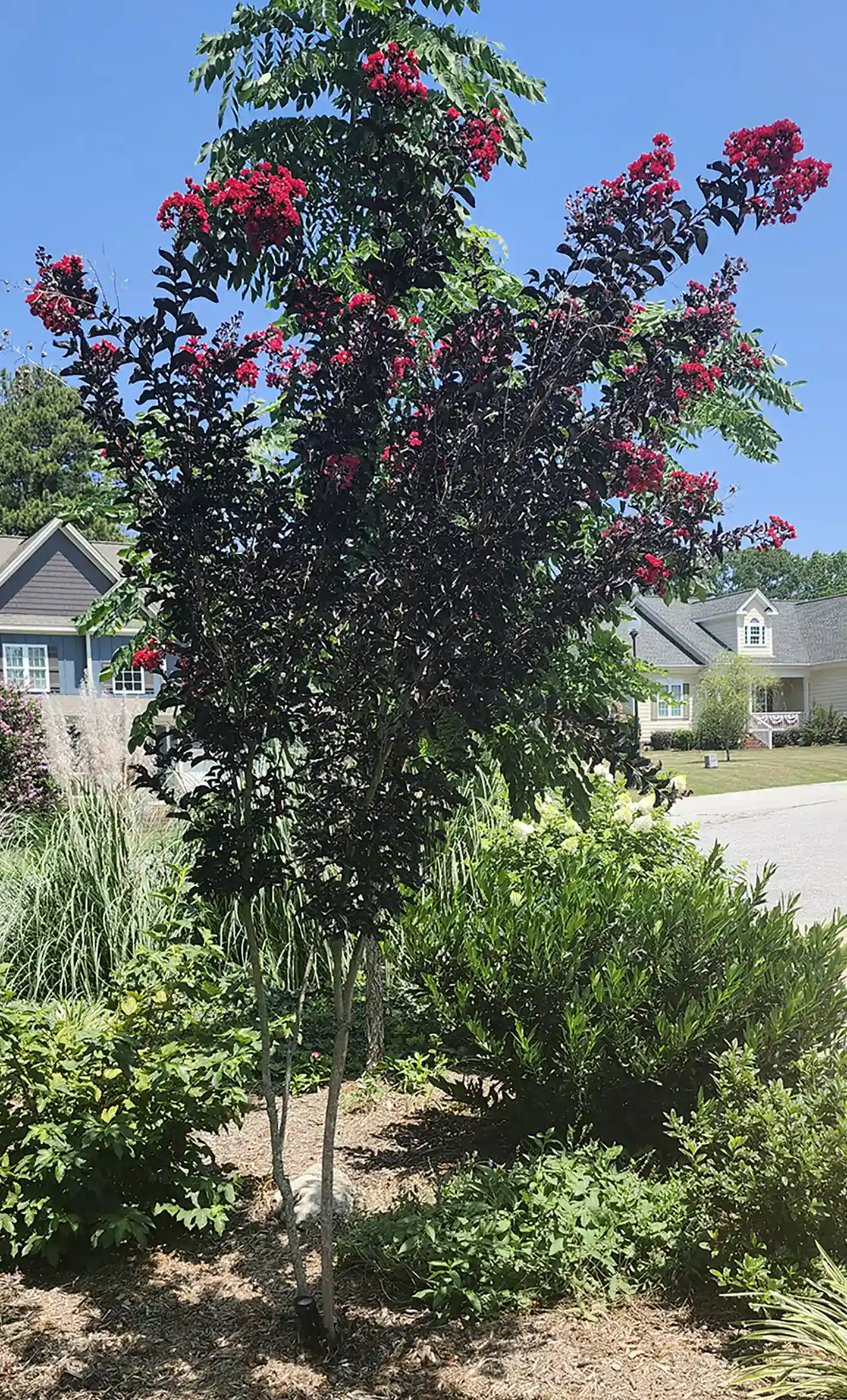
If you want crepe myrtle color in a foundation bed, a border, or even a big pot, the true dwarfs are your answer – and they never need topping because they never get big. Pocomoke and Chickasaw stay knee-to-waist high. The Razzle Dazzle and Dazzle series – Cherry Dazzle, Snow Dazzle, Ruby Dazzle – stay in the 3-to-5-foot range and rebloom through summer. These are the plants to reach for when you have a small spot and want a crepe myrtle that behaves.
Semi-dwarf and shrub crepe myrtles: the sweet spot
For a 6-to-10-foot slot – flanking a walkway, anchoring a bed corner, or making a loose flowering hedge – the semi-dwarfs are the workhorses. Acoma is a graceful white with a slightly weeping habit; Hopi is a clear medium pink; Zuni brings lavender-purple. All three are National Arboretum hybrids, which means good mildew resistance on top of the right size. This class is where a lot of homeowners should be shopping and is not.

Medium and tree-form crepe myrtles: only where you have room
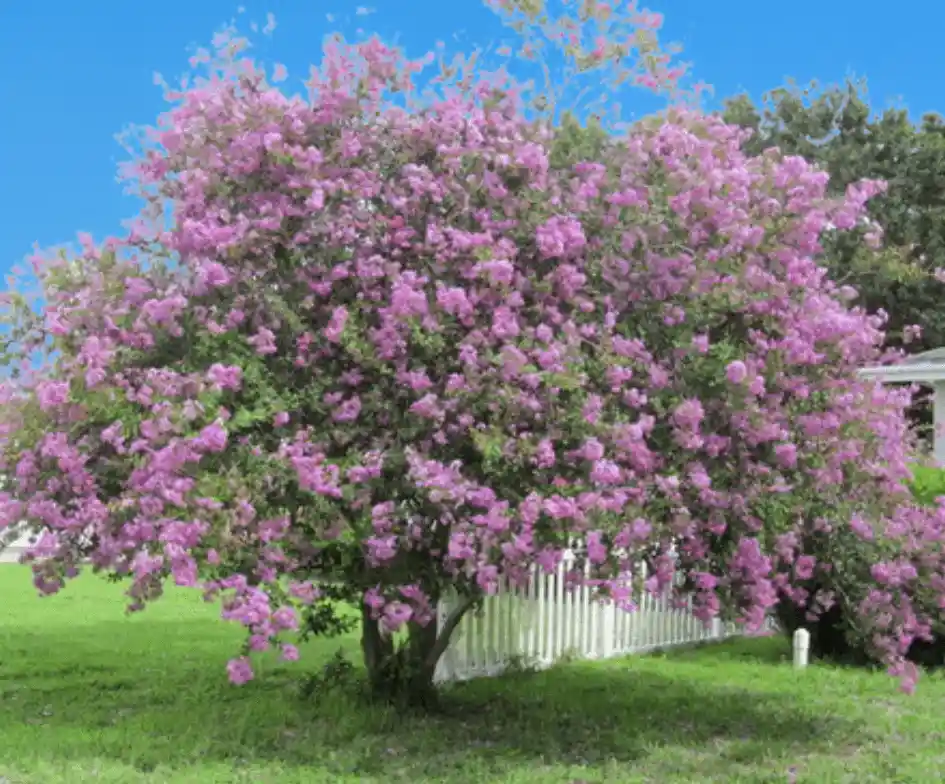
The medium types (10 to 20 feet) like Sioux and Catawba are great for a patio corner, a street strip, or a small specimen tree. The tree-form giants – Natchez, the classic white with cinnamon bark, and Muskogee, a long-blooming lavender – reach 20 to 30 feet or more. These are gorgeous trees, but they are exactly the ones people cram against a foundation and then top every year. Plant a tree-form crepe myrtle only where you genuinely have the room to let it be a tree, and it will reward you with a graceful canopy and stunning bark instead of a row of stumps.
Choosing by disease resistance
In our humid Triangle summers, powdery mildew is the main disease that turns crepe myrtle leaves white and stunts the bloom. The good news is that the U.S. National Arboretum hybrids – the ones with Native American names like Natchez, Acoma, Hopi, Zuni, Sioux, and Tuscarora – were specifically bred to resist it, and most of the dwarfs are resistant too. The newer pest to watch is crepe myrtle bark scale, which shows up as white specks on the bark and leads to black sooty mold. Choosing a mildew-resistant variety and keeping an eye out for bark scale covers the two things most likely to bother a crepe myrtle here.
Frequently Asked Questions
Want the Right Crepe Myrtle for Your Spot?
We help you pick a crepe myrtle sized to the space – so it never needs topping – and plant and prune it the right way. Text us to plan yours.
Sources
NC State Extension Gardener – Popular Crepe Myrtles Available in Smaller Sizes
NC State Extension Gardener Plant Toolbox – Lagerstroemia
Clemson Cooperative Extension HGIC – Crepe Myrtle and Crepe Myrtle Diseases and Insect Pests
U.S. National Arboretum – Crepe Myrtle breeding program
