

Gray Leaf Spot in NC Fescue Lawns: Spot It, Stop It, Save Your Grass
By Ken Erickson · Updated June 2026
If your tall fescue lawn is thinning out in irregular brown patches in the dead heat of a Triangle summer, gray leaf spot is a prime suspect. It is a fungal disease that turns aggressive from late July into September across Fuquay-Varina, Holly Springs, Apex, Cary, and Garner, and it is routinely mistaken for brown patch or Pythium. Below we cover exactly what gray leaf spot looks like, what triggers it in our climate, how it differs from brown patch, and what actually stops it. Not sure which disease you have? Start with our lawn diagnosis guide.
Key takeaways
- Gray leaf spot is a fungal disease that hits tall fescue lawns hardest from late July through September in North Carolina.
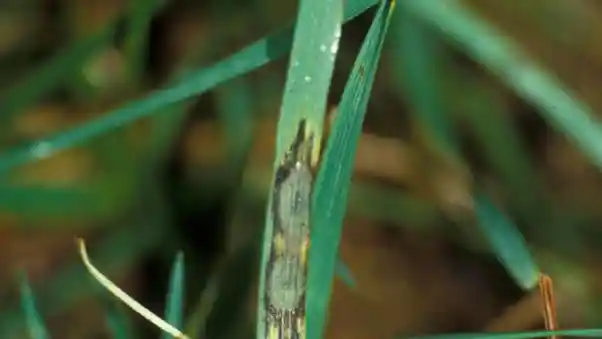
- The tell-tale sign is small oval leaf spots, tan-to-gray in the center with a dark brown to purple border, on blades that look matted and greasy.
- It turns severe when nighttime temperatures stay above 72F and leaves stay wet 14 or more continuous hours, and summer nitrogen makes it worse.
- New and young fescue stands are the most vulnerable, so spring and late-summer seedings are the highest-risk lawns.
- Cultural fixes help, but active gray leaf spot on fescue usually needs rotated fungicides – which is where a licensed applicator earns their keep.
What is gray leaf spot in a lawn?
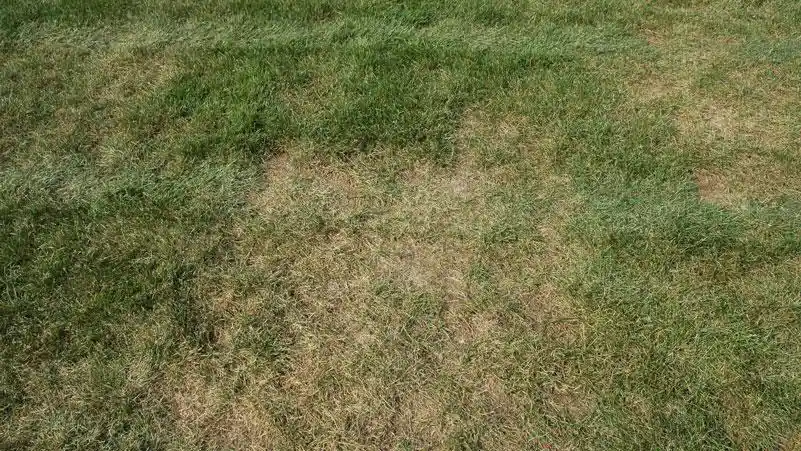
Gray leaf spot is a foliar fungal disease caused by the fungus Pyricularia grisea. It infects and kills the leaf blades of cool-season grasses, and in our area that means tall fescue, the most common lawn grass in the Raleigh suburbs. It also attacks perennial ryegrass and warm-season St. Augustinegrass, but tall fescue is where most Triangle homeowners run into it. The disease first appears as spots on individual blades, then blights the leaves in expanding patches that can quickly merge into large, ragged brown areas. Because the damaged tissue looks matted and greasy, gray leaf spot is easy to confuse with Pythium blight or brown patch, which is why a close look at the individual blades matters.

What does gray leaf spot look like on tall fescue?
Start by pulling a few blades and looking closely, because the diagnosis lives on the individual leaf. Gray leaf spot begins as small, round or oval spots that are tan in color with a dark brown or purple border. When leaves are wet or humidity is high, those spots turn gray and fuzzy as the fungus produces spores, and over time each spot expands, girdles the blade, and kills it back from the tip. At the lawn scale, blighting on tall fescue often starts as patches four to twelve inches across that look orange to yellow, then rapidly grow together into large, irregular dead areas. The blighted grass has that matted, greasy appearance that gives the disease away. You may need to examine several blades before you find a clear, textbook leaf spot.
What causes gray leaf spot, and what conditions trigger it?
Gray leaf spot is driven by heat plus prolonged moisture. The fungus can develop when temperatures sit between 70 and 95F, but it needs at least 14 hours of continuous leaf wetness to start an infection, and it turns most severe when nighttime temperatures stay above 72F. That is why our humid mid-to-late summer nights are the danger window. Anything that keeps the leaves wet longer feeds the disease: extended cloud cover, evening or late-afternoon watering, and long rainy stretches. Excess nitrogen is a major trigger, because lush leaf tissue from heavy summer feeding is extremely prone to infection. General stress, including drought stress, also makes fescue more susceptible. Newly established stands are the most at-risk of all, which puts spring and late-summer seedings squarely in the crosshairs.
Gray leaf spot vs. brown patch: how do you tell them apart?
Both diseases hammer tall fescue in the summer, and both leave brown patches, so homeowners mix them up constantly. The fastest way to separate them is the individual leaf lesion and the timing:
Feature | Gray Leaf Spot | Brown Patch |
|---|---|---|
Leaf lesion | Oval, gray-to-tan center with dark brown/purple border | Tan lesion with irregular chocolate-brown to reddish margins |
Peak timing (NC) | Late July through September | Roughly May through August |
Stand appearance | Irregular patches; grass looks matted and greasy | Often roughly circular brown patches |
Turf age affected | Much worse on young, newly seeded fescue | Affects lawns of any age equally |
Fungicide resistance | High – must rotate chemistries and tank-mix | Low – rotation generally not required |
When they overlap in August, or when the greasy blighted look points toward Pythium, it is worth getting a positive ID before you spend money on the wrong fungicide.
How do you prevent gray leaf spot on fescue?
Most of prevention comes down to keeping the leaves dry and not pushing lush growth in summer. Water deeply but infrequently, and always irrigate early in the morning before sunrise so the blades dry fast; never water in the late afternoon or evening, which extends leaf wetness overnight. Hold off on nitrogen in late spring and summer, since heavy feeding produces exactly the tender tissue this fungus loves. Mow at recommended fescue heights using the one-third rule, and when the disease is active, bag and remove clippings so you are not spreading spores. Open the lawn up to airflow and sunlight by pruning back overhanging trees and crowding shrubs. When you seed a new fescue stand, use proper seeding rates so seedlings mature quickly, because young turf is the most vulnerable.
How do you treat gray leaf spot, and when should you call a pro?
Once gray leaf spot is active on tall fescue, cultural steps alone usually are not enough, and fungicides are required to stop it. The catch is that this fungus develops resistance easily, so a single product used over and over often fails. NC State’s research shows the strobilurin (QoI) fungicides alone give only about 50 percent control on gray leaf spot, which is why the recommended approach is rotating chemistries and using tank-mixes across different chemical classes, not spraying the same thing twice. Effective applications generally hold the disease for about 14 to 21 days before a repeat is needed, and timing and diagnosis matter as much as the product. This is where a licensed pro earns their fee: we are licensed by the state of North Carolina to apply fungicides on turf, we can confirm it is actually gray leaf spot and not brown patch or Pythium, and we build the rotation so it works. If your fescue is thinning fast in late summer, text us at 984-284-5399 and we will take a look.
Frequently Asked Questions
Fescue Thinning Fast in the Late-Summer Heat?
Gray leaf spot needs the right diagnosis and a rotated fungicide program to stop – not a single spray. We are licensed to apply on turf in NC. Text us for a look.
Sources
NC State Extension TurfFiles – Gray Leaf Spot in Turf
NC State Turf Pathology – Struggling With Gray Leaf Spot in Tall Fescue (Dr. Jim Kerns)
Clemson Cooperative Extension HGIC 2151 – Gray Leaf Spot
NC State Extension TurfFiles – Disease Management in Landscape Turf Our Fescue lawn maintenance plan builds the healthy, well-fed turf that resists gray leaf spot.
