

What’s Eating My Shrubs? A NC Guide to Leaf-Chewing Pests
By Ken Erickson · Updated June 2026
Leaf eating insects are behind most of that ragged, chewed, lace-like damage on shrubs and trees. If you are standing in your yard looking at ragged holes, notched edges, leaves chewed down to lace, or a shrub that got stripped bare in what felt like a week, you are dealing with a leaf-chewing pest. Out here in Raleigh’s southern suburbs – Fuquay-Varina, Holly Springs, Apex, Cary, Garner – these are some of the most common calls we get on trees and shrubs. Chewing pests are different from the sap-suckers like aphids and spider mites: sap-suckers leave stippling, sticky residue, and curled leaves, but chewers leave real, physical damage you can put your finger through. Three groups cause most of the trouble in our area – bagworms on evergreens, Japanese beetles on roses and crepe myrtle, and web-building caterpillars in shade trees. I am licensed in North Carolina to work on turf and ornamental plants like shrubs and trees, so below I will walk you through how to tell them apart. If you would rather just have us handle it, text me at 984-284-5399.
Key takeaways
- Chewing pests leave physical damage you can see – actual holes, notched edges, lacy skeletonized leaves, or whole branches stripped bare – different from sap-suckers that cause stippling and sticky residue.
- Bagworms are the most dangerous of the group in NC because they hit evergreens – Leyland cypress, arborvitae, juniper, cedar – and a defoliated evergreen cannot regrow its needles.
- Japanese beetles are the classic summer skeletonizer – metallic green-and-copper beetles that eat the tissue between leaf veins, hammering roses, crepe myrtle, and Japanese maple from June into midsummer.
- Not every web in a tree is the same pest – fall webworms build loose nests on the outer branch tips in late summer, while eastern tent caterpillars build tight tents in branch crotches in spring.
- Timing decides everything, especially with bagworms: the bags you see in late summer are already sealed and full of next year’s eggs, so the window to treat is early, when the tiny caterpillars first emerge.
Leaf Eating Insects: What is eating my shrub or tree leaves?
Start with the damage, because the damage tells you the pest. Round or irregular holes chewed through the middle of the leaf usually mean caterpillars or slugs; ragged notches bitten inward from the leaf edge point to beetles or weevils; a lacy, see-through leaf where only the veins are left is skeletonizing, the calling card of Japanese beetles. Whole branches or evergreens stripped bare fast is defoliation, and on evergreens that almost always means bagworms. The other big clue is speed and season: chewing damage shows up as physical, missing tissue, while sap-sucking pests leave stippling, stickiness, and curl instead. Once you know which pattern you are looking at, the rest of this guide points you to the culprit. If the damage looks more like stippling, sticky residue, or cottony tufts than chewing, you may be dealing with sap-sucking pests instead.
Bagworms on Leyland cypress, arborvitae, and juniper
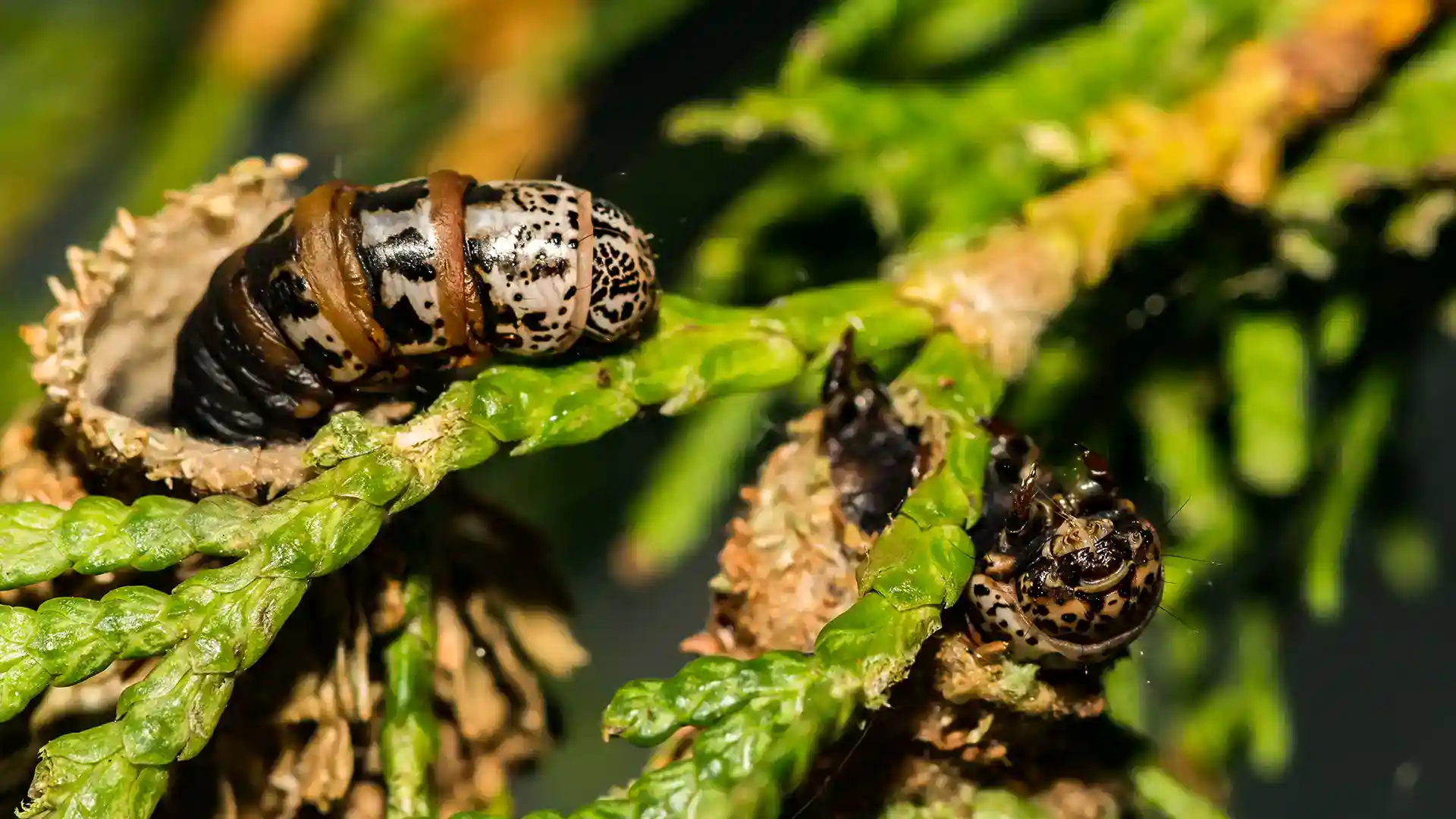
Bagworms are the one I want NC homeowners to catch early, because they go after evergreens and evergreens do not bounce back. The dead giveaway is a spindle-shaped, cone-like bag – one to two inches long – hanging off the branch, covered in bits of the plant’s own needles, so people constantly mistake them for small cones or seed pods. Inside each bag is a caterpillar that never really leaves it; the females stay inside for life and lay 500 to 1,000 eggs in the bag before dying in fall. They are most common on Leyland cypress, arborvitae, cedar, juniper, and pine, and a heavy population can defoliate and kill whole sections of a screen or hedge. Because the females cannot fly, an infestation often stays concentrated – you might see only four or five plants in a long hedgerow hit hard. If your privacy screen is thinning out in patches, look closely for the bags before you write it off as winter burn.
Japanese beetles and skeletonized leaves
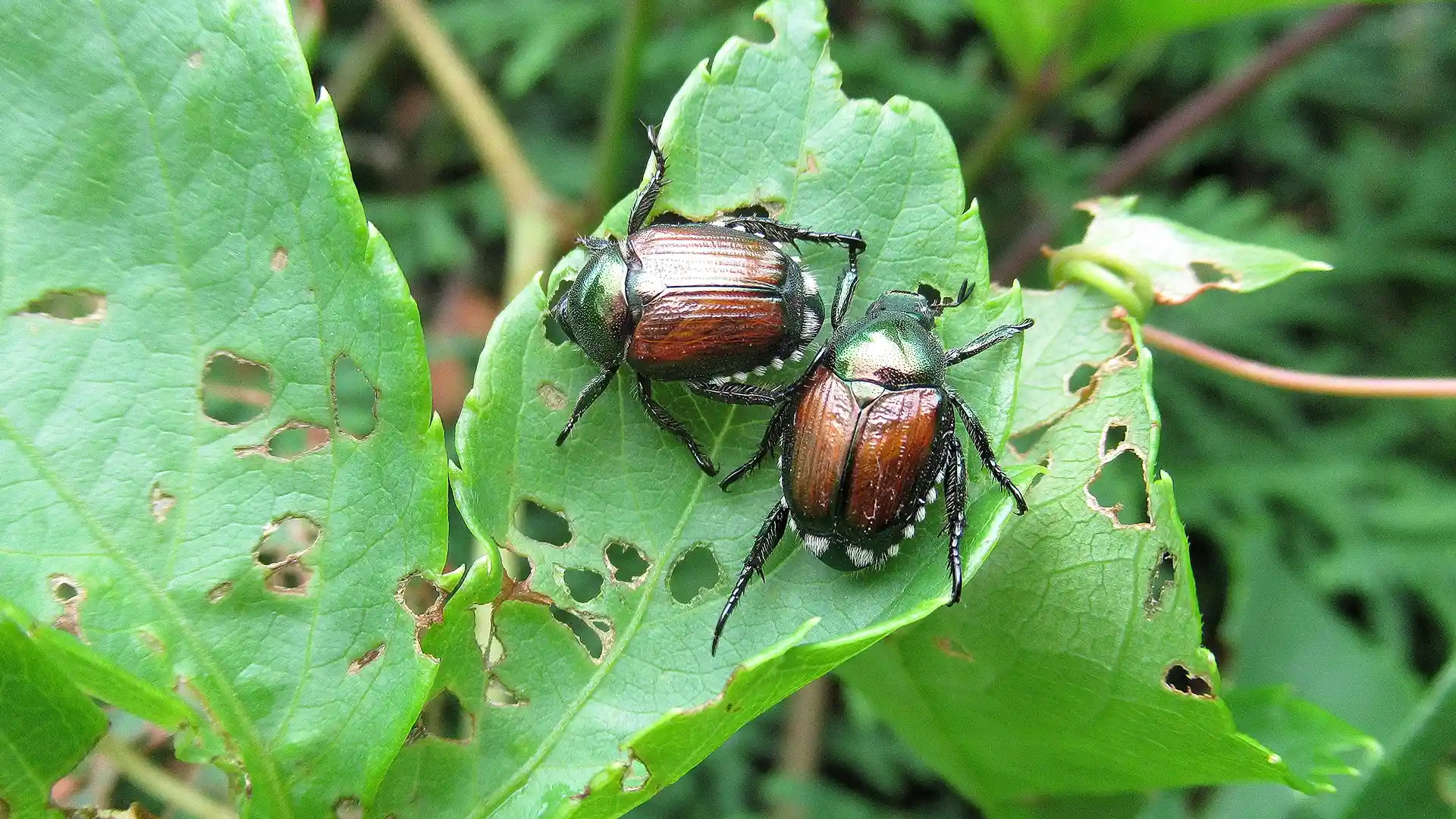
Japanese beetles are the metallic, half-inch beetles – shiny green with coppery-brown wing covers – that show up on warm summer days and cluster on the plants they love. Their damage is unmistakable: they eat the soft tissue between the veins and leave the veins behind, so the leaf ends up looking like green lace, which is called skeletonizing. In our area they emerge as early as mid-to-late spring and peak in the heat of July, and they pile onto roses, crepe myrtle, Japanese maple, linden, and ornamental cherry – they will feed on hundreds of plant species. They are also social feeders: damaged leaves and the beetles themselves release odors that pull in even more beetles, so a small problem snowballs. Healthy, established plants usually survive the season, but the ragged, chewed look on a specimen crepe myrtle or a prized rose is what makes people want them gone.
Pest | Damage you see | Common NC hosts | When |
|---|---|---|---|
Bagworms | Spindle-shaped bags like small cones; needles stripped; evergreen sections thinning | Leyland cypress, arborvitae, juniper, cedar, pine | Hatch late spring (May-June); bags visible late summer to winter |
Japanese beetles | Lacy, skeletonized leaves; chewed petals; beetles clustered on plants | Roses, crepe myrtle, Japanese maple, linden, cherry | Emerge mid-to-late spring; peak in July |
Fall webworm | Loose, messy webs on the outer branch tips; leaves eaten inside | Pecan, sourwood, persimmon, hickory, sycamore, fruit trees | Early summer through fall |
Eastern tent caterpillar | Tight, cottony tent in branch crotches; leaves chewed near the nest | Wild cherry, crabapple, apple | Spring |
Sawfly larvae | Caterpillar-like larvae chewing holes and notches; no webbing | Various shrubs and trees | Spring to summer |
Caterpillars and webworms: what’s making webs in my trees?
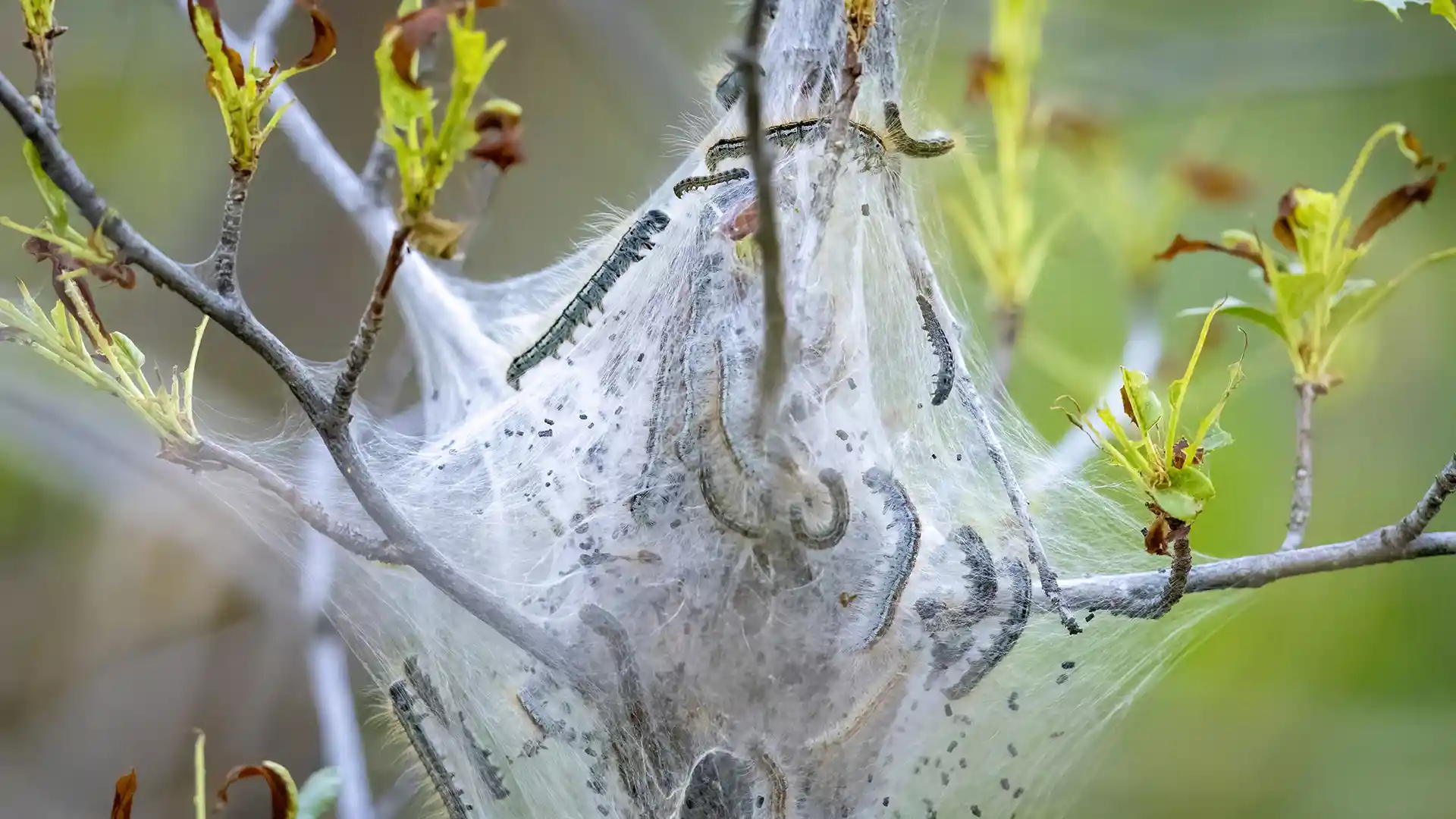
If you are seeing webbing in a tree, it is almost always one of two caterpillars, and where the web sits tells you which. Fall webworms build loose, messy, silk nests out on the ends of the branches and get active from early summer through fall – they feed inside the web and enclose more leaves as they grow, hitting pecan, sourwood, persimmon, hickory, sycamore, and fruit trees. Eastern tent caterpillars are the spring version: they build a tight, dense, cottony tent in the crotch where branches fork, then leave the tent to feed, and they favor cherry, crabapple, and apple. There are also sawfly larvae, which look like small caterpillars and chew shrub and tree foliage without any web at all. The good news is that on established, healthy shade trees the damage from these web-builders is usually cosmetic rather than life-threatening – it looks alarming but the tree recovers.
When to treat leaf-chewing pests, and why timing matters
Timing is the difference between fixing the problem and just documenting it – nowhere more than with bagworms. The bags you notice in August are already sealed tight and packed with next year’s eggs, so by then treatment does almost nothing; the real window is late spring into early summer, when the tiny new caterpillars first emerge and are still exposed and vulnerable. Japanese beetles are a summer job caught at first sight before the crowd builds. Web-building caterpillars are easiest to knock back while the nests are small and the caterpillars are young. The universal fallback that works in any season is physical removal – hand-picking bags off evergreens in fall and winter, breaking open webs so birds and wasps can get at the caterpillars, or dropping beetles into soapy water. Miss the window and you are usually waiting for next year, which is exactly why scouting early pays off.
Should you DIY it or call a pro?
Plenty of these you can handle yourself, and I will tell you straight when to. If you have got a few bagworm bags on a small shrub, a light dusting of Japanese beetles you can knock into a bucket, or one reachable webworm nest, that is a DIY afternoon – hand-removal genuinely works. Where it is worth a call is when the plant is too tall to reach, when a whole Leyland or arborvitae screen is infested and you are at risk of losing the planting, when the same pest comes back year after year, or when you simply want the timing handled so the treatment actually lands in the right window. That is the value of a program – someone scouting your shrubs and trees on a schedule catches bagworms in the emergence window instead of after the damage is done. We are licensed in North Carolina to treat turf and ornamental plants, so if you want it off your plate, our tree and shrub program covers exactly this. Text 984-284-5399 for a quote.
Frequently Asked Questions
Holes, Skeletonized Leaves, or Bags on Your Evergreens?
Chewing pests – especially bagworms on evergreens – have to be caught in the right window. We scout and treat trees and shrubs across the southern Raleigh suburbs. Text us for a quote. For a professional inspection and treatment, see our tree and shrub pest control service, or keep chewing pests off your plants year-round with our tree and shrub maintenance plan.
Sources
NC State Extension – Bagworms in Ornamental Landscapes
NC State Extension – Japanese Beetles on Ornamental Landscape Plants
Clemson Cooperative Extension HGIC – Fall Webworm Management
Clemson Cooperative Extension HGIC – IPM for Evergreen Bagworms
