

When to Apply Pre-Emergent in North Carolina
By Ken Erickson · Updated July 2026
When to Apply Pre-Emergent: Timing Is the Whole Game
Knowing when to apply pre-emergent is the whole game — a few weeks late and the crabgrass wins. With a pre-emergent, timing beats everything. Put it down too late and the crabgrass has already sprouted — the product does nothing to a weed that’s already up. Put it down on time and you stop a whole season of crabgrass, goosegrass, and Poa annua before it ever shows. In North Carolina that window is narrow, and it’s moving earlier every year, so the calendar alone won’t save you.
A pre-emergent doesn’t kill the weeds you can see. It lays a thin barrier in the top inch of soil that stops weed seeds from rooting as they germinate. That’s why it has to be in the ground before the seeds wake up — and why it does nothing for weeds already growing (those need a post-emergent). For the weeds already up that a barrier won’t touch, you need a post-emergent — here is the best weed killer for Bermuda grass.
Key takeaways
- In NC, crabgrass germinates when soil holds about 55°F for 3–4 days — the pre-emergent has to be down before that.
- Apply 1–2 weeks before that window. In central NC that’s usually late February; east of Raleigh, mid-February.
- It stops seeds, not standing weeds — pre-emergent prevents, it doesn’t cure.
- The fall round has a hard date: NC State says down and watered in by September 1. About 80% of North Carolina’s Poa annua germinates between September 1 and October 30.
- Don’t seed and pre-emerge at the same time — and the right product depends on your grass. Mesotrione is labeled to go down at seeding on fescue; the label lists bermuda and zoysia as sensitive to it.
Watch the Soil Temperature, Not the Calendar
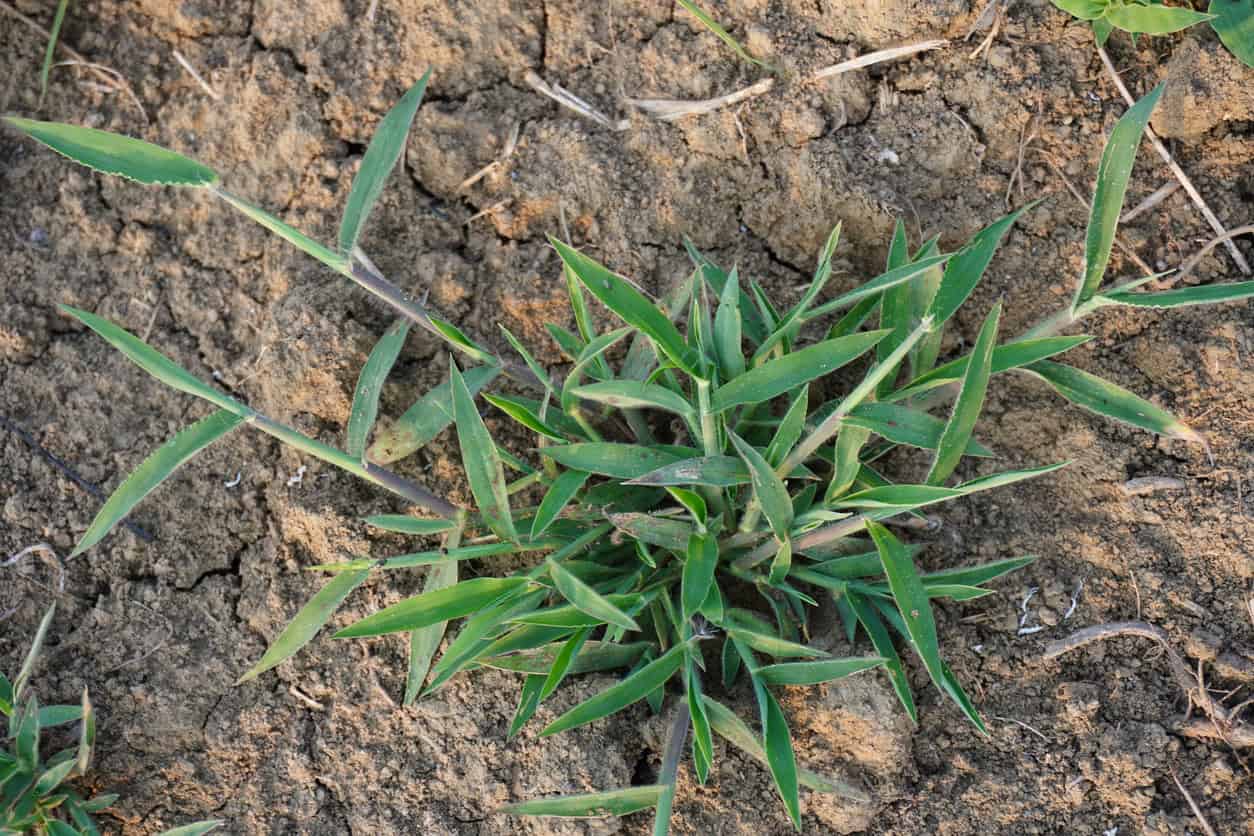
Crabgrass doesn’t read a calendar — it reads the soil. It germinates when the 24-hour average soil temperature holds around 55°F for three to four days straight. NC State has been finding crabgrass germinating earlier and earlier; in recent years they’ve documented it sprouting in February right here in Wake County. Warm winters mean the old “tax-day” rule is now too late.
So the move is to get the pre-emergent down one to two weeks before the soil hits that 55°F mark. A cheap soil thermometer takes out the guesswork — or watch the forsythia: when those bright yellow blooms open, the soil is warming toward crabgrass territory and you’re at the back edge of the window.
Check the Soil, Not the Date
Push a soil thermometer four inches down — that’s the depth NC State measures at when it says smooth crabgrass germinates between 53 and 58°F. Read the same representative spot at the same time each day, several days running, and keep it out of the hot south-facing strips and the pavement edges, because those run warm and will read high. When the 24-hour average is in the upper 40s and climbing, get the product down — you want it in the ground before the soil holds 55°F for three or four days straight. Those warm edges do germinate first, so treat them on the early side.
Where / situation | Spring timing | Fall timing | Main targets |
|---|---|---|---|
Coastal Plain (east of Raleigh) | Mid-February | Latest in the state — go by soil temp | Crabgrass, goosegrass |
Triangle / central NC | Late February | Down and watered in by Sept 1 | Crabgrass, Poa annua |
Western Piedmont | Very early March | Before the Triangle — go by soil temp | Crabgrass, foxtail |
Mountains / higher elevations | Mid-March | Earliest in the state — go by soil temp | Crabgrass |
Soil-temp rule | 1–2 weeks before 55°F | As soil cools under ~70°F | The germination window |
Forsythia in bloom | You’re at the LATE edge | — | Visual back-stop |
Overseeding year | Use a seeding-safe product | Pre-emergent blocks grass seed | Don’t do both at once |
How long it lasts | 3–4 months typical | Split apps for full season | Season-long control |
When to Apply in NC, by Region
North Carolina isn’t one climate. The Triangle sits in the transition zone, and the right date slides about a month from the coast to the mountains. Here’s the rule of thumb — but always let the soil temperature, not the date, make the final call.
In the Triangle and central NC — Raleigh, Fuquay-Varina, Holly Springs, Apex — aim for late February. East of Raleigh toward the coast the soil warms sooner, so mid-February is safer.

Move west into the Piedmont and very early March is the target; up in the mountains and higher elevations, mid-March. Every year that window is trending earlier as our winters warm.
Keep one thing straight: that west-to-east order is a spring order only. Fall runs the opposite direction. Poa annua germinates as the soil cools through about 70°F, and soil cools in the mountains first and on the coast last — so the fall round moves west to east, backwards from spring. Up in the mountains let the thermometer call it. Here in the Triangle there is a date: NC State says the fall pre-emergent needs to be applied and watered in by September 1.
If you remember one thing: get it down a week or two before the soil holds 55°F. Miss that by a few warm days and the crabgrass is already up.
Bermuda and Zoysia vs Fescue: Same Dates, Different Products
The dates above don’t change with your grass type — soil temperature doesn’t care what’s growing in it. The product does change, and that is where DIY lawns get hurt.
On tall fescue the fall round runs straight into overseeding season, so you either skip the pre-emergent where you’re seeding or you use mesotrione (Tenacity), which is labeled to go down at seeding on tall fescue, Kentucky bluegrass, perennial ryegrass and fine fescue. On bermuda and zoysia there is no collision — you’re not seeding warm-season grass in the fall — so the fall round is a straight call. But mesotrione is off the table on those two: the Tenacity label names bermudagrass and zoysiagrass as sensitive to it. Half the lawns on a Fuquay-Varina street are bermuda and half are fescue, and the same bag is right on one and wrong on the other.
Spring and Fall: Two Different Jobs
Most people think pre-emergent is a one-and-done spring chore. It isn’t. Spring and fall target completely different weeds, and skipping the fall round is why a lot of lawns fight Poa annua all winter.
Spring: Crabgrass and Summer Annuals
The spring application (mid-Feb to early March, by region) stops the warm-season annuals before they germinate — crabgrass, goosegrass, foxtail, and spurge. These are the weeds that take over a thin summer lawn.
Fall: Poa Annua and Winter Weeds
A second round in late summer to early fall stops the cool-season invaders — annual bluegrass (Poa annua), henbit and chickweed — before they sprout. In North Carolina about 80 percent of the annual bluegrass germinates in the 60-day window between September 1 and October 30, and NC State is specific about the deadline: the pre-emergent has to be applied and watered in by September 1. Watered in, not just spread.
On bermuda and zoysia that’s a straight call — put it down. On tall fescue it isn’t, because that same window is your overseeding window, and NC State says plainly that these herbicides will prevent reseeding of tall fescue right along with the Poa. If you’re overseeding fescue this fall, skip the pre-emergent in the seeded area and come back to it once the new grass is established. Skip the fall round altogether and you’ll see those light-green clumps all winter.
Why Two Rounds Beat One
Most pre-emergents only hold three to four months. A single spring application is usually gone by mid-summer, leaving a late-season germination window wide open. Splitting it — an early-spring round and a fall round — keeps the barrier intact through the whole season.
The common thread: a pre-emergent only works while the barrier is intact and the seed is still underground. Once it breaks down, or the weed is already up, you’ve missed it for that flush.
What Pre-Emergent Controls — and What It Doesn’t
Pre-emergent shuts down weeds that come back from seed every year — crabgrass, goosegrass, Poa annua, foxtail, spurge, and many winter annuals. What it can’t touch: perennial weeds that spread by root or tuber (nutsedge, wild violet, dollarweed) and anything already growing. For those you need a targeted post-emergent. Pre-emergent is prevention; it never cures a weed you can already see.
Don’t Seed and Pre-Emerge at the Same Time
Here’s the trap that ruins a lot of fall lawns: a pre-emergent doesn’t know the difference between a crabgrass seed and your fescue seed. Put down a standard pre-emergent and overseed the same season, and you’ve just paid to stop your own grass from coming up.
The Exception: Seeding-Safe Products
If you’re seeding tall fescue, either skip the pre-emergent in that area or use mesotrione (Tenacity), which is labeled to go down at seeding on tall fescue, Kentucky bluegrass, perennial ryegrass and fine fescue. Don’t put mesotrione on bermuda or zoysia — the label names both as sensitive to it. On warm-season grass you’re not seeding in the fall anyway, so the conflict doesn’t come up. This is exactly the kind of conflict we plan around when we build a program — you don’t want to find out in October that your overseed never came up.
On product: the active ingredient matters more than the brand. Prodiamine and dithiopyr are the workhorses for crabgrass — and dithiopyr has a little early post-emergent activity if you’re slightly late. Read the label, match it to your grass and your weeds, and follow the rate.
If You Missed the Window
It happens — a warm February sneaks up on everybody. If the crabgrass is already up, a pre-emergent won’t help. Here’s the recovery plan:
Switch to Post-Emergent
Treat the weeds already growing with a targeted post-emergent. It’ll take more than one application, and timing still matters — young weeds die far easier than mature ones.
Tighten Up the Mowing
Mow on schedule and at the right height so weeds can’t set seed. A thick, properly fed lawn crowds out a surprising amount on its own — most weed problems are really a thin-turf problem.
Skip the Reseed for Now
Tempted to reseed the bare spots? Wait — a fresh pre-emergent and new grass seed cancel each other out. Fix the weeds first, then seed in the next safe window.
Move Next Year Earlier
Mark the fall window now, and move next spring’s application up a week or two. Once you’ve been late once, earlier is almost always the right correction.
We Handle the Timing
The hard part of pre-emergent isn’t the spraying — it’s hitting the window. We track soil temperatures across the Triangle and put the product down at the right moment for your zone, spring and fall, as part of our weed control and fertilization program — including weed control in Cary and Apex. You don’t have to watch a thermometer or read the forsythia.
And because we identify your actual weeds first, we match the active ingredient to what’s really in your lawn — instead of blanket-spraying the same thing on every yard.
That’s the difference between a pre-emergent that mostly works and one that actually keeps crabgrass out all season.
One Last Thing: New and Overseeded Lawns

When to Wait
On a brand-new or recently seeded lawn, wait 60 days after seeding or until after the second mowing, whichever is longer. That’s the prodiamine label talking, not a rule of thumb — and on new fall fescue here in the Triangle the 60 days is almost always the one that binds, because two mowings inside a month is routine. Go earlier than that and you’d be protecting weeds at the cost of your own seedlings.
Pre-Emergent FAQs
Want It Done On Time, Every Time?
The whole game with pre-emergent is hitting the window — and in NC that window moves every year. We track the soil temperatures, match the right active ingredient to your weeds, and put it down at the right moment in spring and fall as part of our weed control and fertilization program across the south Raleigh suburbs. Text us at 984-284-5399 — text is fastest — and we’ll get you on the schedule before the crabgrass wakes up.
