

What a Pro Puts Down on His Own Bermuda Lawn: Weeds, Grubs and Fungus
By Ken Erickson · Updated August 2026
There’s no best weed killer for bermuda grass. There’s a calendar. I’m licensed by the state of North Carolina to apply herbicides and pesticides on turf and ornamental plants, I spray Triangle lawns every week, and on my own bermuda lawn I run eight rounds of herbicide, one grub application and two fungicide applications a year. Prodiamine in January and February. Specticle Flo in the fall. Celsius and Certainty on whatever breaks through. Chlorantraniliprole the first week of June. The whole schedule is in the table below.
Almost every product I use, you can buy. That’s the part most articles won’t tell you. What you can’t buy off a shelf is knowing that purple nutsedge and yellow nutsedge don’t die to the same thing, that the product cleaning up my bermuda will scorch your neighbor’s fescue, and that the window you needed closed while you were at a tournament in February. This is the program, the products and the timing. The rates are the part I sell.
Key takeaways
- The program beats the product. Two pre-emergent applications in winter, one more in fall, plus targeted post-emergents — that combination is what keeps a bermuda lawn clean, not any single jug.
- Timing runs on soil temperature, not the calendar. Pre-emergent has to be in the ground before weed seeds germinate, generally when soil climbs into the 50–55°F range.
- Grass type decides everything. A product that is fine on bermuda can wreck fescue, and the label is what tells you which.
- Three weeds will fight you: dallisgrass, purple nutsedge and doveweed. Each one takes a tank mix and more than one application.
- Weeds are not the whole job. Grubs go down in early June and fungicide goes down in the fall, and both are applied months before you would ever see the damage they prevent.
Weed killer types at a glance
Four kinds of herbicide, each with one job:
Type | What it does | When and where to use it |
|---|---|---|
Pre-emergent (prodiamine, Specticle Flo) | Stops weed seeds before they sprout | Spring and fall, before germination — the foundation |
Selective post-emergent (Celsius, Certainty) | Kills weeds already up without harming the grass | Growing season, matched to your grass type |
Three-way (2,4-D, MCPP, dicamba) | Broad broadleaf cleanup in one pass | Spring, when you missed the pre-emergent |
Sedge control (sulfentrazone, halosulfuron) | Kills nutsedge and kyllinga — neither a grass nor a broadleaf | Summer, once sedge shows up |
Non-selective (glyphosate) | Clears everything green | Beds, cracks, fence lines, dormant bermuda only |
My year on my own bermuda lawn, round by round
Here is the calendar I actually run on my own lawn. Eight herbicide and fertility rounds plus the grub and fungicide applications, and the dates shift a week or two either way depending on how the winter goes. I am not publishing my rates — that is the part I sell — but the products and the windows are what decide whether a lawn is clean, and most people get the timing wrong long before they get the product wrong.
North Carolina sits in the transition zone, the hardest place in the country to grow grass — too far south for cool-season grasses to love summer, too far north for warm-season grasses to love winter. That is why a program written for Ohio or Georgia backfires here. For the month-by-month version of this calendar, see our bermuda and zoysia lawn care schedule for NC.
Type | What it does | When and where to use it |
|---|---|---|
Pre-emergent (prodiamine, Specticle Flo) | Stops weed seeds before they sprout | Spring and fall, before germination — the foundation |
Pre-emergent (prodiamine, Specticle Flo) | Stops weed seeds before they sprout | Spring and fall, before germination — the foundation |
Pre-emergent (prodiamine, Specticle Flo) | Stops weed seeds before they sprout | Spring and fall, before germination — the foundation |
Pre-emergent (prodiamine, Specticle Flo) | Stops weed seeds before they sprout | Spring and fall, before germination — the foundation |
Pre-emergent (prodiamine, Specticle Flo) | Stops weed seeds before they sprout | Spring and fall, before germination — the foundation |
Pre-emergent (prodiamine, Specticle Flo) | Stops weed seeds before they sprout | Spring and fall, before germination — the foundation |
Pre-emergent (prodiamine, Specticle Flo) | Stops weed seeds before they sprout | Spring and fall, before germination — the foundation |
Pre-emergent (prodiamine, Specticle Flo) | Stops weed seeds before they sprout | Spring and fall, before germination — the foundation |
Pre-emergent (prodiamine, Specticle Flo) | Stops weed seeds before they sprout | Spring and fall, before germination — the foundation |
Pre-emergent (prodiamine, Specticle Flo) | Stops weed seeds before they sprout | Spring and fall, before germination — the foundation |
Pre-emergent (prodiamine, Specticle Flo) | Stops weed seeds before they sprout | Spring and fall, before germination — the foundation |
Two pre-emergent applications in winter, not one. That is the single biggest difference between a clean bermuda lawn and a crabgrass lawn, and it is the step almost every DIY program skips.
I feed by the lawn, not the calendar. Feeding bermuda while it is still waking up feeds the weeds instead of the grass, so the first fertilizer waits until the lawn is fully green — usually late April, sometimes the middle of May. Nothing about that date is on a calendar; it is on the grass.
July and August is the stretch where DIY lawns get burned. In peak Carolina heat I am spot spraying only, and the round the customer actually watches me do is the one where nothing goes down but food. Blanket-spraying bermuda in a Carolina July is how you pay for it in August.
Miss the late-August window and you will spend February looking at a lawn full of Poa annua with no good options left. That one is unforgiving, and it is the round that separates a lawn that looks good in March from one that does not. The October reinforcement goes down 45 days behind it, per the label.
What Is the Best Weed Killer for Bermuda Grass?
There isn’t one. The closest honest answer is prodiamine in winter and Specticle Flo in fall to stop seeds from germinating, Celsius and Certainty on what comes up anyway, and glyphosate only where you want bare ground. Each does one job. Run them on schedule and the lawn is clean because weeds never established — not because you rescued it.
That’s the difference between managing a lawn and chasing it. And in North Carolina every one of those choices depends on your grass, because we grow both warm-season bermuda and zoysia and cool-season fescue, and they don’t tolerate the same chemistry. If you want the category-by-category breakdown, see our guide to the different types of weed control.
Pre-emergent for bermuda grass: the foundation most people skip
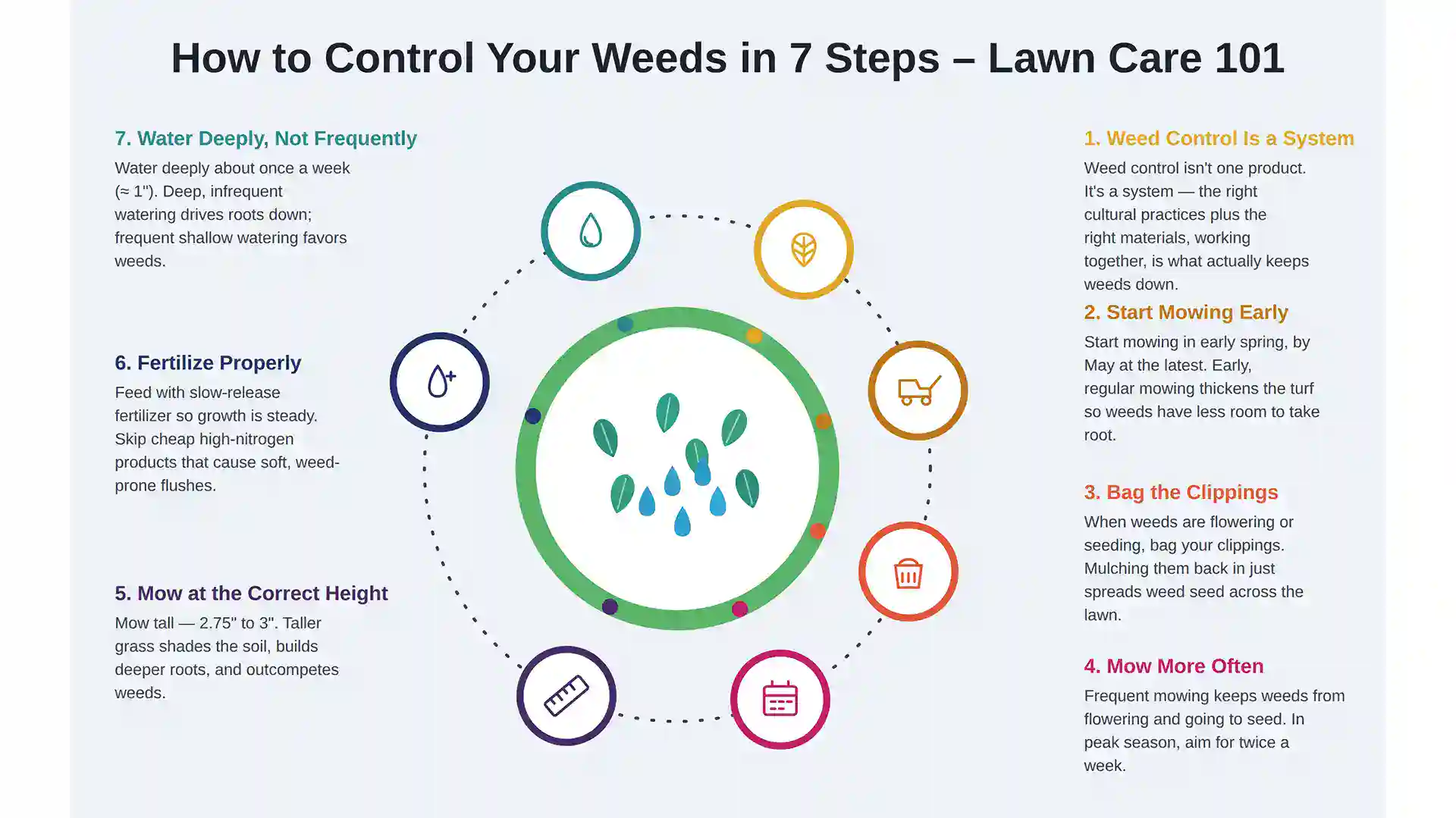
This is where a professional program starts, and it’s the step homeowners most often miss. A pre-emergent doesn’t kill a weed you can see — it stops the seed from germinating in the first place. My early-season foundation is prodiamine (sold as Resolute or Barricade), and it goes down in January and February, before spring green-up.
Here’s the field marker I go by: get it down before the forsythia blooms yellow. Once you see forsythia turning yellow around town, soil temperatures are climbing and you’re already late — the crabgrass window is opening. Weed seeds germinate on soil temperature, not the date, generally when soil climbs into the 50–55°F range. Prodiamine is cheaper and far more effective as a barrier than trying to kill crabgrass after it’s up, so that timing is everything. Not sure whether it is crabgrass or nutsedge you are fighting? Here is how to identify and kill crabgrass and nutsedge in NC lawns.
In the fall I switch to a different active — Specticle Flo (indaziflam) — and on a lawn with a Poa annua problem it’s worth every penny. Poa annua is that clumpy winter grass that plagues a lawn all winter and is the first thing greening up in spring, and indaziflam shuts it down far better than prodiamine does. There’s a legal reason to rotate, too: prodiamine has an annual label limit. If it’s your only pre-emergent you have to split that yearly allotment into roughly four weaker doses to cover spring through fall, and a weak dose won’t hold back Poa annua. Two stronger prodiamine applications in spring plus indaziflam in fall gets better coverage on both crabgrass and Poa while staying inside each product’s label.
And here’s what most people miss entirely: they obsess over crabgrass and time everything around it — but crabgrass is a summer problem. The weeds that take over a lawn all winter (Poa annua, chickweed, henbit, hairy bittercress) germinated back in the fall, and a spring crabgrass pre-emergent does nothing about them. They’re at their ugliest in early spring, green and lush against a bermuda lawn that’s still brown and dormant. Skip the fall pre-emergent and you can no longer prevent them — you’re forced into post-emergent cleanup, which costs more and never looks as clean as prevention. One more thing pros always account for: most pre-emergents and new grass seed don’t mix, so if you’re overseeding, the whole program gets planned around it.
Selective herbicides: killing weeds without killing the lawn
For weeds already up in a warm-season lawn, my two workhorses are Celsius and Certainty, and I tank-mix them constantly. Celsius handles both broadleaf and grassy weeds and holds up on warm-season turf in summer heat, when a lot of products would burn the grass. Certainty picks up sedges and certain grasses. Together they’ll clean up almost anything in bermuda or zoysia. Both go out with a non-ionic surfactant — that spreader-sticker is what makes the herbicide cling to and penetrate a waxy weed leaf instead of beading up and rolling off, and it’s a big reason a professional spray works when the same active from a hose-end bottle doesn’t.
If you missed the pre-emergent and the broadleaf is already up, a three-way is where to start — a blend of 2,4-D, MCPP and dicamba that knocks out dandelion, clover, chickweed, henbit and plantain in one pass. Triplet, Trimec and LESCO Three-Way are all built on that backbone, affordable and reliable. When a weed won’t quit — wild violet, oxalis, ground ivy — I step up to Change Up (MCPA, fluroxypyr and dicamba). It outperforms a standard three-way on the stubborn broadleaf and it’s gentler on the turf than straight 2,4-D. It costs more, so I don’t blanket a lawn with it; it’s what I reach for when nothing else finishes the job. Speedzone, which adds carfentrazone for a faster burn-down, is another solid step-up.
Three-ways are labeled for bermuda, zoysia, fescue and bluegrass, so on bermuda and zoysia you can run them at label rate — just watch the heat. And this is exactly why the store bottle disappoints: it doesn’t know whether you have oxalis or buttonweed, bermuda or fescue, and the right product changes with both.
Dallisgrass, doveweed and nutsedge: the three that actually give me trouble
Most weeds in a bermuda lawn are easy once you match the product to the weed. Three of them are not, and they are the ones I get called about after somebody has already spent a summer fighting them with the wrong bottle.
Nutsedge. Sedge is not a grass and it is not a broadleaf, so the all-in-one bottle does nothing to it. My spot mix for bermuda runs three actives together — sulfentrazone for the fast burn-down, halosulfuron for the staying power, and Celsius to clean up the broadleaf in the same pass — with a non-ionic surfactant. Identify before you spray: yellow nutsedge (lighter, upright, needle-like tips), purple nutsedge (darker, lower-growing, duller tips) and green kyllinga look alike from standing height and do not respond the same. Purple is the hard one — it runs on tubers and it will come back from them, so plan on more than one application. And it is a spot treatment, not a blanket. There is no reason to treat a whole lawn for sedge that is in two corners of it.
Dallisgrass. This is the hardest weed in a bermuda lawn and I will not pretend otherwise. It is a perennial clump grass, it lives through winter, and it grows from a crown that a single application will not kill. Two things decide whether you get anywhere with it. The first is timing: this is a late-summer and early-fall job, spot treated, with a second application 30 to 60 days behind the first — sprayed in the middle of summer it mostly just makes the clump angry. The second is the partner product. The combination with real university data behind it pairs Celsius with foramsulfuron and a methylated seed oil, not a plain surfactant. Anyone who tells you one spray takes out dallisgrass has never sprayed dallisgrass. Expect two seasons, and if a lawn is more dallisgrass than bermuda, the honest answer is usually to kill the area out and re-establish rather than spray it for three years.
Doveweed. Doveweed fools people because it germinates late — well after the spring weeds are up and after most homeowners think the weed season is over. By the time it is noticeable it has already spread along the ground and rooted at the nodes. Celsius is what I reach for, and the whole game is catching it while it is small. On a lawn with a doveweed history I am watching for it in early summer, not August.
Wild garlic and wild onion. Those bulb weeds that come up in clumps in late winter take metsulfuron with a three-way and a surfactant. The reason they feel impossible is that the bulbs do not all sprout in the same year — you can clear a patch completely and have it back next winter from bulbs that never came up. Plan on hitting it across two seasons and stop expecting a one-and-done.
And one thing nobody mentions: pre-emergents have annual limits, not just per-application limits. Indaziflam caps out at a set amount per acre per calendar year, and so do most of the others. You do not get to keep spraying because the weeds keep coming. You get a fixed number of shots each year, and the whole game is spending them at the right time. That constraint is invisible to somebody buying a bottle at a big-box store, and it is the reason a program beats a reaction.

Getting fescue, ryegrass and Poa annua out of a bermuda lawn
Here is a job the store aisle has no answer for: removing Poa annua, tall fescue or ryegrass that has invaded a bermuda or zoysia lawn over winter. Those coarse clumps that stay green when everything around them browns out are cool-season grass growing in the wrong lawn, and getting one grass out of another takes a sulfonylurea — Negate, Katana, Revolver or Tribute Total — applied while the warm-season grass is dormant or just waking up. It is slow. Several weeks, sometimes a second application.
For mature Poa annua that is past the seedling stage, prevention is off the table and it is a different job entirely. I use Negate at the top of its label rate on bermuda and zoysia, and it is slow — one to three weeks before it shows. Removing tall fescue works the same way, and it thins the bermuda around it for a while, so I do it when the bermuda is growing hard enough to fill the hole back in. Do it in October and you are looking at a bare spot until May.
Non-selective: beds, hardscapes and dormant bermuda
When the goal is bare ground — a mulch bed being reset, cracks in a driveway, a fence line — glyphosate (the generic name for Roundup) is the standard. Precision is the whole game with a non-selective: sprayed carelessly near turf or ornamentals, it kills the very plants you’re protecting.
A trick I use for weeds in flower beds gets around that entirely. Instead of spraying glyphosate anywhere near my shrubs, I put a foam ball on the end of my sprayer wand — the kind of foam windscreen that slips over a microphone — wrap it with a cloth and a rubber band, and soak that foam in the herbicide. Then I just drag it across the leaves of the weeds I want dead. The glyphosate only touches what I wipe it on: no spray, no drift, no dead spots on the ornamentals, and you barely use any product. It works just as well for a homeowner as it does for me.
Pros also use a targeted timing move: spraying glyphosate across a fully dormant bermuda lawn in the dead of winter to kill invaders like dallisgrass without hurting the sleeping bermuda — done in July it would kill the lawn. And for sedges pushing up through mulch, I skip the non-selective and come back with halosulfuron, which is labeled for landscape and ornamental beds, so I kill the sedge and nothing around it. Read the label before anything goes into a bed. Plenty of turf herbicides are not labeled for that site, and some carry a replant interval long enough to cost you the shrubs you put in next.
How pros apply it: the rig and the technique
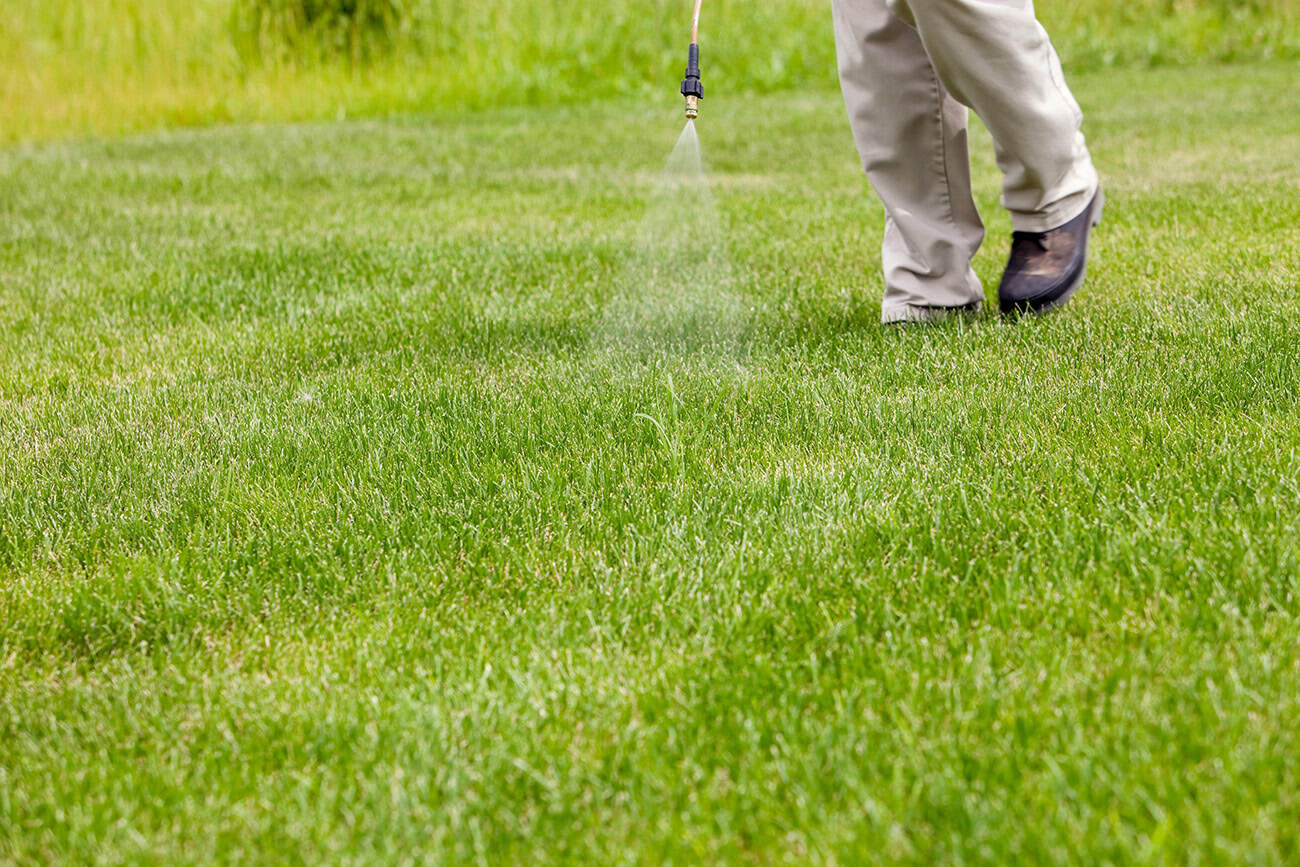
The chemical is only half the job. How it is applied decides whether it works, whether it lands somewhere you did not want it, and how long anybody has to stay off the lawn afterward.
A few things I’d tell anyone spraying their own lawn. Skip the cheap single-pump gallon sprayers, or at least cut off the little filter on the intake tube — herbicides like glyphosate clog it, and once it clogs, the pressure pushes product out the bottom of the tank. Set that leaking sprayer down on your lawn and you’ll have a dead ring right where it sat. A good battery-powered two-gallon unit is worth the money — the Ryobi ones at Home Depot are a solid, affordable pick. Add a longer aftermarket metal wand so you can stand up straight and keep the spray tip down near the ground instead of hunched over fogging the air. And don’t spray on a windy day — that’s how product ends up on the plants you were trying to protect.
Skip the marker dye if you can. Beginners spray a blue dye so they can see where they’ve been, but that dye gets tracked everywhere — the dog’s feet, into the house, onto white carpet and your shoes. A better habit is a grid pattern: work the lawn in even, overlapping lanes, end to end and back, section by section, with simple markers at your bed edges. You get complete coverage without painting your yard — or yourself — blue.
Protect yourself, too. The most common route of exposure is not breathing it in — it is your hands, and then you touch your face. So gloves, always, plus long sleeves and long pants. Wear eye protection, keep the spray low and out of the air you are breathing, and put on a respirator any time you have to spray anything overhead like shrubs or trees. Every product carries a re-entry interval on its label. Read it, and follow it.
This is also where a careful applicator is genuinely different from a high-volume one. Running the cheapest product available through a big hose is not the same job as placing a quality product precisely at ground level. The careless version drifts, and drift does not stop at the property line — it settles on ornamentals, vegetable gardens and fruit trees. We spray from ride-on rigs that put the product where it belongs, at the rate the label calls for, and we tell you exactly how long to stay off it.
Why buying the same product won’t get you the same lawn
Here is the honest part. You can buy most of this. Celsius, Certainty, prodiamine, halosulfuron — all of it is available to a homeowner willing to do the reading. So what actually separates a professional result from a DIY one? Three things, and none of them is a secret bottle.
Diagnosis. Is that purple nutsedge or yellow? Kyllinga or a grassy weed? Doveweed or oxalis? The correct product changes with the answer, and a wrong guess wastes a whole application and the window that went with it.
Grass-type safety. A product that is perfect on bermuda can scorch a fescue lawn. Knowing what your specific lawn tolerates, and at what temperature, is what keeps the cure from being worse than the weed.
Time. If you start today on a lawn with a real weed problem, you are looking at a full year before it looks the way you want. If it is a bad one — winter weeds, summer weeds, sedge, some dallisgrass — give it two. Weeds run on a calendar and you get one shot at each window. Miss the fall pre-emergent and you have Poa annua all winter with nothing to do about it until next fall. Every window you miss adds a season.
What I put down for grubs, and when
Grub control is one application a year and the window is narrow. I put chlorantraniliprole down in early to mid June, ahead of egg hatch, and I water it in. One shot, timed right, is the whole program.
“Grub” is not one insect, either. North Carolina has roughly eight white grub species that chew turf roots — Japanese beetle, the masked chafers, green June beetle, Asiatic garden beetle and others — and their flights do not all line up on the same week. Japanese beetle adults show up here the first or second week of June, which is what I time off, and a June application ahead of hatch catches the species that matter on a Triangle lawn. The water-in is not optional. The product has to move down to where the grubs feed, and if it sits on the surface you have spent the money for nothing. That single step is the most common reason a grub application fails.
Here is where I will talk you out of it: you do not need this every year on every lawn. If you have never had grub damage, and you are not seeing moles working the yard or turf that lifts like loose carpet, you can skip it. Grub products are cheap insurance on a lawn with a history and a waste of money on one without. If you are not sure what you are looking at, our guide to white grubs in NC lawns shows the damage and how to check for them.
The fungus program on bermuda
Spring dead spot is bermuda’s disease. It is the one that shows up as dead circles at green-up, and by the time you can see it the damage happened months earlier — it can only be prevented in the fall. Large patch is mostly a zoysia problem here; NC State is clear that bermuda is rarely affected by it. I run the same two fall applications on both grasses because the windows overlap.
Both applications are timed off soil temperature rather than the calendar — the working window is roughly 60 to 80°F soil, and I start when soil is coming down through about 70. First application is azoxystrobin. Second rotates to a different chemistry, tebuconazole, three to four weeks later. Tebuconazole is the one carrying spring dead spot, and NC State rates it stronger than azoxystrobin on that disease, which is why it is in the program and why the order matters.
Both get watered in, because spring dead spot and large patch both live at the crown and roots. And you rotate the chemistry rather than running the same active twice. Running one product back to back is how resistance gets built, and once you have it on a lawn you do not get it back.
Fescue is a different program entirely — brown patch in the heat of summer, three applications, and those do not get watered in because they work on the leaf blade. If you have fescue, none of the disease timing above applies to you.
Read the bugs in your lawn — they are telling you something
Most people never connect the two halves of the same insect. Grubs are not their own animal. Grubs are baby beetles. The white C-shaped things under your sod in August are the larvae of the Japanese beetles that were flying around in June.
So when you are standing in the yard in early summer and there are beetles all over the roses, all over the crepe myrtles, hitting the porch light at night — those came out of turf. Maybe your neighbor’s. Most likely yours. That is your lawn telling you it produced a crop of grubs last year and it is about to produce another one.
Here is what I will not tell you: that treating your lawn for grubs saves your roses. It does not. Adult beetles fly in from a long way off, and extension research is clear that a grub application on your turf does not protect the plants in your beds. A grub treatment protects your roots. Protecting the shrubs from the adults is a separate, foliar job on a different schedule — do not let anybody sell you the first one as if it were the second.
The moths tell the same story. Mow at dusk or first thing in the morning and watch what comes up in front of you. If little pale moths are flushing out of the grass ahead of the mower, they are not just passing through. They are laying eggs. Those eggs become caterpillars — armyworms and sod webworms — and caterpillars eat grass. People notice the moths and think nothing of it, then wonder three weeks later why a section of lawn thinned out overnight.
Pay attention to what is living in the lawn. The insect you see flying is the adult stage of something that already grew up in your turf, and it is heading back to lay the next round. Break that cycle once and you are not fighting it every year. If something is wrong and you cannot name it, start with what is wrong with my lawn.
What I spray in the heat of July and August
This is the stretch where DIY lawns get burned, so I am careful about what goes down. If I am spraying at all in peak summer, it is something proven safe on warm-season turf in heat — the Celsius combination is my default, because it holds up at temperatures that would scorch a lawn sprayed with an old-school three-way.
If a cool stretch comes through and the turf is not stressed, I will work a little metsulfuron into the mix to widen what it covers. That is a decision made standing on the lawn looking at the forecast, not one made in January when the program was written.
Is professional weed control safe around kids and pets?
Every product we put on a lawn carries a re-entry interval on its label, and for most turf herbicides that interval is simply until the treated area is dry. We tell you that time on every application and we do not guess at it. A licensed applicator also puts down less product than a typical DIY pass: metered to a steady pace and placed low and on target, instead of an uneven blanket from a hose-end bottle whose dose swings with your walking speed. Less product, in the right place, is both more effective and easier to keep off the people and animals using the yard. If you want the specifics for your lawn, see how our weed control works.
When you can do it yourself — and when to call a pro
And in that year or two, you cannot miss. That is the part that gets people. It is not that the products are hard to buy — most of what I use is available to a homeowner willing to do the reading. It is that the program only works if somebody actually does it, on time, eight or nine times, in weather that is rarely convenient.
Which is really what you are paying a professional for. Not the chemicals. The showing up. You are busy in January, you are on vacation in August, your kid has a tournament the weekend soil temperature hits 55 — and the window closes without you. I am watching the weather, watching the rain, and putting product down when conditions are right, whether that lands on a Tuesday or a Saturday. You do not even notice it happened. You just have a lawn that looks good while you got on with your life.
So here is the honest line on doing it yourself. If you can hit the four pre-emergent applications — two in winter, two in fall — you have got about 75 percent of your weed control right there. That is the highest-value thing you can do and it does not take much time. If you can reliably be home and organized for those four, plus get your fertilizer down on schedule, do it yourself and keep the money.
Call somebody when you cannot. If you know January and February are going to get away from you, or the end of summer is always chaos, those are exactly the windows that decide how the lawn looks — and missing one costs you a season you cannot buy back. Not sure a pro program is worth it? Here is what separates a premium weed service from a cheap one.
The bottom line
The best weed killer for bermuda grass is a schedule, not a jug: pre-emergent twice in winter and again in fall, selective post-emergents matched to the weed and the grass, a non-selective only where you want bare ground, and grub and fungicide applications timed months before the damage would ever show. The chemistry is mostly available to anyone. The diagnosis, the timing, and the honesty to tell you a weed will take three trips are what deliver the result.
At Lawn Panther, that’s our whole specialty. We’re a weed control and turf management company — not just another landscaper who also sprays — with a background in turf management and environmental biology, licensed by the state of North Carolina to apply herbicides and pesticides on turf and ornamental plants. We build the program, mix it, time it to your grass, and stand behind the result. Call or text us at 984-284-5399 for a free quote, and see our weed control program and how weed control works for the full picture on the weed control Raleigh NC homeowners count on.
American/Veteran/Family-owned and local, serving Raleigh’s suburban homeowners, HOAs, and commercial properties since 2019 — for the Purrfect lawn.
Frequently Asked Questions
Want Weeds Prevented, Not Chased?
Our weed-control program puts the right products down on the right timing – pre-emergent by soil temperature, targeted post-emergent, and a thick lawn – applied by licensed NC applicators. Text us for a quote.
