

Fast Growing Trees and Privacy Shrubs for North Carolina (That Beat Leyland Cypress)
By Ken Erickson · Updated June 2026
Fast growing privacy trees are how you get a real screen in a few seasons instead of a decade. Out here in the southern suburbs, a huge share of the new homes went up on cleared farmland – no mature trees, no privacy, and a neighbor’s window looking right into your backyard. A living privacy screen is the fix, but the plant you choose matters enormously, because the default pick for decades is now the worst one. Here is what actually works for a NC privacy screen, what to avoid, and how to space it so it fills in. Landscaping a brand-new yard? A privacy screen goes in early — see the right order to landscape a blank yard. Want shade and fall color rather than a screen? A Chinese pistache is the tougher pick for an open lawn.
Key takeaways
- Thuja Green Giant arborvitae is the fast-growing screen king – about 3 feet a year, 40 to 60 feet tall, disease-resistant, and it handles NC heat and humidity far better than Leyland cypress.
- Skip Leyland cypress. It is now plagued by canker, bagworms, and root rot in our climate, grows too big, and dies young – the cankers are untreatable and spread down the whole row.
- The best workhorses are Green Giant, Nellie Stevens holly, and cryptomeria Radicans, with native eastern red cedar and wax myrtle for tough, informal screens.
- Spacing makes or breaks a screen. Space to the plant’s mature width, not to fill in fast – a single row for most yards, or a staggered double row for a faster, solid wall.
- Mix your species. A single-species hedge can be wiped out by one disease, so a mixed screen is more resilient and looks better year-round.
Fast Growing Privacy Trees: What Makes a Good Screen in North Carolina?
A good screen is evergreen, dense all the way to the ground, and sized to the job – tall enough to block the view but not so huge it swallows the yard or crowds the house. Here that also means it has to shrug off our humid summers (which breed disease on the wrong plants) and tolerate heavy Piedmont clay. And it has to be spaced right. The table below lays out the reliable choices; then we will talk about the one everybody plants that you should not.
The fast-growing workhorses
These three do the heavy lifting for most yards:
Nellie Stevens holly
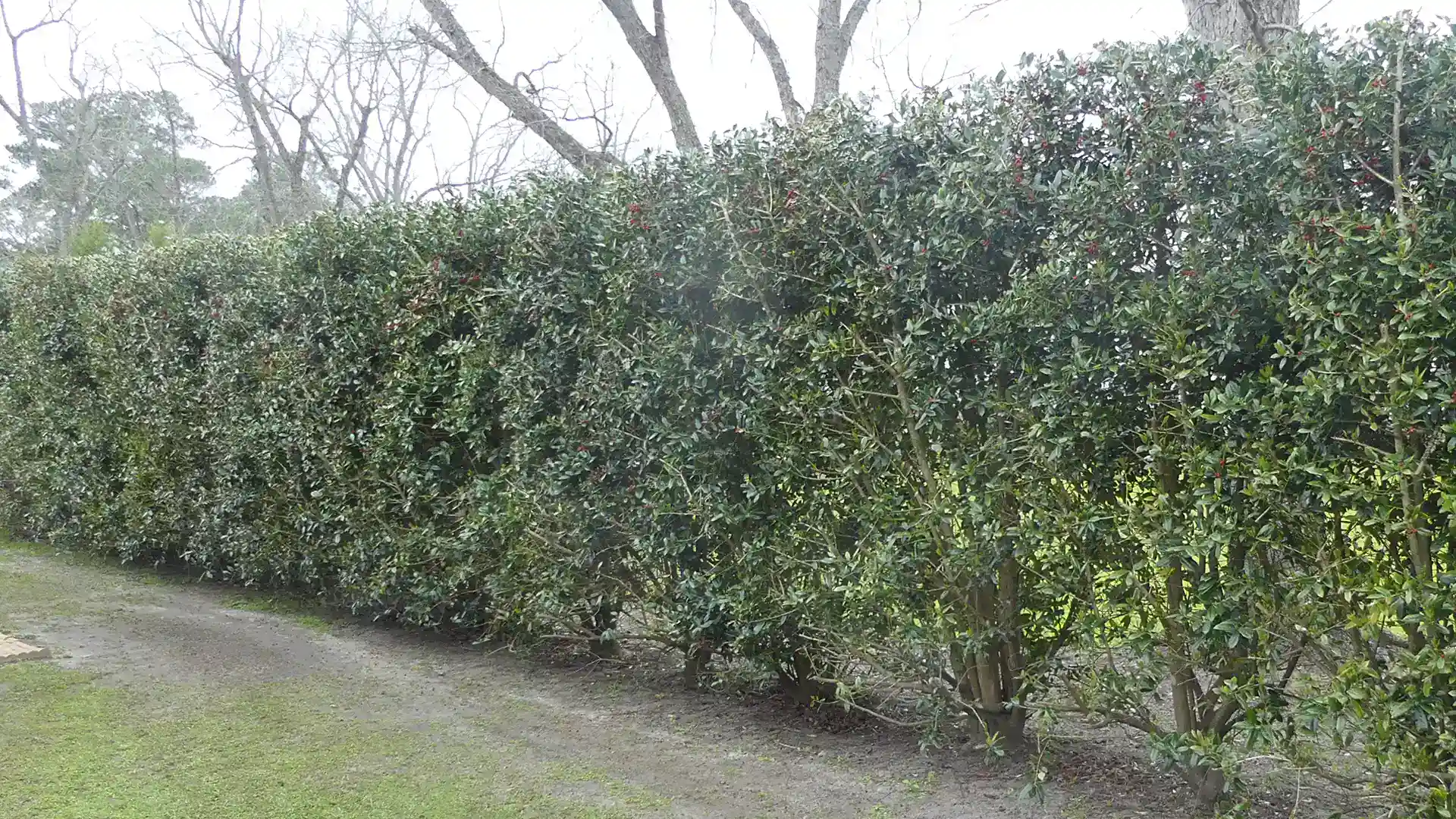
This is the one I reach for most. Nellie Stevens is a dense, dark-green broadleaf evergreen that grows fast for a holly – about 2 to 3 feet a year – and tops out around 15 to 25 feet, so it screens a two-story window without becoming the 60-foot monster a Leyland turns into. It holds its branches to the ground, shrugs off most disease, is mildly deer-resistant, and sets bright red winter berries without needing a male plant nearby. Space them about 5 to 6 feet apart for a solid wall. If you plant one thing off this list, plant this.
‘Green Giant’ arborvitae
Green Giant, a Thuja hybrid, is the other go-to – the plant most nurseries hand you when you ask for a Leyland replacement, and for good reason. It’s a soft, feathery evergreen that can put on 3 feet or more a year while young, matures around 30 to 40 feet tall and 10 to 12 feet wide, and it doesn’t get the killer cankers or bagworm blowups that take Leylands down. Give it full sun and set it 5 to 6 feet on center for a screen, wider if you want each tree to keep its full shape.
Waxleaf privet
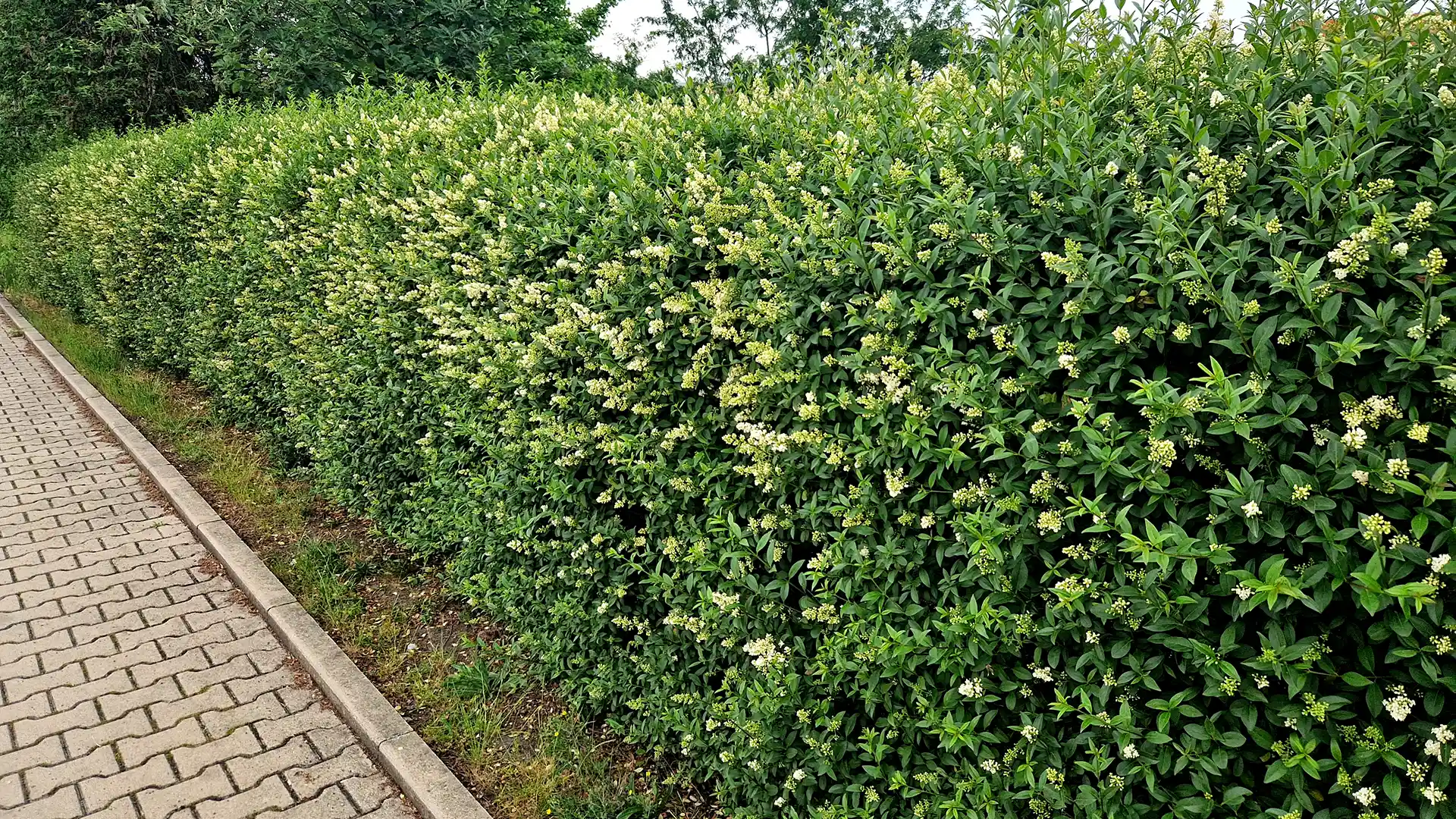
I’ll be honest, privet is one of my favorites for a privacy screen down here. It grows fast, it’s evergreen, the deer leave it alone, and it throws little white flowers in spring that are actually pretty and smell great. Best of all is the upkeep – a privet only needs shearing about once a year to stay tight, where a holly usually wants it twice. Plant it right up against a fence and it fills in fast. The one thing you have to know going in: NC State Extension lists privet – even the waxleaf and Japanese types – as invasive in North Carolina, because birds eat the berries and carry the seed off into woodlines and fencerows. Shearing it so it doesn’t fruit heavily helps keep it in check, but plant it with your eyes open.
Loropetalum (Chinese fringe flower)
You’ll see loropetalum used as a privacy hedge all over down here, usually a few planted together and sheared into big globes. It’s not my favorite, but it works – plant two or three together and you get a nice full shrub, and the burgundy foliage looks sharp against a fence. A couple of honest warnings from doing it for a living: the little leaves shed constantly and stick to everything – dog fur, fleece jackets, and they track right into the house. It also grows fast and wants shearing three or four times a year to stay small, or it gets away from you. And check before you cut – wasps love to nest down inside loropetalum, and I’ve been stung more than once trimming them. Give the shrub a hard shake and watch it for a few seconds before you start. Whatever you plant, keeping it sheared on schedule is what makes a screen look sharp – here is how to trim evergreen hedges the right way.
Plant | Evergreen / size | Growth rate | Spacing / note |
|---|---|---|---|
Thuja Green Giant arborvitae | 40-60 ft tall, 12-20 ft wide | Fast (~3+ ft/yr) | 8-12 ft apart; the screen king; dislikes wet feet |
Nellie Stevens holly | 15-25 ft tall, 8-10 ft wide | Moderate (~2-3 ft/yr) | 5-6 ft apart; dense, red berries, clay-tolerant |
Cryptomeria Radicans | 30-40+ ft tall | Fast (~3+ ft/yr) | 5-8 ft apart; the soft Leyland alternative |
Eastern red cedar (native) | 40-50 ft tall | Slow-moderate | 8-10 ft apart; native, drought and clay tough |
Wax myrtle (native) | 15-25 ft tall/wide | Fast (~2 ft/yr) | 5-10 ft apart; fast informal screen, aromatic |
American holly (native) | 40-50 ft tall | Slow | 15+ ft apart; long-lived structure; needs a male for berries |
Emerald Green arborvitae | 10-15 ft tall, 3-4 ft wide | Slow (~1 ft/yr) | 3-4 ft apart; for tight side yards |
Native and tough options
If you want a screen that basically takes care of itself, the natives are hard to beat. Eastern red cedar is a tough, drought- and clay-tolerant native conifer – just keep it away from apple and crabapple trees, since they share a rust disease. Wax myrtle is a fast, aromatic, informal screen that handles almost any soil and gives you a looser, more natural look than a formal hedge. American holly is slower but builds real structure and longevity, plus berries for the birds. Natives also support local wildlife, which is a nice bonus over a wall of imported arborvitae.
American holly
If you want a native, American holly (Ilex opaca) is the classic – a pyramidal evergreen that has screened Carolina yards since long before any of us got here. It’s slower than Nellie Stevens, but it’s tough as nails, feeds birds all winter, and is one of the most deer-resistant screens you can plant. One catch: American holly needs a male plant nearby for the females to set those red berries, so plant a few. Great for a bigger property where you’re not in a hurry.
Why you should avoid Leyland cypress
For years Leyland cypress was the default privacy tree, and I still see it planted everywhere – please do not. In our hot, humid climate it has become a magnet for problems: seiridium and botryosphaeria canker (which are untreatable and kill branches, then whole trees, spreading right down the row), bagworms, spider mites, and root rot in wet clay. On top of that it grows enormous, far bigger than most people expect, and it is short-lived. When one dies in the middle of a row, you get a gap you cannot easily fill. Plant Green Giant arborvitae or cryptomeria Radicans instead – same fast screen, a fraction of the heartache.

How to space and plant a privacy screen
The most common mistake is planting too close to fill in fast. Space to the mature width in the table – crowd them and they compete, thin out in the middle, and stress into disease. For most yards a single row does the job. If you want a faster, denser, more solid wall – common on a wide-open new-build lot – plant a staggered double row, offsetting the two rows so the gaps overlap. Whatever you plant, water deeply and regularly the first year or two to get the roots established; that first season is what determines whether the screen takes off or limps along. Fall or early spring is the best time to plant.
Pro install vs. DIY
A handful of arborvitae along a fence line is a doable weekend if you can dig in clay and haul water. Where people bring us in is the bigger project: laying out a long or staggered screen so the spacing and sightlines are right, sourcing good-sized plants, and getting them in and established on a blank lot where there is no shade and no help from existing trees. That is exactly the kind of work we do in the southern suburbs. Text us at 984-284-5399 and we will help you screen the yard right the first time.
Frequently Asked Questions
Need Privacy on a Blank Lot?
We lay out and plant fast-growing privacy screens across the southern suburbs – sized and spaced right, and never another failing Leyland cypress. Text us to screen your yard.
Sources
NC State Extension Gardener – What Can I Plant for Privacy?
NC Cooperative Extension – Problems With Leyland Cypress
Clemson Cooperative Extension HGIC – Leyland Cypress Alternatives
NC State Extension Gardener Plant Toolbox – Nellie R. Stevens Holly
