

Billbugs in Your NC Lawn: The Damage That Looks Like Drought
By Ken Erickson · Updated June 2026
Billbug control comes down to catching the damage before you write it off as drought. Billbugs are the sneakiest lawn pest we deal with, because their damage is a dead ringer for drought. Scattered patches brown out in the summer heat, the homeowner waters harder, and the patches keep dying – because the problem is not water, it is a weevil larva that has hollowed out the grass stems. Here is how to spot billbugs, the one test that proves it, and why timing is everything with these.
Key takeaways
- Billbugs are weevils, and it is the legless larvae – not the snout-nosed adults – that kill your lawn by hollowing out grass stems from the inside.
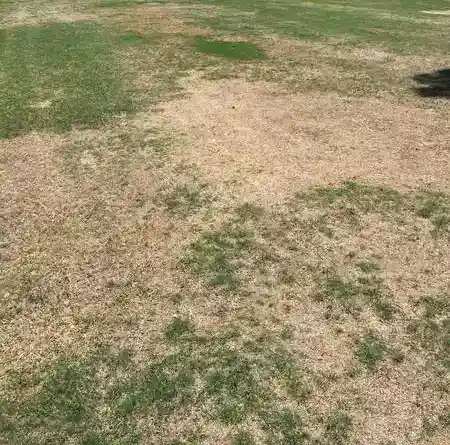
- Damage shows as scattered brown, dead patches in summer, and it is constantly mistaken for drought, dormancy, or disease.
- The tug test settles it: billbug-killed stems snap off easily at the base and are packed with sawdust-like frass.
- In our warm-season lawns the culprit is the hunting billbug (zoysia and bermuda), and NC adults are active in spring and again in early fall.
- Prevention beats cure – a spring treatment timed to the adults works, but once the larvae are inside the stems they are protected and hard to kill.
What are billbugs?
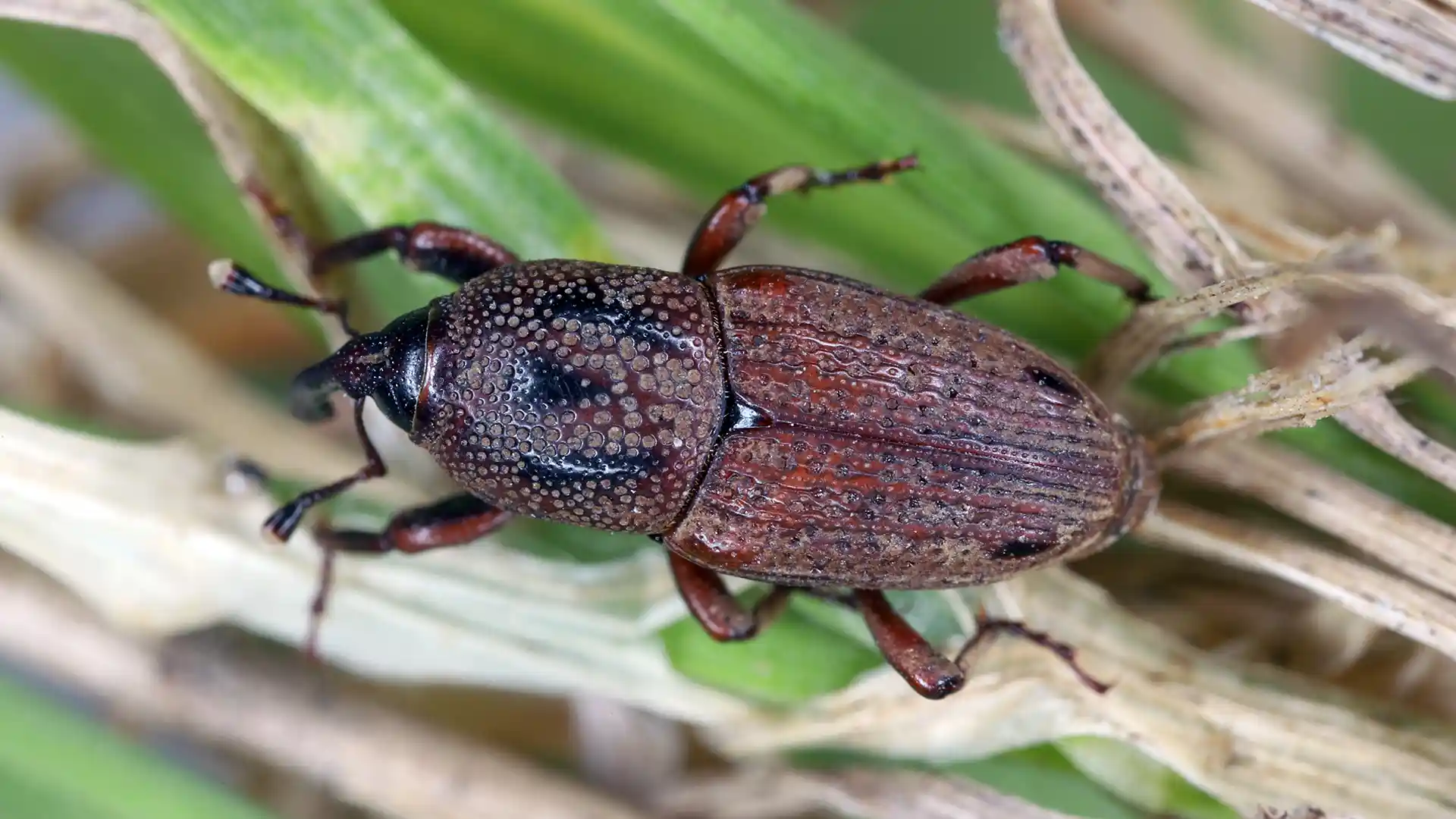
Billbugs are weevils – beetles with a long bill-like snout. The adults are small, about a third of an inch, dark gray to brown, and you will sometimes see them walking across driveways and sidewalks in spring, which is an early warning sign. But the adults are mostly harmless. The damage is done by the larvae: small, white, legless grubs with a reddish-brown head, smaller than a white grub, that tunnel inside grass stems and then feed down into the crown and roots. In our warm-season lawns the hunting billbug goes after zoysia and bermuda; cool-season tall fescue lawns can get the bluegrass billbug instead.
Billbug damage and the tug test
Billbug damage looks like scattered dead and dying patches that show up in summer heat. The test that proves it is the tug test: grab a browning stem and pull straight up. If it snaps off easily right at the base and the hollow broken end is packed with fine, sawdust-like material – that is frass, the larvae’s droppings – you have billbugs. That is the detail that separates them from everything else. It also separates them from white grubs: grubs are legged, C-shaped, and live down in the soil, while billbug larvae are legless and inside the stems.
Drought vs. billbugs vs. grubs
Because summer browning has three common causes, here is the quick sort:
Clue | Drought / Dormancy | Billbugs | White Grubs |
|---|---|---|---|
Pattern | Uniform fade across the lawn | Scattered brown patches, worse in summer | Irregular dead patches, often larger |
Tug test | Grass rooted firm, will not pull | Stems snap off at the base with sawdust-like frass inside | Turf lifts up like loose carpet |
What you find | Nothing – just dry soil | Tiny legless larvae in the stems | Fat C-shaped larvae with legs in the soil |
Greens up with water? | Yes | No | No |
If watered grass stays brown and pulls free with frass in the stems, it is billbugs – not drought.
Billbug control and timing in NC
Here is the hard truth about billbugs: by the time you see the damage, the larvae are tucked inside the stems where sprays cannot reach them, so a treatment then is largely wasted. The control that works targets the adults in spring before they lay eggs, or the newly hatched larvae before they burrow in. In NC, hunting billbug adults are active roughly April into June, with a second wave in late summer to early fall, so spring is the window. A systemic timed to that adult activity, plus reducing thatch and keeping the turf healthy, is what actually protects the lawn. One caveat: a preventive spring treatment is worth it mainly on lawns that have had billbugs before – not every lawn needs it.

DIY vs. hiring a pro
A homeowner can do the tug test, reduce thatch, and keep the lawn healthy, all of which help. But billbugs are the pest where correct ID and correct timing make or break it – treat too late, when the damage is showing, and you are spraying protected larvae for nothing. A licensed applicator confirms it is billbugs and not grubs or disease, and hits the narrow spring window when treatment actually works. We are licensed to apply on turf in North Carolina. If your zoysia or bermuda browns out in patches every summer no matter how you water it, text us at 984-284-5399 and let us check for billbugs before next spring.
Frequently Asked Questions
Zoysia or Bermuda Browning in Patches Every Summer?
It may be billbugs, not drought – and they are beaten in spring, before the damage shows. We confirm the ID and hit the window. Text us to get on the list for next spring.
Sources
NC State Extension TurfFiles – Hunting Billbugs in Turf
Purdue Extension – Managing Billbugs in Turfgrass (E-266)
University of Arkansas Extension – Billbug Damage in Lawns
Utah State University Extension – Billbugs in Turfgrass
