

What’s Wrong With My Crepe Myrtle? Bark Scale, Sooty Mold and Common Problems
By Ken Erickson · Updated July 2026
Crape Myrtle Bark Scale: Start With What You’re Actually Looking At
Crape myrtle bark scale is the white, crusty pest behind most of that black sooty film on the trunks. Crepe myrtles are tough, but when something looks wrong, most homeowners guess — and guess wrong. They scrub the black film thinking it’s mold in the wood, or panic when the bark peels, which, is completely normal. Nine times out of ten in the Triangle, the real culprit is an insect: crepe myrtle bark scale or aphids, with the black sooty mold riding along on top. Also fighting suckers? See How to Stop Crepe Myrtle Shoots and Suckers.
This is a field guide to the whole list. Match what you’re seeing to the section below, learn what’s serious and what isn’t, and know when it’s a five-minute DIY job versus a call to a licensed applicator. Our education and background controlling pests on turf and ornamentals is extensive, and this is the diagnosis we do every week across Raleigh’s southern suburbs. Bark scale is one of several sap-suckers — see our overview of scale insects and mealybugs on trees and shrubs.
Key takeaways
- White, crusty bumps on the bark plus a black, sooty film below are the signs of crepe myrtle bark scale — an invasive insect now common across the Triangle.
- The black film is sooty mold, not a fungus in the wood. Kill the insect and it clears on its own.
- Bark scale rarely kills a healthy tree outright, but it disfigures and weakens it over years — treat it, don’t ignore it.
- The most effective control is a systemic soil drench (dinotefuran) timed to spring, backed by a dormant-season horticultural oil.
What Crepe Myrtle Bark Scale Looks Like (the “White Bugs”)
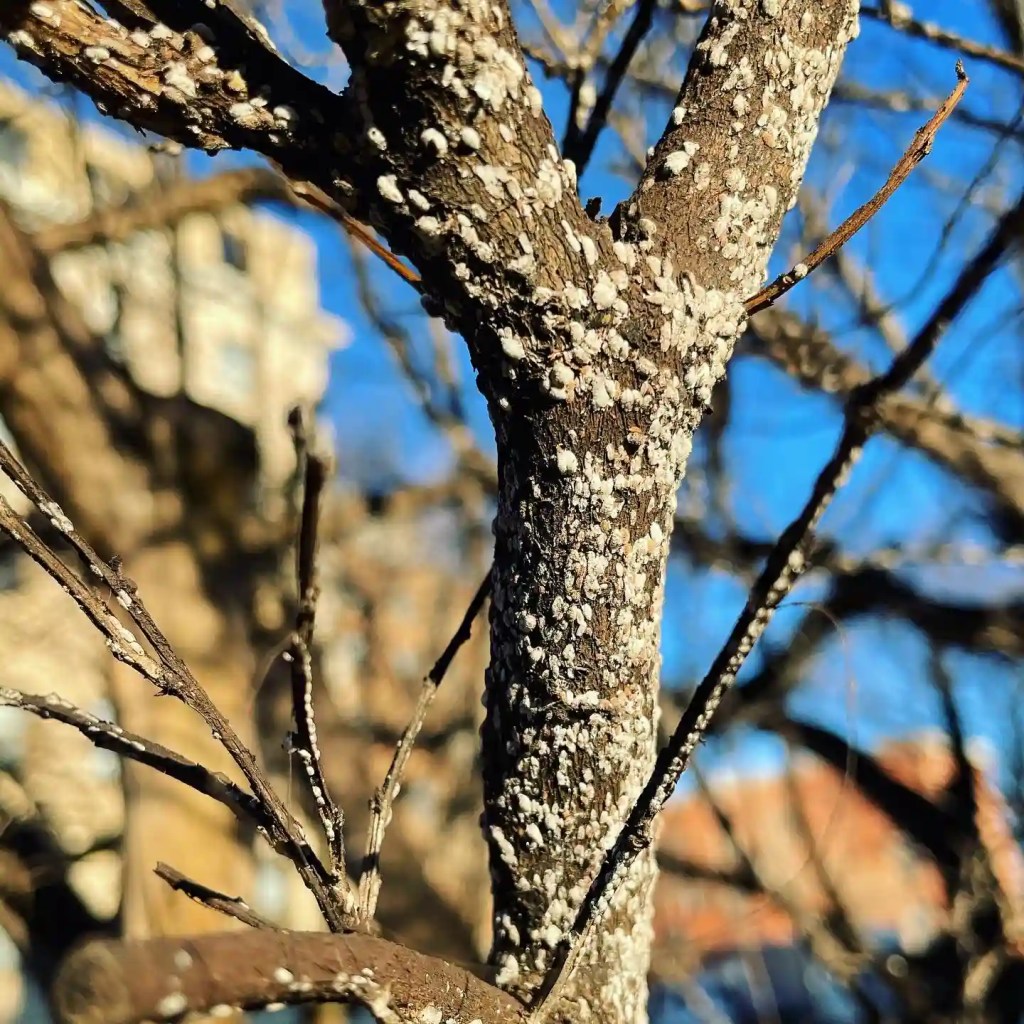
Crepe myrtle bark scale (Acanthococcus lagerstroemiae) is an invasive insect from Asia, now well established across Raleigh, Durham, Cary, and the greater Triangle. People usually find it as “white bugs” or a white crust on the trunk — small, felt-like, gray-to-white bumps clustered in the branch crotches and along the main stems.
Press one and it “bleeds” pink — that’s the tell that separates bark scale from lichen or a harmless crust. The scale feeds on the tree’s sap under that waxy shell, and it multiplies fast in our warm, humid summers.
Left alone, the colonies spread up the branches and onto every crepe myrtle nearby. It’s the single most common — and most misidentified — crepe myrtle problem we see in the area.
Is the Black Stuff a Fungus? (No — It’s Sooty Mold)
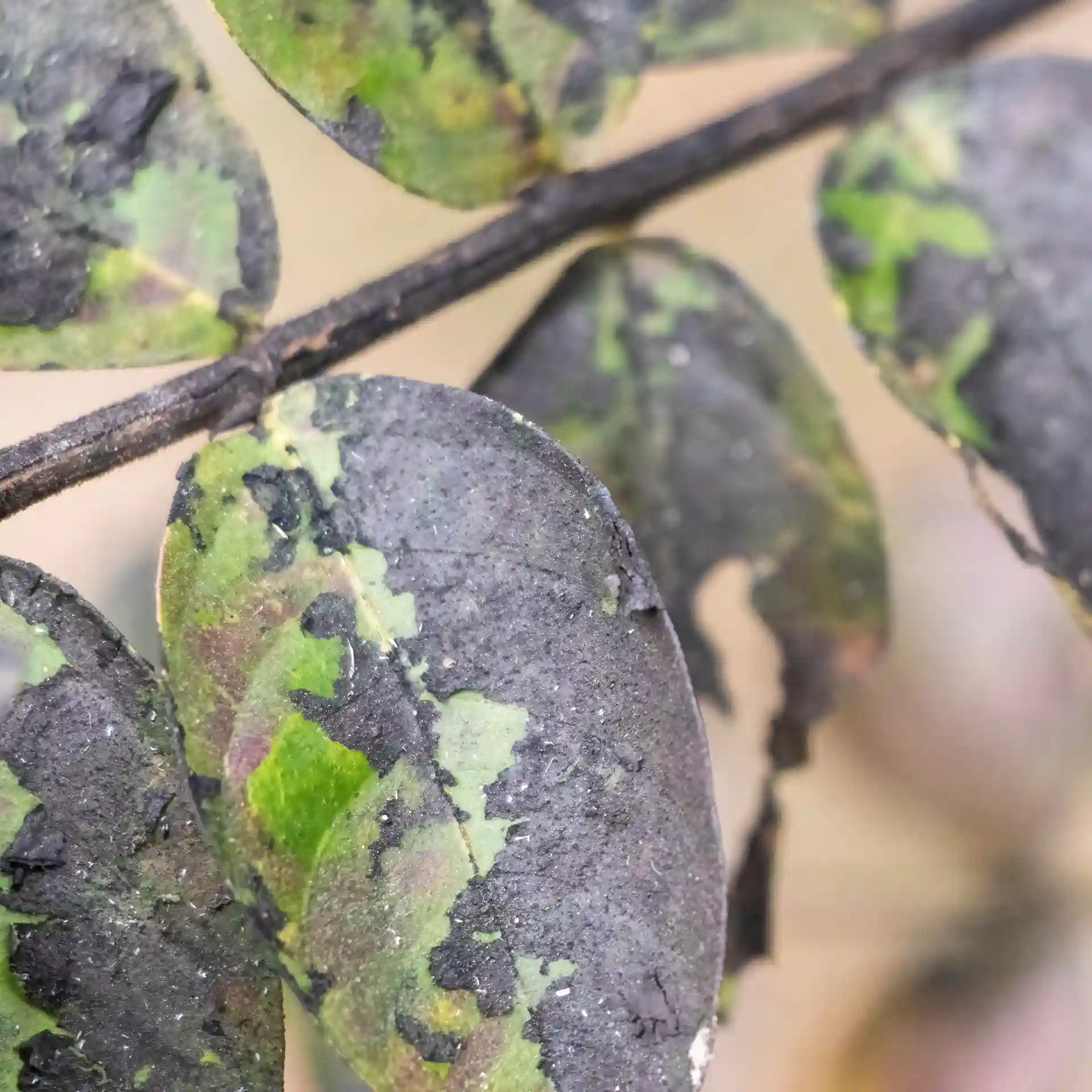
The black coating on the bark and leaves is the thing that scares people most, and it’s the most misunderstood. It is not a disease of the wood and not a fungus attacking your tree.
Here’s what’s really going on underneath it — and why scrubbing the black film is wasted effort until you deal with the insect causing it.
Where the Black Film Comes From
As bark scale and aphids feed, they excrete a sugary waste called honeydew. A harmless mold grows on that honeydew, coating whatever sits below — bark, leaves, even the patio. So the black film is a symptom of the insect, not the problem itself. Kill the scale or aphids and the sooty mold weathers off on its own within a season.
Will Bark Scale Kill My Tree?
This is the question we get most, and the honest answer is reassuring — with a catch.
Not Overnight
A healthy crepe myrtle rarely dies outright from bark scale. What it does is disfigure the tree — black bark, fewer and smaller blooms, a tired-looking canopy — and quietly weaken it year over year.
But Don’t Ignore It
A heavy, long-running infestation stresses the tree enough to cause twig dieback and thin the canopy, and a stressed tree is an easier target for everything else. It’s not an emergency, but it is a “handle it this season” problem.
It Spreads Down the Street
Bark scale moves readily to every crepe myrtle nearby, so an untreated tree becomes your neighbors’ problem too. Treating early keeps one tree from seeding a whole row.
The Bark Scale Life Cycle — and Exactly When to Treat
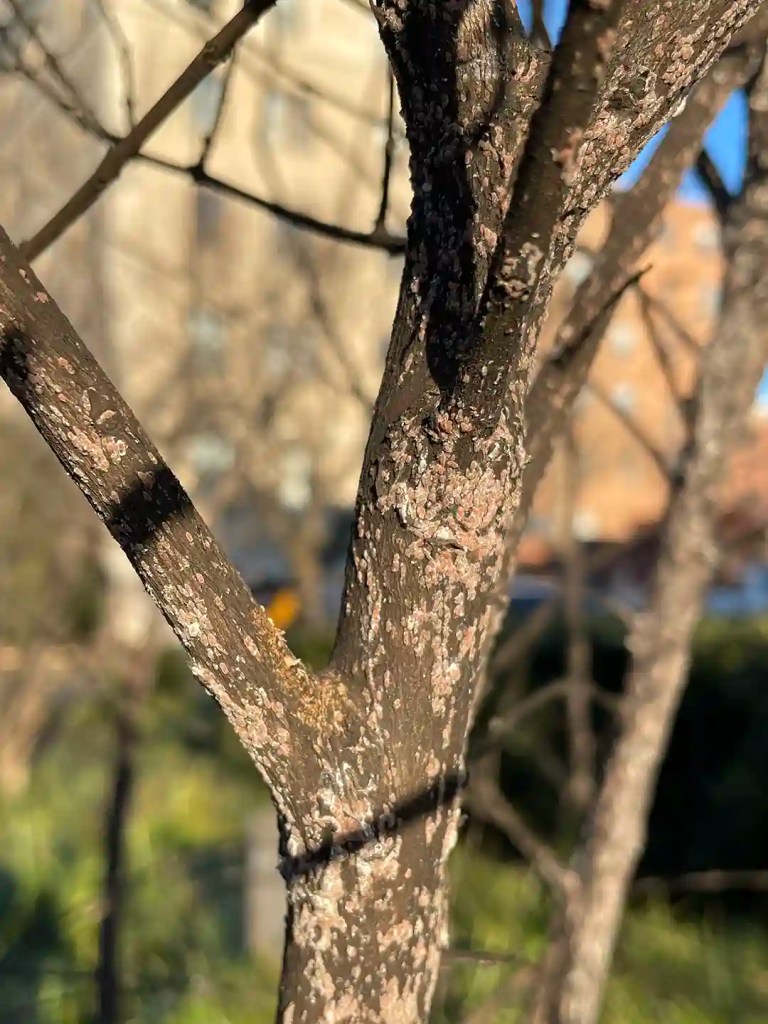
Timing is everything with scale, because the insect is only vulnerable at one stage. It overwinters on the bark and, in spring, hatches into tiny mobile “crawlers” — the one phase before they build their protective waxy shell.
Once they’ve settled and crusted over, contact sprays barely touch them. That’s why blasting a mature infestation with something off the shelf usually fails — the shell shrugs it off.
The two windows that work: a systemic treatment in spring so the tree carries the insecticide into the sap the scale drinks, and a dormant-season horticultural oil after leaf drop to smother the overwintering scale. Miss the biology and you waste the product.
Diagnostic Table of Symptoms and Causes
Symptom | Likely Cause | Is It Serious? | What To Do |
|---|---|---|---|
White, waxy crust on bark | Crepe myrtle bark scale | Yes, over time | Systemic drench + dormant oil |
Black film on bark and leaves | Sooty mold (from scale/aphids) | No — it’s cosmetic | Kill the insect; mold clears |
Sticky leaves and ground | Honeydew from scale or aphids | No | Treat the insect |
Curled, distorted new leaves | Aphids | Minor | Water blast; treat if heavy |
Smooth bark peeling in strips | Normal exfoliating bark | No — it’s healthy | Nothing; enjoy it |
Gray-green crusty patches | Lichen | No — harmless | Nothing |
White powder on leaves | Powdery mildew | Minor | Full sun, airflow, resistant variety |
Ants marching up the trunk | Farming the honeydew | No | Treat the scale or aphids |
Twig dieback, thinning canopy | Heavy scale infestation | Yes | Licensed systemic treatment |
How to Treat Crepe Myrtle Bark Scale
There’s a right order here, and the strongest tools are the ones a licensed applicator can time correctly. A dormant oil after leaf drop in winter smothers a lot of the overwintering scale — low-risk, and a good DIY starting point.
The most effective control is a systemic insecticide applied as a soil drench in spring — the roots carry it up, and the scale takes it in as it feeds. This is the treatment that actually knocks a heavy infestation down.
On the active ingredient: dinotefuran and imidacloprid are both systemic neonicotinoids, but they aren’t equal for this pest. Dinotefuran moves through the tree faster and performs better against bark scale, which is why it’s the common choice for a serious case; imidacloprid is slower and applied earlier. Matching the active ingredient, the rate, and the timing is exactly the judgment a licensed applicator brings — and why store-bought guesswork disappoints. We’re licensed by the state of North Carolina to apply pesticides on ornamental plants such as shrubs and trees.
What Bark Scale Treatment Costs
Homeowners searching “crepe myrtle bark scale treatment cost” want a straight answer, so here’s how it works. A single systemic soil treatment for a typical yard tree is modest.
A mature tree, a row of trees, or a heavy infestation that needs a systemic plus dormant oil across two windows costs more. The bigger cost is doing it wrong — the wrong product at the wrong stage — and paying again next year while it spreads to the rest of your crepe myrtles.
We price the job to the tree count and the severity, and we tell you up front. For a single tree it’s an easy call; for an established row it’s worth a quote.

If you want a firm number for your yard, call or text 984-284-5399 and we’ll size it to what you actually have.
What Eats Crepe Myrtle Bark Scale? (Your Free Help)
You have an ally on your side, and it’s worth protecting.
The Twice-Stabbed Lady Beetle
The twice-stabbed lady beetle — small, black, with two red spots — is the main natural predator of bark scale, and both the adults and their odd, alligator-like larvae eat it. If you see them working a tree, that’s a good sign, not a bad one.
Don’t Nuke Your Own Allies
This is why blanket-spraying broad insecticides can backfire — you kill the beetles that were keeping the scale in check. A targeted systemic the beetle doesn’t feed on protects your predators while it works the pest.
That’s Integrated Pest Management
Treating the specific insect at the specific stage, while protecting its natural enemies, is the whole idea behind IPM — and it’s how we build a treatment plan instead of spraying everything and hoping.
Done right, one well-timed season of treatment usually turns a heavily crusted, blackened tree back into a clean one.
Aphids and Sooty Mold — the Other Honeydew Bug
Same Symptom, Different Insect
If you’ve got sticky leaves and black film but no white crust on the bark, you’re likely looking at aphids, not scale.
Crepe myrtle aphids cluster on the undersides of leaves, suck sap, and produce the same honeydew that grows sooty mold. A strong blast of water knocks colonies off, and a healthy tree with its predators intact usually keeps them in check.
Heavy, repeat infestations get the same logic as scale — treat the insect, and the mold clears itself. Don’t scrub the leaves and call it fixed.
The ants marching up the trunk are farming that honeydew, not attacking the tree — one more sign to look for the sap-sucker rather than spray the ants.

Problems People Confuse With Bark Scale (and What’s Actually Fine)
Half of what gets called a “crepe myrtle disease” is harmless. Here’s how to tell the real problems from the normal stuff.
Peeling, Shedding Bark — Totally Normal
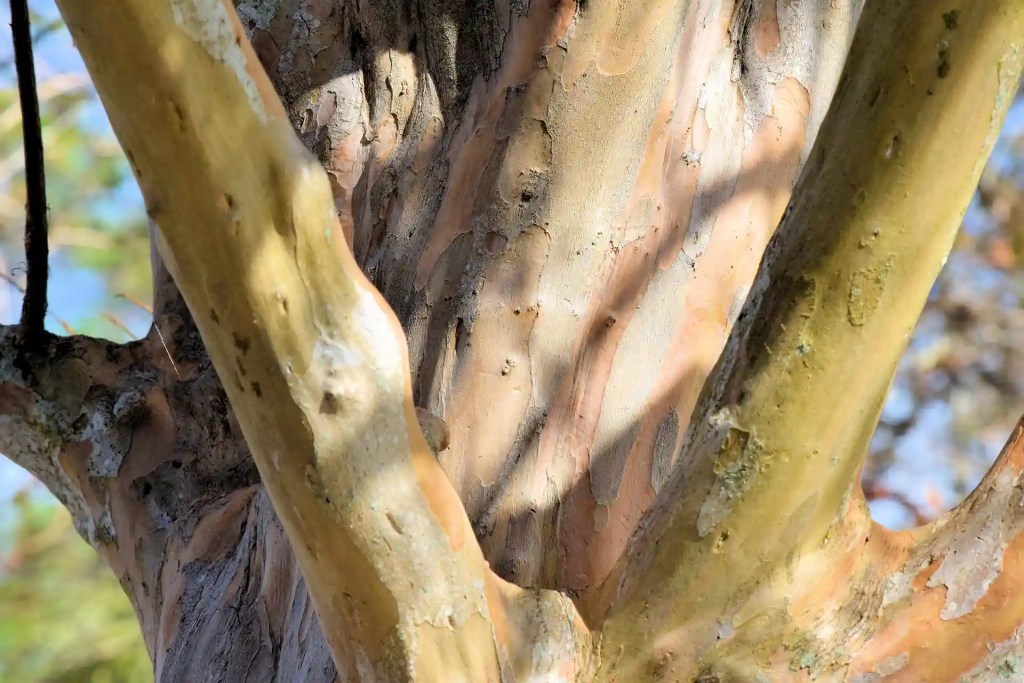
Smooth bark peeling away in cinnamon-and-tan strips is not a problem — it’s the tree’s natural exfoliating bark and one of its best features. Don’t peel it off yourself; let it do its thing.
Lichen — Harmless
The gray-green, crusty or leafy patches on the trunk are lichen, not scale and not a disease. They use the bark only as a perch and don’t hurt the tree. Leave them be.
Powdery Mildew — Minor and Preventable
A white powder on new leaves is powdery mildew, a fungus that thrives in shade and crowded growth. Plant mildew-resistant varieties in full sun and thin the canopy for airflow; chemical control is rarely needed on a well-sited tree.
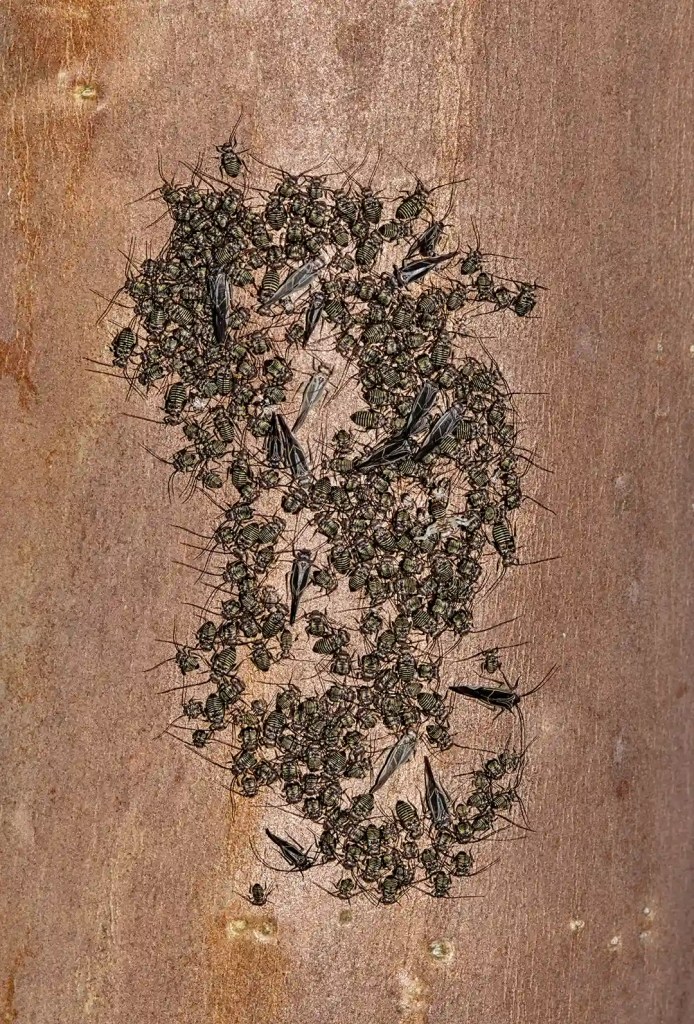
Barklice (“Tree Cattle”) — Harmless, Even Helpful
See a moving herd of tiny striped bugs grazing the bark? Those are barklice, not a pest — they eat the lichen, algae, and sooty mold off the trunk, so they’re cleaning the tree for you. Some spin a harmless silky webbing on the bark. Leave them be; spraying them does nothing but kill a free cleanup crew.
The Rule for All of It
Identify before you treat, and treat the insect, not the symptom. Guessing wastes money and stresses the tree.
When you’re not sure which camp a symptom falls in, a photo and a licensed eye settle it fast — and that’s free to ask.
That habit alone — diagnose first — will save you more crepe myrtles than any single product.
When to DIY and When to Call a Pro

Do the Easy Stuff Yourself
Plenty of this is DIY. Hose the aphids off, apply a dormant oil in winter, plant the right variety in the sun, and leave the lichen and peeling bark alone — you don’t need to pay anyone for that. Where it’s worth a call is the part with real downside: a heavy bark scale infestation that needs a systemic timed to the crawlers, an established row of trees, or a tree already declining. That’s licensed work — the right active ingredient at the right rate in the right week — and it’s what we do for homeowners across Fuquay-Varina, Holly Springs, Apex, Cary, and Garner.
Crepe Myrtle Bark Scale FAQs
Not Sure What’s Wrong? We’ll Tell You Straight
Send us a photo or point at the tree and we’ll identify it — bark scale, aphids, mildew, or nothing to worry about — and give you a plan and a price. Lawn Panther treats crepe myrtles and other ornamentals across Raleigh’s southern suburbs: Fuquay-Varina, Holly Springs, Apex, Cary, Garner, and the surrounding towns. Call or text 984-284-5399.
