

Crepe Myrtle Care in North Carolina: What NOT to Do
By Ken Erickson · Updated July 2026
Crape Myrtle Care: These Trees Are Tough — So People Love Them to Death
Crape myrtle care is mostly smart pruning, feeding, and catching pests early. Crepe myrtles are the workhorse of Triangle summer color. You see them lining driveways and street fronts from Fuquay-Varina to Cary because they shrug off our heat, humidity, and heavy clay and still bloom for a hundred days. That toughness is exactly why they get abused — people figure a tree this durable can take anything.
Most of the crepe myrtle care I get called out to fix isn’t neglect. It’s damage from doing the wrong thing at the wrong time. So this guide is written backward on purpose: here’s what NOT to do to a crepe myrtle in North Carolina, and the right move in each case. Get these right and yours will bloom hard every summer with almost no work from you.
Key takeaways
- The worst thing you can do is “crepe murder” — topping the tree to thick stubs. It ruins the shape, creates weak, floppy regrowth, and invites pests.
- Most crepe myrtles need almost no pruning. When you do, keep it light, do it in late winter (February–March here), and never cut a branch thicker than your thumb.
- Right plant, right place beats pruning every time — match the variety’s mature size to the spot and give it full sun so you’re not fighting it forever.
- Crepe myrtle bark scale is now established across Raleigh, Durham, and Cary; the white crust and black sooty mold are the tells. Catch it early.
Don’t Commit “Crepe Murder” — the #1 Mistake
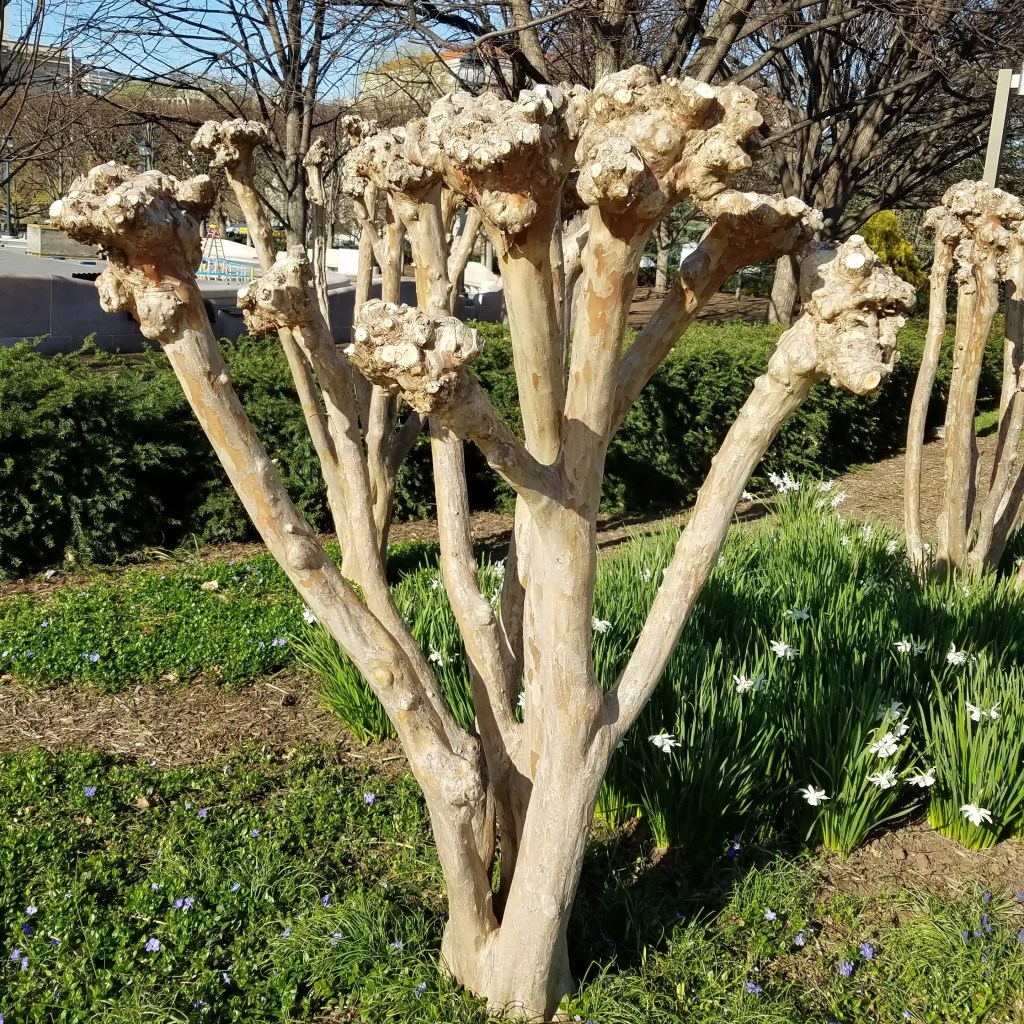
“Crepe murder” is the practice of topping a crepe myrtle — cutting every branch back to thick, knuckled stubs three to five feet off the ground, usually every single winter. It is the most common thing done to these trees and by far the most damaging. Fighting basal shoots? See How to Stop Crepe Myrtle Shoots and Suckers.
Topping — sometimes dressed up with the term “pollarding” — destroys the natural vase shape and the smooth, peeling bark that makes a mature crepe myrtle worth having. Worse, it forces a burst of skinny, weakly attached shoots called watersprouts out of every stub. Watersprouts can’t hold the weight of the blooms, so they flop and snap, and all that soft new growth is a magnet for insects and disease.
You don’t get more tree — you get a knobby one with a shorter life. A healthy crepe myrtle can live 50 years or more; topping it every winter throws that away. The good news: a topped tree is recoverable, and I’ll walk through how to bring one back further down.

Don’t Prune at the Wrong Time of Year
Timing is half the battle. In central and eastern North Carolina, the pruning window is late winter — February into March — before new growth breaks. Prune then and the tree heals fast and blooms on the fresh season’s wood.
What you want to avoid is pruning in late summer or early fall. Cutting that late pushes out tender growth that has no time to harden off before our first freeze, and you’ll lose it — sometimes along with the branch it grew from.
If You Missed the Winter Window
Leave it alone. It is always better to skip a year than to “tidy it up” in September. A crepe myrtle that goes unpruned for a season is far healthier than one cut at the wrong time.
Don’t Hack It — Here’s How to Actually Prune
Here’s the part most people get backward: a healthy crepe myrtle needs very little pruning, and the goal is to enhance its natural shape, not force it into a smaller one. When you do prune, keep it light and follow a simple order.
Start With the Three D’s
Remove the dead, dying, and diseased branches first. Then take out the suckers at the base and any branches that cross or rub. On most trees, that alone is the whole job.
Thin, Don’t Top
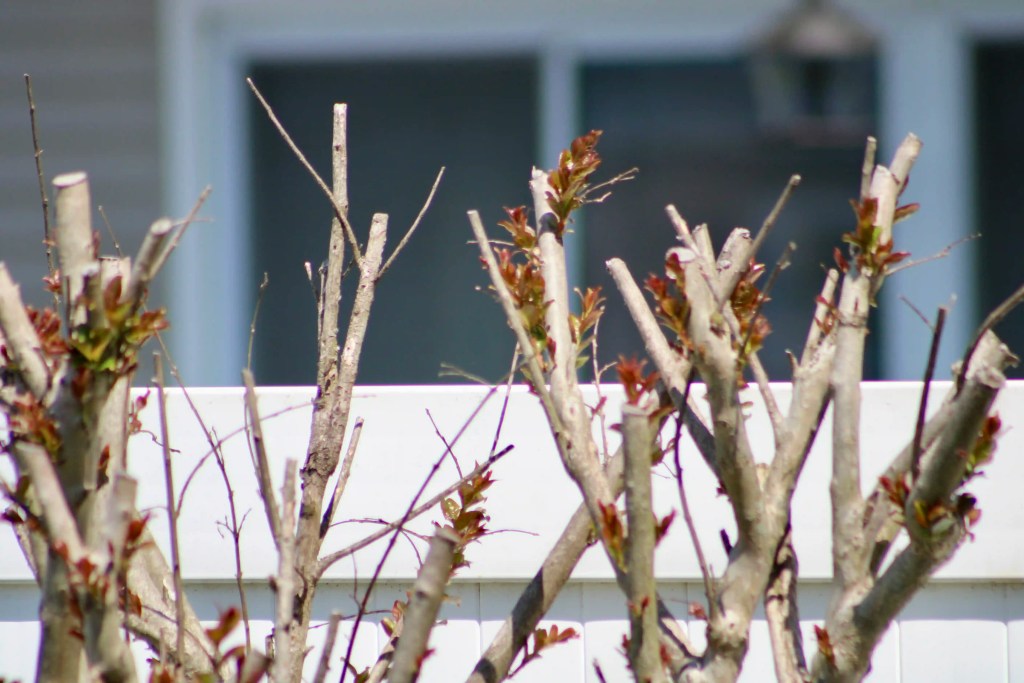
If the canopy is crowded, thin interior branches back to where they meet another branch. This opens the tree so air moves through it, which is your best defense against powdery mildew. You’re removing whole branches at their base — never shearing the top flat.
The Thumb Rule
Never cut a branch thicker than a pencil, and never thicker than your thumb. If you’re reaching for a saw, stop — that’s crepe murder territory. On a young tree, gradually remove the lowest branches over the first few years to raise the canopy and show off the trunks; pick three to five of the strongest trunks and cut the rest at ground level.

Don’t Plant the Wrong Size in the Wrong Spot
Nearly every “it’s too big” problem traces back to the day it went in the ground. Crepe myrtles range from 18-inch dwarfs to 30-foot trees, and the plant tag tells you the mature size. Plant a 25-foot variety under a window and you’ve signed up for a lifetime of hacking it back — which is how crepe murder starts.
Match the variety to the space and you’ll almost never need to prune for size. They want full sun — at least six hours — for the best bloom and the least disease, and they want decent drainage. Avoid the low, soggy corners of the yard where our clay holds water after a storm.
When you plant, dig the hole twice as wide as the root ball, set it no deeper than it grew in the pot, and keep the crown out of standing water. Getting the variety and the spot right is the single biggest favor you can do a crepe myrtle.
The Mistake | Why It Hurts | Do This Instead | Best Timing |
|---|---|---|---|
Crepe murder (topping) | Weak, floppy regrowth; broken limbs; shorter life | Thin lightly; keep the natural vase shape | Late winter only |
Pruning in late summer or fall | New growth won’t harden before frost | Prune in February–March | Feb–March |
Wrong variety for the spot | A lifetime of cutting it back | Match mature size at planting | At planting |
Planting too deep | Crown rot and slow decline | Set it no deeper than the pot | At planting |
A soggy, low spot | Root rot in our heavy clay | Plant high with good drainage | At planting |
Overwatering an established tree | Wet feet and root disease | Water deep and infrequent | After year one |
Overfertilizing | Lots of leaves, fewer blooms | One light spring feeding | Early spring |
Ignoring bark scale | Sooty mold, decline, spreads down the street | Scout early; treat at the crawler stage | Spring plus dormant oil |
Shade and old varieties | Powdery mildew takes hold | Full sun and resistant varieties | At planting |
Don’t Drown It or Overfeed It (NC Clay Rules)
Established crepe myrtles are drought-tough, so in our heavy clay the bigger risk is too much of a good thing. Water new plants deeply two to three times a week the first season, then back off. After that, about an inch of water a week is plenty — and our weather usually handles most of it.
Constant watering in clay keeps the roots wet and invites rot. Fertilizer is the same story: one light feeding of a balanced fertilizer in early spring is all a crepe myrtle wants. Overfeeding gives you a bush full of leaves and fewer of the blooms you planted it for.
Two to three inches of mulch over the root zone — pulled back off the trunk, never mounded up against it — does more for the tree than any aggressive feeding schedule. It holds moisture, steadies the soil temperature, and keeps the mower away from the bark.
Don’t Ignore Crepe Myrtle Bark Scale — It’s Here Now
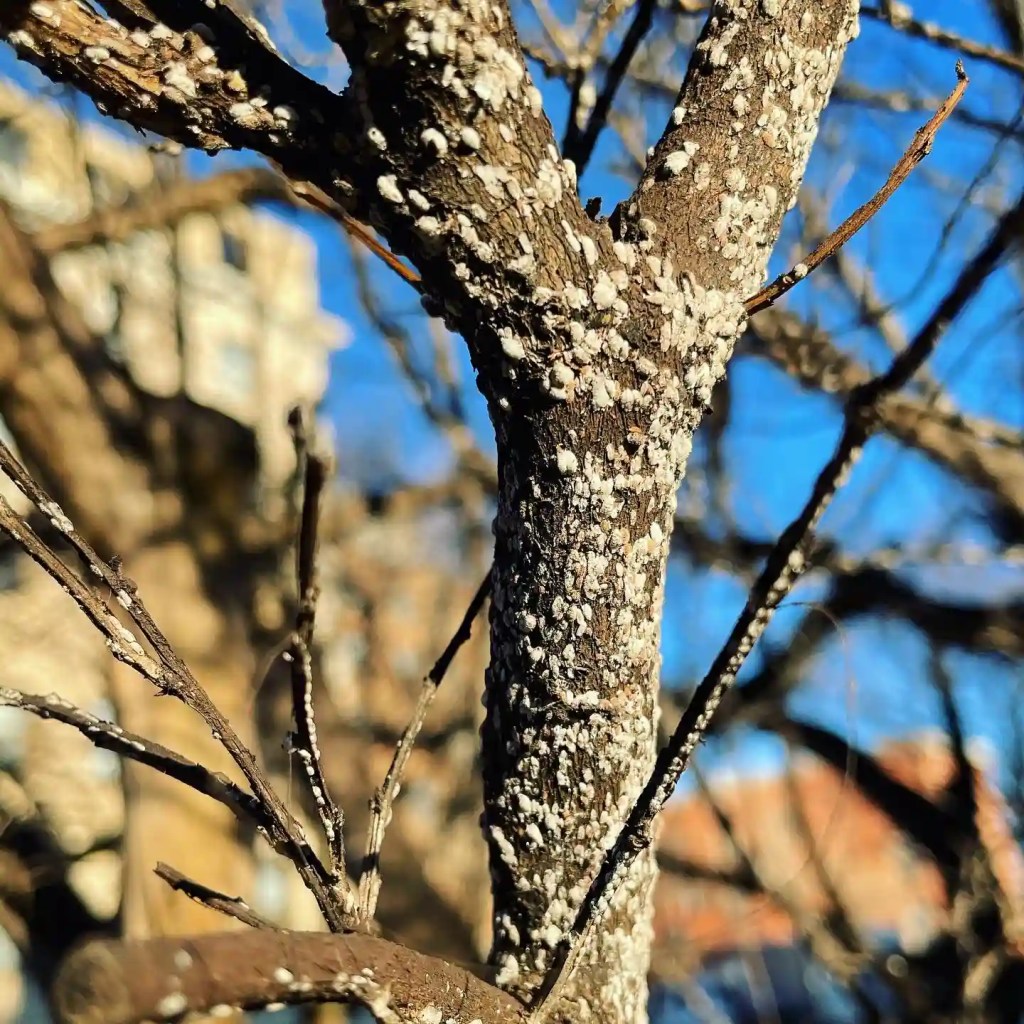
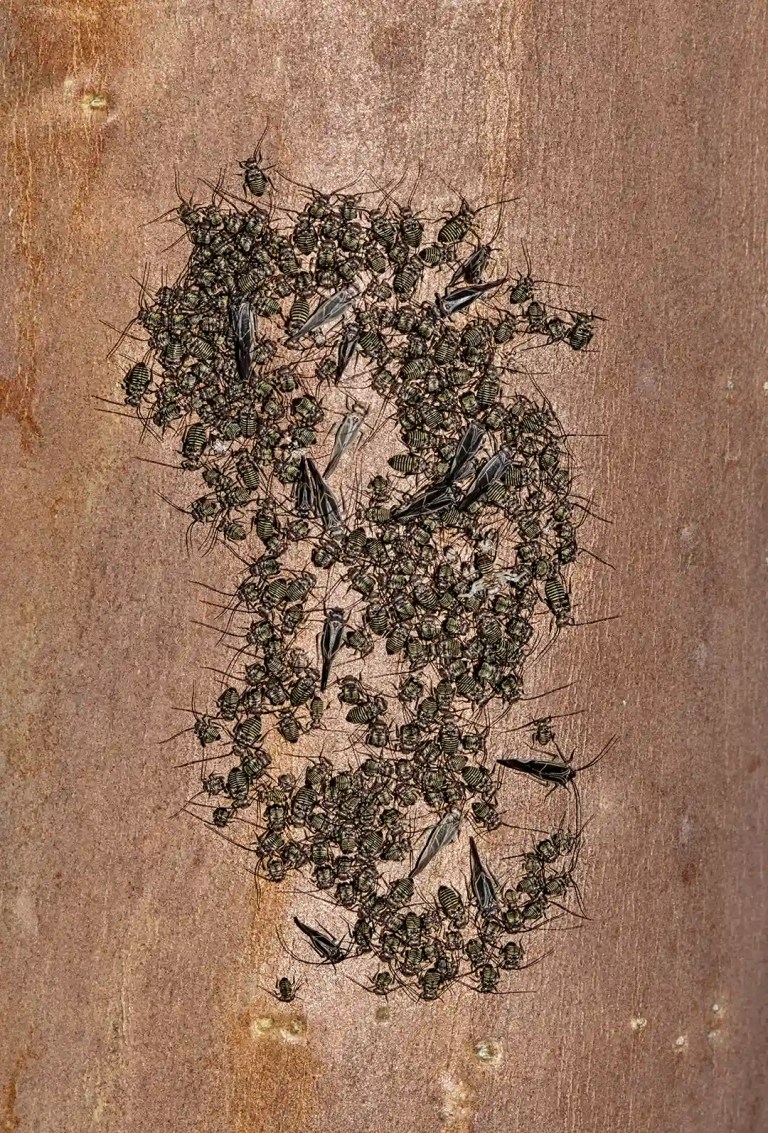
This is the one Triangle homeowners keep missing. Crepe myrtle bark scale (Acanthococcus lagerstroemiae) is an invasive insect — originally from Asia — that has spread across North Carolina and is now well established in the Raleigh, Durham, Chapel Hill, and Cary areas. It is the biggest new threat to crepe myrtles (Lagerstroemia) in our region. For the full identification and treatment plan, see our guide to crepe myrtle bark scale.
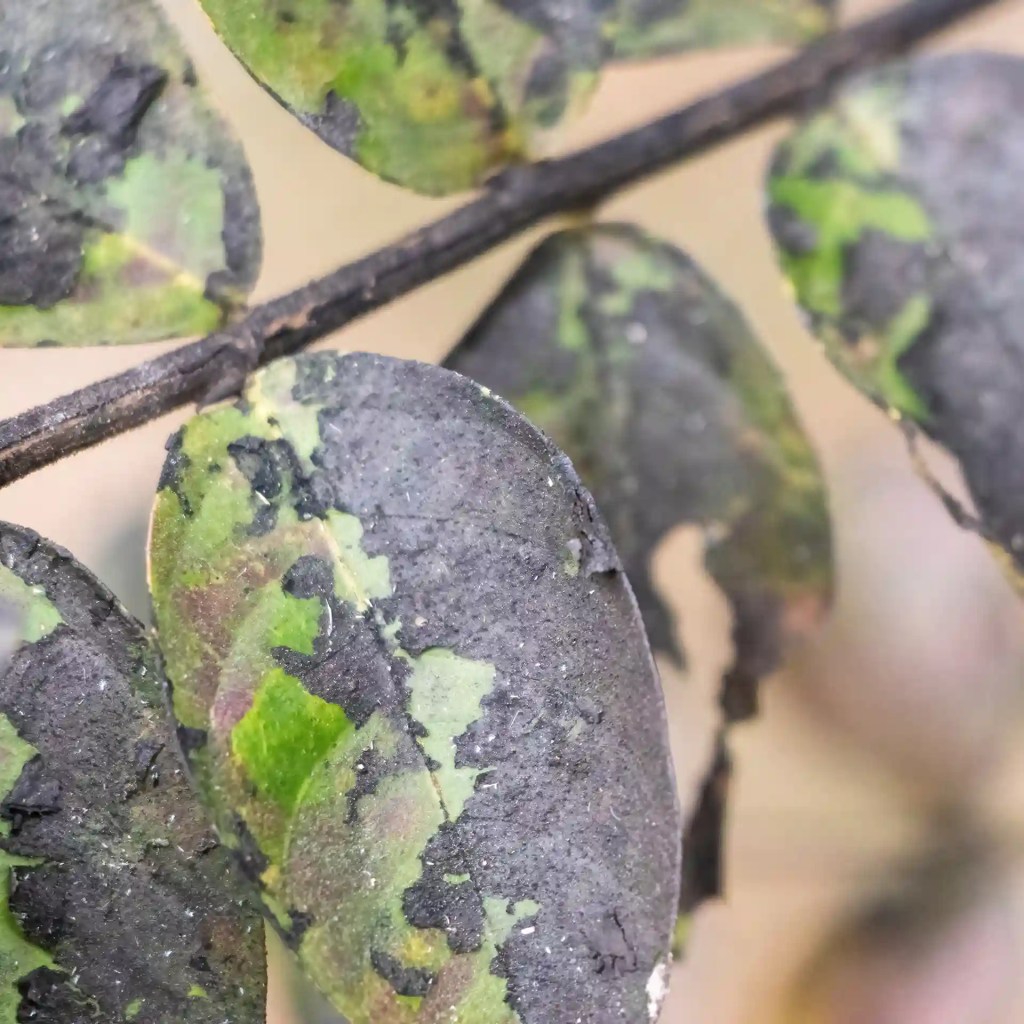
The tells are easy once you know them: white-to-gray, waxy crusts on the trunk and in the branch crotches — most people find them as “white bugs” — plus a black, sooty film coating the bark and the leaves below. That black film is sooty mold, not a fungus in the wood; it grows on the sugary honeydew the scale excretes. It’s ugly, but the insects are the real problem.
Left alone, a heavy infestation weakens the tree, ruins the bark, and spreads to every crepe myrtle on the street. The fix is to scout for it early and treat when the crawlers are active; a properly timed systemic soil treatment is the most effective control, and a dormant-season horticultural oil knocks back the overwintering scale.
This is exactly the kind of work our license covers. We’re licensed by the state of North Carolina to apply pesticides and fungicides on ornamental plants such as shrubs and trees, so if you see that white crust or black film starting on a crepe myrtle, it’s worth a look before it takes the whole row.
Don’t Set It Up for Powdery Mildew and Aphids
Two more headaches, both largely preventable, and both tied to the choices you make at planting.
Powdery Mildew
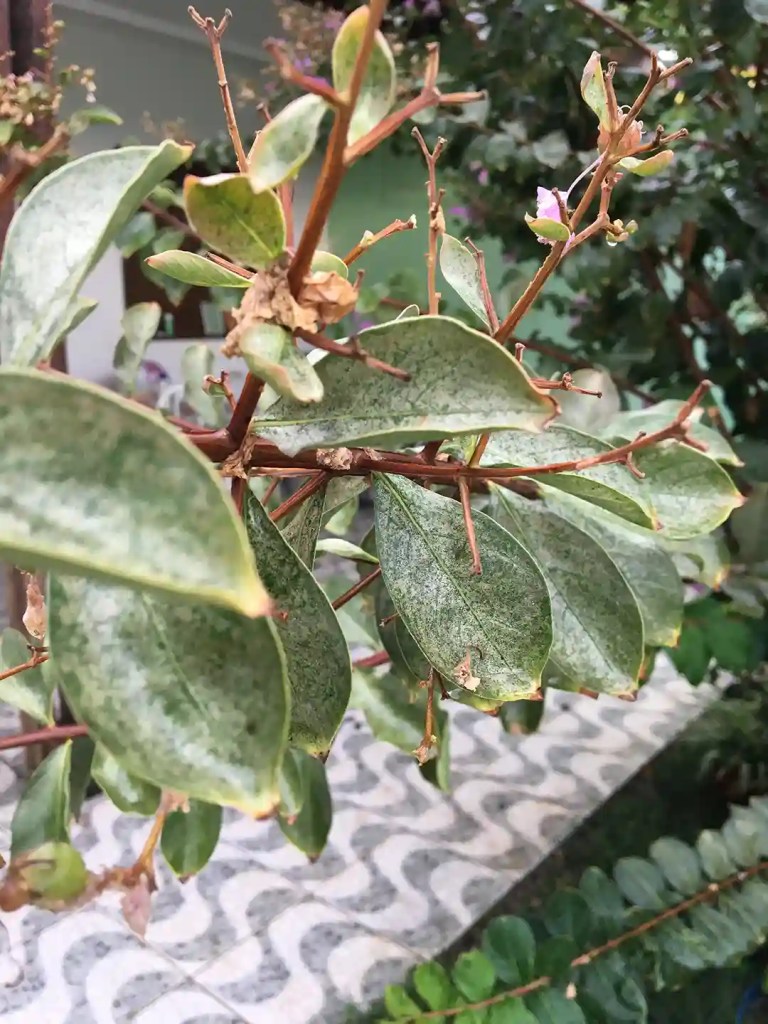
Powdery mildew shows up as a white dusting on new leaves and buds, and it thrives on crowded, shaded, poorly circulated growth. Beat it by planting mildew-resistant varieties in full sun and thinning the canopy so air moves through. Most of the older cultivars are highly susceptible; the newer NC-friendly varieties were bred to resist it.
Aphids and Sooty Mold
Aphids are the other regular visitor, and they’re a honeydew source that feeds the same sooty mold as bark scale. A strong blast of water knocks colonies off, and a healthy tree usually keeps them in check on its own. If you’re seeing sooty mold, don’t scrub the leaves and call it done — chase down the insect that’s causing it.
Don’t Reach for the Sprayer First
Most crepe myrtle pest problems are solved by air, sun, and variety choice, not a spray schedule. Open the canopy, put the tree in enough light, and pick a resistant variety, and you remove the conditions these problems need.
When an infestation does get ahead of you — bark scale especially — that’s the point to bring in a licensed applicator who can time the treatment to the insect’s life cycle instead of spraying blind.
How to Fix a Crepe Myrtle That’s Already Been Topped
Yes, It Can Recover
If yours has already been “murdered,” don’t dig it out. Crepe myrtles are resilient, and a topped tree can be rebuilt into a natural shape over two to three seasons with the right cuts.
The first spring after topping, each ugly stub will push a dozen or more skinny shoots. The recovery is about editing those down, not cutting them all off again.
On each stub, choose the one to three strongest, best-positioned shoots and rub or cut the rest off. Those keepers become the new branches. Do it again the next winter, thinning to keep the structure open.
Within a few years the knuckles soften, the canopy fills back in, and the tree carries its blooms on stronger wood. It takes patience, but it beats starting over — and it beats topping it again.
Choosing the Right Crepe Myrtle for Your NC Yard
The easiest way to avoid every mistake above is to buy the right plant on day one. Here’s how to pick for a Triangle yard.
Match the Size to the Space
Dwarf varieties stay under five feet and fit beds and containers; semi-dwarfs run six to twelve feet; standard trees hit twenty to thirty. Read the tag and buy for the mature size, not the size in the pot.
Pick a Mildew-Resistant Variety
Many of the U.S. National Arboretum varieties with Native American names — Natchez, Tuscarora, Muskogee, Sioux — were bred for disease resistance and do well here. It’s a simple way to design powdery mildew out of the picture before you ever plant.
Choose Your Color and Bark
Crepe myrtles come in white, pink, red, lavender, and purple, and the best varieties have showy cinnamon-to-tan peeling bark for winter interest. Since you’re keeping the natural form, that bark becomes a feature — one more reason not to top it.
Give It Full Sun
Six-plus hours of direct sun gives you the heaviest bloom and the least disease. In shade, crepe myrtles bloom poorly and mildew badly. If a spot is shady, it’s simply the wrong spot for a crepe myrtle.
Respect the Clay
Our soil is heavy and holds water. Plant slightly high, amend as little as possible so the roots grow out into native soil, and never put a crepe myrtle in a low spot that stays wet.
Get these five right at the nursery and you’ve eliminated most of the reasons anyone ever picks up a saw.
If you’d rather have it chosen and planted correctly the first time, that’s exactly what we do across Raleigh’s southern suburbs.
When You Can DIY — and When to Call a Pro

A Lot of This Is DIY
I’ll say it plainly: basic crepe myrtle care is something a homeowner can absolutely do. Light winter thinning, a spring layer of mulch, an occasional deep watering — none of that needs a pro, and I’d rather you do it right yourself than pay someone to top it. Where it’s worth a call is the stuff with real downside: a bark scale infestation that needs licensed treatment timed to the insect, a mature tree that’s been topped and needs rebuilding, or a full bed of shrubs and trees you want designed and planted right from the start. That’s the work we do for homeowners across Fuquay-Varina, Holly Springs, Apex, Cary, and Garner.
Frequently Asked Questions About Crepe Myrtles in NC
Plant It, Prune It, or Rescue It — Done Right
Crepe myrtles reward you for leaving them alone the right way: good placement, a light winter thinning, and catching bark scale before it spreads. If you’d rather not guess, Lawn Panther plants, prunes, and treats crepe myrtles and other ornamentals across Raleigh’s southern suburbs — Fuquay-Varina, Holly Springs, Apex, Cary, Garner, and the surrounding towns. Call or text 984-284-5399 for a quote.
