

Large Patch in Your Lawn: The Zoysia and Bermuda Fungus That Isn’t Brown Patch
By Ken Erickson · Updated June 2026
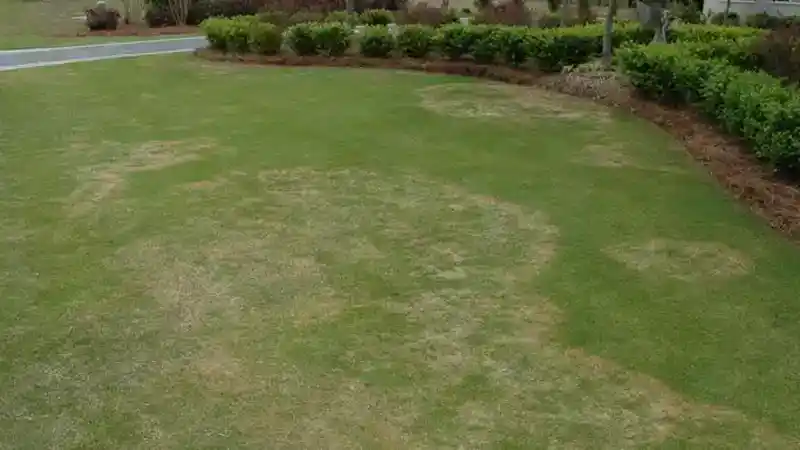
Your zoysia or centipede lawn comes out of winter with big circular dead rings – sometimes a foot across, sometimes ten – and the edges look orange or bronze in the morning. That is not winter kill, and it is not brown patch. That is large patch.
I get these calls every spring, and almost everyone Googles brown patch first and buys the wrong plan. Large patch is a different disease, on a different grass, in a different season. I deal with it personally too – I put in a zoysia lawn for family, and every spring green-up I am out scouting it, because zoysia is the grass this fungus hits hardest and the slowest to fill back in once it takes hold. Here is what it is, why your lawn has it, and how to actually stop it. Not sure what is wrong with your lawn? Start with our lawn diagnosis guide. On bermuda, don’t confuse it with spring dead spot, which shows as dead circles at spring green-up.
Key takeaways
- Large patch is the cool-weather fungus of warm-season lawns – zoysia, centipede, St. Augustine, and (less often) bermuda.
- It is NOT brown patch. Brown patch hits fescue in summer heat; large patch hits warm-season grass in the cool, wet parts of spring and fall.
- It infects in the fall, but you usually don’t see the damage until the lawn wakes up in spring.
- The fix is a fall preventive fungicide on the soil-temperature trigger – spraying in spring when you finally see it is too late.
- Bermuda usually grows right out of it. Zoysia and centipede are the ones worth treating.
What is large patch?
Large patch is a lawn disease caused by a soil fungus called Rhizoctonia solani. If that sounds familiar, it should – it is the same genus that causes brown patch on fescue. But it is a different strain, and it acts like a completely different disease: different grass, different season, different fix. It used to be lumped in with brown patch; the pros split it out and renamed it large patch to keep them straight. Other than the fact that they affect different grasses, there are important differences between brown patch and large patch. They occur at different times of the year and have different distinct symptoms. Caused by different strains of the same fungus Rhizoctonia solani, they require very different control strategies.
The fungus lives in the soil and thatch of basically every warm-season lawn. It flares up when the weather turns cool and wet and the grass is slowing down – going into dormancy in fall, or waking up in spring.
Large patch vs. brown patch – do not treat the wrong one
This trips up almost everyone, so here it is simple:
Large Patch | Brown Patch | |
|---|---|---|
Grass | Warm-season (zoysia, centipede, St. Augustine, bermuda) | Cool-season (tall fescue) |
Season | Cool, wet spring and fall | Hot, humid summer |
Fungus | Rhizoctonia (large-patch strain) | Rhizoctonia (brown-patch strain) |
If your fescue browns out in July, that is brown patch. If your zoysia or centipede comes out of winter with dead rings, that is large patch. Treating one for the other wastes your money and your season.
What large patch looks like
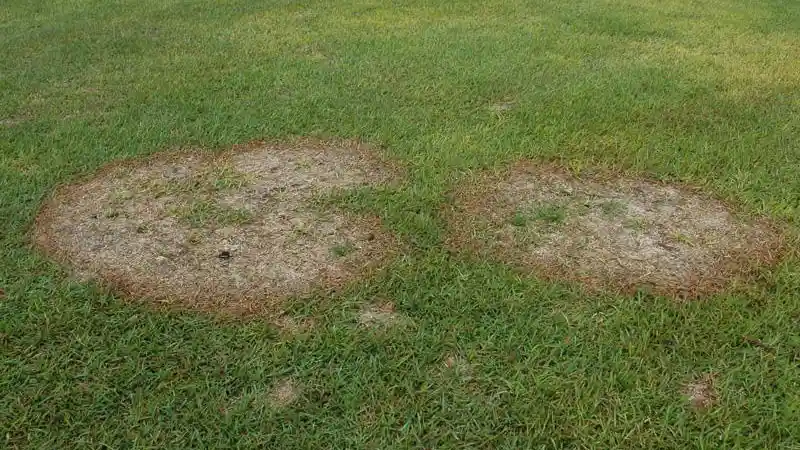
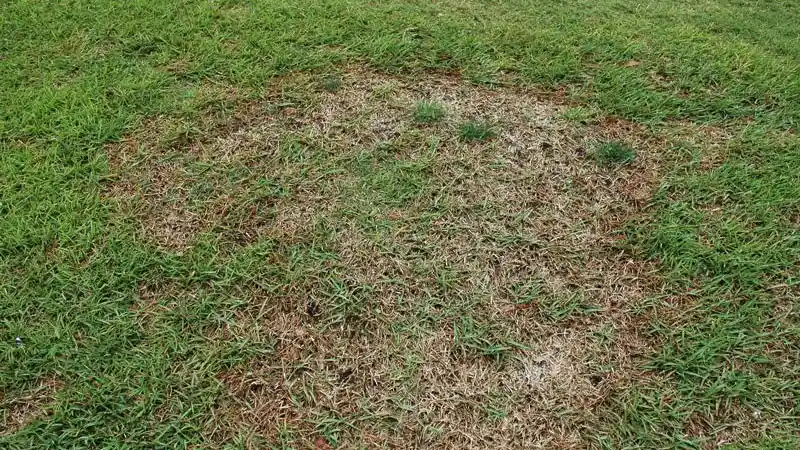
Look for roughly circular patches, tan to straw-brown, from a few inches to several feet across (larger if it has gone untreated). A few tells separate it from drought or winter damage:
• An orange, yellow, or bronze ring around the edge of the patch – that is the fungus actively working, and it shows best on a humid morning.
• Rotted leaf sheaths at the soil line. Tug a blade at the edge of a patch and it pulls free easily, with a dark, slimy, rotted base.
• A doughnut look – the center often greens back up while the ring keeps spreading outward.
The roots and crown stay fine – this is a leaf-and-sheath disease – which is why the lawn recovers once you get it under control.
Which grasses get it
Not all warm-season grass is equally at risk:
• Centipede and zoysia – the most susceptible. These get scarred every year, and they are the ones worth a real program.
• St. Augustine – susceptible.
• Bermuda – the tolerant one. Bermuda grows so aggressively that it usually outgrows large patch on its own, especially once it warms up and you feed it.
• Fescue and bluegrass – they do not get large patch at all. They get brown patch (the summer version) instead.
When large patch shows up in NC
Here is the part that fools people. Large patch is a cool-weather disease. It gets going in the fall when soil temperatures drop to around 70 degrees – in the Triangle that is usually September into October – and again in the cool, wet stretch of spring. Summer heat above about 85 degrees actually shuts it down (the fungus goes dormant, not dead).
The catch: it infects in the fall, but the damage often does not show until the lawn greens up in spring. So people see the rings in March or April and think it is a spring problem, when the fungus really set up shop six months earlier.

How to fix it – start with how you water and feed
Most of large patch is a management problem, and the cultural fixes are free:
• Ease off the nitrogen at the edges of the season. Do not push a warm-season lawn with fertilizer within about six weeks of fall dormancy or three weeks of spring green-up – soft, lush growth in cool weather is exactly what the fungus wants.
• Water in the morning, and only as much as the lawn needs. The disease needs the grass to stay wet; evening watering and overwatering feed it.
• Fix the drainage and the thatch. Low, soggy spots and thick thatch hold moisture and harbor the fungus. Core-aerate to relieve compaction and cut thatch, and fix any spot that stays wet.
• Mow at the right height, and do not mow through diseased patches into clean grass – you will spread it on the mower.
Do those and a tolerant lawn – especially bermuda – often never needs a fungicide.
Fungicide: it is all about fall timing
When a fungicide is worth it – mainly on zoysia, centipede, and St. Augustine – timing is everything, and here is the thing the internet buries:
The spray that matters goes down in the FALL, before you ever see a symptom. By the time the rings show up at spring green-up, the damage is already done – a spring-only spray is mostly closing the barn door after the horse is out.
The program that works is about three applications:
• Two in the fall, starting when soil temps drop to about 70 degrees (around 80 degrees for centipede and St. Augustine, which can be as early as mid-August), with a second app two to four weeks later.
• One in spring at green-up to clean up.
That fall-heavy, three-application approach is what actually protects the lawn.
DIY: what to buy at the big-box store
If you want to handle it yourself, here is what actually works off the shelf at the big-box store – and buy by the active ingredient, not the label art.
Product | Active ingredient | On large patch |
|---|---|---|
Scotts DiseaseEx | azoxystrobin | Good – easiest single product, widely stocked, granular |
BioAdvanced Fungus Control for Lawns | propiconazole | Good – the common liquid / hose-end option |
Headway G or Pillar | two modes (strobilurin + triazole) | Excellent – best result, and two modes fight resistance |
Spectracide Immunox | myclobutanil | Fair – weakest of the group; do not expect much |
Three things make or break a DIY treatment:
• Timing beats product. Put it down in the fall on the soil-temp trigger, not in spring when you see it.
• Liquid outperforms granular of the same active. If you use a granule, water it in with about a quarter inch of irrigation so it reaches the crown and thatch.
• Two modes of action (a Headway or Pillar type) will out-perform a single-active product and will not build resistance.
Honest note: the strongest fungicides for large patch are not labeled for homeowner use. A licensed applicator can run those on the correct fall schedule; the store shelf cannot. So the DIY ceiling is good, not best.
Will your lawn recover?
Yes, in most cases. Large patch is a leaf-and-sheath disease – it does not kill the roots or crown – so the grass grows back once the weather and the fungus settle down. Bermuda bounces back fast. Zoysia and centipede spread more slowly, so a bad case can leave thin spots that need plugging or reseeding in the growing season – and the real answer for those grasses is to prevent it next fall rather than chase it every spring.
When to call a pro vs. do it yourself
A lot of large patch is a DIY job – especially on bermuda, where the honest answer is usually fix your watering and thatch, feed it as it warms up, and skip the fungicide. You do not need me for that.
Where it is worth a call: a zoysia, centipede, or St. Augustine lawn that gets scarred every year, or one you want kept clean. That is a fall preventive program timed to soil temperature with products that actually rate excellent – exactly what a licensed applicator sets up. We are licensed to apply on turf in North Carolina, and getting the fall timing and the right chemistry on a susceptible lawn is the difference between a clean spring and another year of rings.
Not sure if it is large patch, brown patch, or something else? Text us a photo – text is the fastest way to reach us, at 984-284-5399 – and we will tell you what you are looking at and whether it is worth treating.
Frequently Asked Questions
Want a Pro to Handle It?
We are licensed to treat turf and ornamental plants across the Raleigh southern suburbs. Tell us what your lawn is doing and we will take it from there.
Sources
NC State Extension / TurfFiles – Large Patch in Turf
Clemson HGIC 2150 – Brown Patch and Large Patch Diseases of Lawns
Oklahoma State Extension – Large Patch / Zoysia Patch of Warm-Season Turfgrasses
UGA Extension – Identification and Control of Rhizoctonia Large Patch Our Bermuda and Zoysia lawn maintenance plan times preventive fungicide before large patch flares.
