

Types of Landscape Lighting: Path, Spot, Well, and Uplights
By Ken Erickson · Updated August 2026
Key Takeaways
- Landscape lighting breaks into a handful of fixture types — path, spot, well, flood, and step or deck lights — each built for a specific job.
- The effect matters more than the fixture: uplighting, downlighting (moonlighting), silhouetting, and grazing are techniques you create by where and how you aim the light.
- Low-voltage LED is the modern standard — safe, efficient, long-lived, and flexible — and it is what we install.
- Fixture material drives lifespan: solid brass and copper outlast aluminum and plastic and are worth it on a system meant to last.
- A good design layers a few fixture types for depth. More lights is not the goal; the right placement is.
What are the main types of landscape lighting?
Landscape lighting, outdoor lighting, exterior lighting, whatever you call it, breaks down into roughly nine workhorse fixtures. Here is the quick reference, then the detail underneath.
That table covers the field. The rest of this guide explains the choices people actually get stuck on.
| Fixture type | What it does | Best used for | Typical output |
|---|---|---|---|
| Path / area light | Casts a soft pool downward and out to the side | Walkways, driveways, garden bed edges | 100–200 lumens |
| Spotlight | Tight, aimable beam on one target | A specimen tree, statue, address stone, flag | 120–300 lumens |
| Flood light | Wide beam over a broad surface | House facades, large trees, wall washing | 700–1,300 lumens |
| Well light | Fixture sunk flush in the ground, beam shoots up | Uplighting columns, trees, high-traffic areas | 50–185 lumens |
| Uplight / downlight | Aims light up from below or down from above | Trees, walls (up); patios, beds (down) | 120–300 lumens |
| Moonlighting | Downlight placed high in a tree | Soft, natural light with leaf shadows | 120–300 lumens |
| Step / deck light | Low, shielded light at foot level | Stairs, deck posts, retaining wall caps | 12–100 lumens |
| Hardscape light | Thin fixture tucked under a cap or ledge | Retaining walls, seat walls, outdoor kitchens | 50–200 lumens |
| Bistro / string light | Overhead ambient glow | Patios, pergolas, gathering spaces | Varies |
| Security light | Bright, wide coverage, often motion-sensed | Side yards, garages, dark corners | 700–1,300+ lumens |
What is the difference between path lights and spotlights?
This is the most common question we get, and the answer is simple once you think about direction. A path light is built to light the ground. It sits on a stem, and a cap over the bulb pushes a soft circle of light down and outward so you can see where you are walking without staring into a glare. You space them along a walk or driveway, usually staggered, not lined up like runway markers.
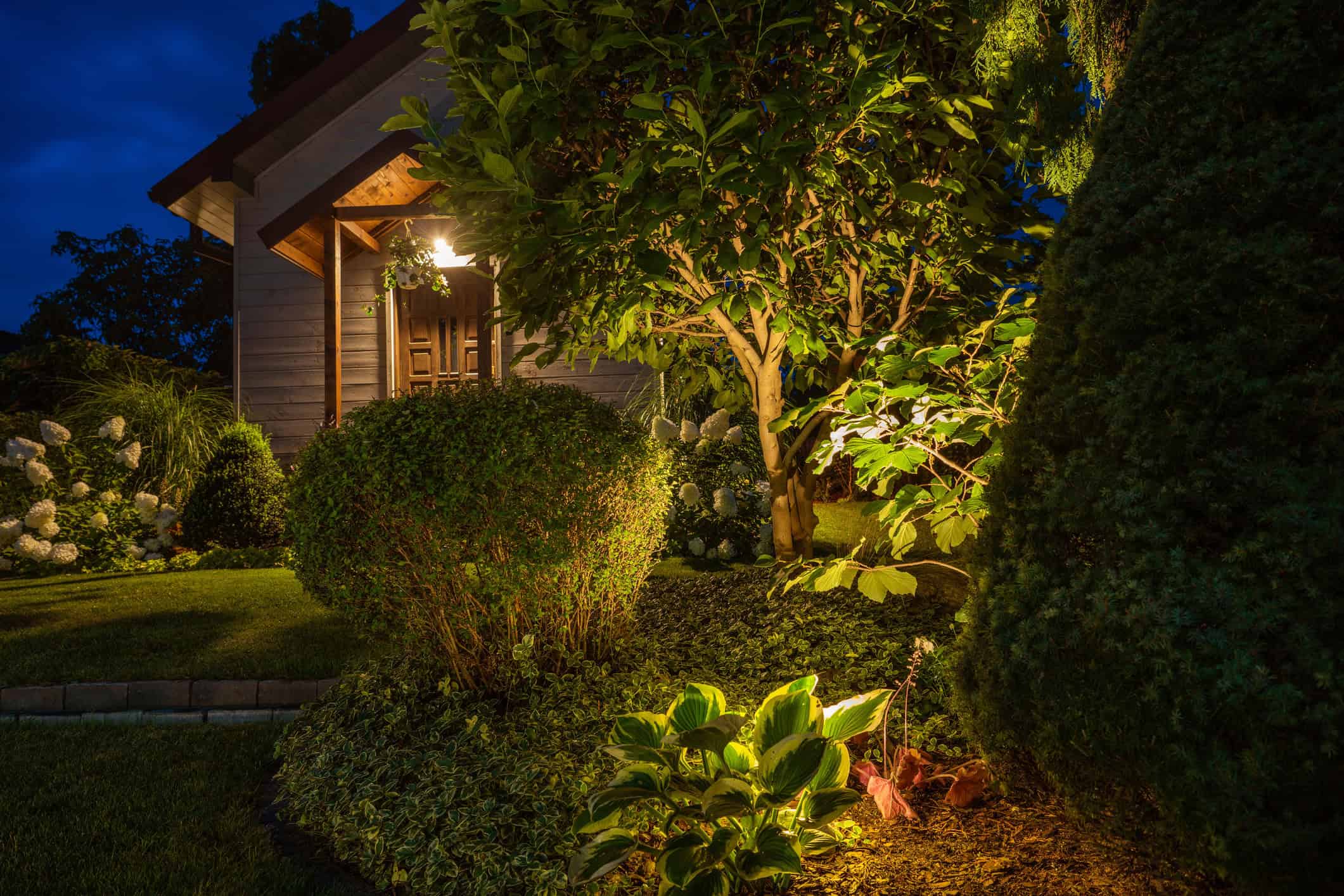
A spotlight does the opposite job. It throws a narrow, aimable beam at a single target, and you point it wherever you want the eye to land, a Japanese maple, a brick column, the house numbers. Path lights are meant to be seen; the fixture itself is part of the look. Spotlights are meant to disappear, tucked into a bed so you notice the tree, not the light. If you only remember one thing: path lights light the walk, spotlights light the feature.
What is a well light, and when should you use one?
A well light is a spotlight that lives in the ground. The housing is buried flush with the soil or mulch, and the beam shoots straight up, so there is no visible fixture at all during the day and nothing to mow around or trip over at night. That makes well lights the right call in two situations: high-traffic areas where a stemmed fixture would get kicked or run over, and clean modern facades where you want the light without seeing the hardware.
The trade-off is aim. Because a well light is fixed low and flush, it is best for straight-up uplighting, a column, a palm, a wall. When you need to angle a beam or reposition it later, an above-ground spotlight or well light with an adjustable knuckle gives you more flexibility. On most Triangle homes we use well lights out front where curb appeal and a clean daytime look both matter.
What are uplighting, downlighting, and moonlighting?
These are techniques, not fixtures, and they are where a lighting plan starts to look designed instead of assembled.
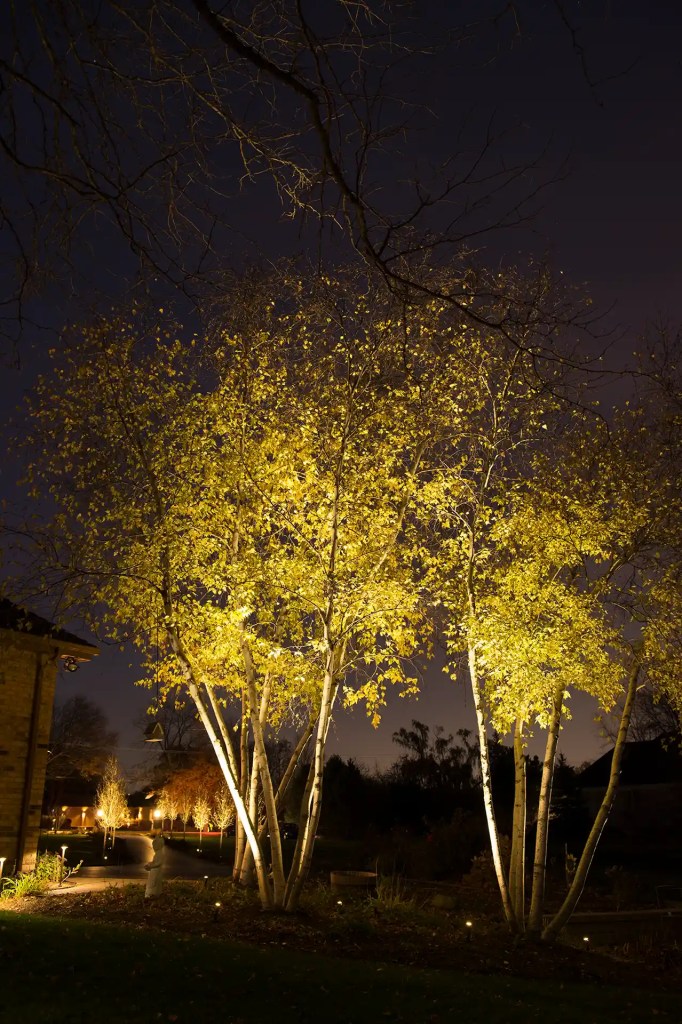
Uplighting means placing a fixture at or below ground level and aiming the beam upward. It is the classic way to light a tree trunk and canopy, a stone chimney, or a facade, and it creates drama because we almost never see landscapes lit from below in daylight. Downlighting flips that: the fixture sits up high, in a tree branch or under an eave, and washes light down over a bed, a walkway, or a patio. It reads as natural because it mimics the sun.
Moonlighting is a specific kind of downlighting. You mount soft fixtures high in a mature tree and let the beams filter down through the branches, so the ground picks up gentle light and dappled leaf shadows, the same effect as a full moon. It is one of the most beautiful things you can do with a big willow oak or river birch, and the Triangle has plenty of both. Most well-lit yards blend all three, uplight the specimen trees, downlight the paths, and moonlight one big canopy for depth.
Where do step, deck, and hardscape lights go?
These are the quiet safety and detail fixtures, and they matter more than people expect.
Step lights are small, shielded fixtures set into or beside stairs so you can see each tread without a bright source in your eyes. They belong on any run of exterior steps, deck stairs, and the transitions between grade changes that are common on our sloped clay lots. Deck lights do the same job on posts, railings, and along the deck perimeter.
Hardscape lights are thin bars or pucks tucked under a wall cap, bench, or countertop ledge so the light grazes down the stone face. They turn a plain retaining wall or seat wall into a feature and add a low, warm glow to outdoor kitchens. With so many homes here built on graded lots with block or stone retaining walls, hardscape lighting is one of the highest-impact upgrades we install, and one of the easiest to miss if a system was designed from a template.
Do you need flood lights and security lighting?
Flood lights and security lights overlap, but they are not the same thing. A flood light throws a wide, even beam and is a design tool, you use it to wash a broad house facade or light a large tree that a single spotlight cannot cover. Security lighting is about coverage and deterrence: bright, wide fixtures, often on motion sensors, aimed at side yards, garage approaches, and the dark corners where you want to see and be seen.
The mistake we fix most often is a yard lit only for security, one blinding motion light over the garage and nothing else. It creates harsh glare and hard shadows that actually make it easier to hide, not harder. A better approach layers low, even light across the whole property so there are no black spots, then adds a motion fixture where you genuinely need it. Good exterior lighting handles safety and looks intentional at the same time; it does not have to be one or the other. When you aim any bright fixture, shield it and point it down to keep light on your property and out of the sky and your neighbor’s windows.
Is low-voltage LED landscape lighting better?
For almost every home, yes. Low-voltage landscape lighting systems run on 12 volts through a transformer instead of household 120-volt current. That means the buried cable is safer to work around, the fixtures cost less to run, and you can add, move, or re-aim lights without an electrician for every change. Pair that with LED bulbs and you get long life, very low energy draw, and a beam you can dial in.
Two specs are worth caring about. Lumens set how bright a fixture is, path lights want roughly 100–200 lumens, tree uplights 120–300, and flood or security fixtures 700–1,300. Color temperature sets the mood: for landscape lighting, stay in the warm 2700K–3000K range. Anything cooler than that reads blue and clinical on a home. We install FX Luminaire fixtures, a low-voltage LED line, and we build the system around your house, your trees, and how you actually use the yard rather than a one-size kit.
When can you DIY landscape lighting, and when should you call a pro?
Here is the honest line. If you want a handful of path lights along a front walk, a plug-in low-voltage kit from the hardware store is a genuinely fine DIY project. Lay the fixtures, run the cable, set the timer, done in an afternoon.
Where DIY falls apart is a full design. Sizing the transformer to the load, splitting runs so the far fixtures do not dim, hiding cable under beds and lawns, aiming spots and wells so the fixture disappears and only the tree shows, and building it to survive our summer storms and clay, that is the part that separates a lighting system from a box of lights. It is also the part that keeps a system working for years instead of failing one zone at a time. If you want the front of your home to look designed, or you already have a system that has gone dark in spots, that is when it pays to bring us in. If you are weighing the investment first, here is what landscape lighting costs in North Carolina.
If you want the outside of your home to match the inside after dark, that is exactly what we do. We design and install low-voltage LED landscape lighting across the Triangle, and we repair and rework systems that have gone dark or dated. For a plan built around your house instead of a catalog, call or text (984) 284-5399.
Frequently Asked Questions
Ready to Light Up Your Landscape?
We design and install low-voltage LED lighting that highlights your home and yard the right way — the correct fixtures, placed and aimed for effect, built to last. Call or text (984) 284-5399 for a lighting quote.
