

What’s Growing in My Mulch? A North Carolina Guide to Mulch Fungus
By Ken Erickson · Updated June 2026
Every spring and after a warm Triangle rain, we get the same call: there’s something weird growing in my mulch – is it going to kill my plants or my kids? Short answer: almost never. The strange mushrooms, orange blobs, and little tar specks that show up in mulch are natural decomposers doing their job, and most are completely harmless. But one of them – artillery fungus – can permanently spot your siding and car, and that’s the one worth understanding. Here’s what actually grows in NC mulch, which ones matter, and how to keep the bad one out.
Key takeaways
- Most mulch fungi (mushrooms, stinkhorns, slime mold, bird’s nest fungus) live only on decaying wood – they do NOT harm living plants.
- The one to watch is artillery fungus: it shoots sticky black spores up to a second-story window that stick like tar to siding and cars, and there’s no fungicide that stops it.
- Our warm, humid NC climate – especially cool, shady, north-facing beds – is prime territory for these fungi.
- Prevention beats treatment: use bark-based mulch (not fresh wood chips), keep beds at 2 to 3 inches, and refresh mulch every year.
- Poisonous mushrooms are a real risk to small kids and pets – rake them out of play areas.
Is mulch fungus harmful?
For your plants, no. Every fungus and slime mold on this list feeds on dead, decaying organic matter – the wood in your mulch – not on living roots or stems. They won’t spread to your shrubs or lawn. The three real concerns are cosmetic (they look gross), safety (some mushrooms are toxic if a child or pet eats them), and property damage (artillery fungus only). So before you rip out a whole bed, know that in most cases the fungus is a sign of healthy decomposition, not a disease.
The 5 things that commonly grow in NC mulch
What you see | Harmful? | What to do |
|---|---|---|
Mushrooms | Harmless to plants; some toxic if eaten | Rake out of play areas |
Stinkhorns | Harmless (just smell) | Pull at the egg stage |
Slime mold (dog vomit) | Harmless | Scoop or rake up |
Bird’s nest fungus | Harmless | Leave it |
Artillery fungus | Stains siding and cars | Prevent – see below |
• Mushrooms: the classic. Dozens of species pop up in mulch, from tiny to several inches. Most vanish in a few days. They’re harmless to plants, but some are poisonous if eaten – rake them out where kids or dogs play.
• Stinkhorns: they start as a golf-ball-sized egg, then send up a stalk topped with a slimy, foul-smelling cap. The smell is the whole problem – they don’t hurt plants. Pull them at the egg stage before they open.
• Slime mold (dog vomit fungus): a bright yellow or orange slimy mass, sometimes a foot across, that seems to appear overnight. It looks alarming and it’s the one people photograph most – but it’s harmless and dries to a crusty powder. Scoop it out or rake it up.
• Bird’s nest fungus: tiny gray-brown cups that look exactly like miniature nests with eggs. Completely harmless, just unusual. No action needed.
• Artillery fungus: small, cream-to-orange cups that aim at light and shoot sticky black spore masses. This is the only one that damages property – covered next.

Artillery fungus: the one that actually causes damage
Artillery fungus (Sphaerobolus) is a wood-decay fungus that grows in moist mulch and does something the others don’t: it launches its black, sticky spore packets toward light – up to 15 to 20 feet, high enough to hit a second-story window. Those specks land on light-colored siding, foundations, fences, and cars, and they cling like tiny dots of tar. Scrape one off and it leaves a stain. There is no fungicide labeled to kill artillery fungus in mulch, and once the spots are on your siding they’re extremely hard to remove – which is exactly why prevention matters. In our climate it favors cool, damp, shady spots, so it usually shows up worst on the north side of the house.
How do I prevent artillery fungus in North Carolina?
You can’t spray it away, so you manage the mulch instead:
• Use bark-based mulch, not fresh wood chips. Artillery fungus feeds on wood. Pine bark, pine bark nuggets, and bark mulch are a far less favorable food source than hardwood chips.
• Refresh mulch every year. Beds that get a fresh top layer annually have noticeably fewer problems than beds left for two or three years to break down.
• Keep it from staying soggy. Don’t over-mulch (2 to 3 inches is right), and don’t keep beds constantly wet. Good drainage and airflow discourage the fungus.
• Blend in mushroom compost. Research shows mixing about 40% used mushroom compost into landscape mulch strongly suppresses artillery-fungus sporulation.
• Go inert near siding. For the north-facing beds right against light-colored siding, river stone or pea gravel eliminates the food source entirely.

How do I get rid of slime mold and mushrooms in mulch?
For the harmless ones, you don’t need chemicals – you need a rake:
• Rake and break up the surface. Disturbing the top layer dries it out and knocks back mushrooms, slime mold, and stinkhorns. A dry surface is a fungus’s worst enemy.
• Remove toxic mushrooms from play areas. Scoop them into the trash (not the compost) wherever children or pets roam.
• Ease up on water. Constantly damp mulch is what feeds all of this. Let the surface dry between waterings.
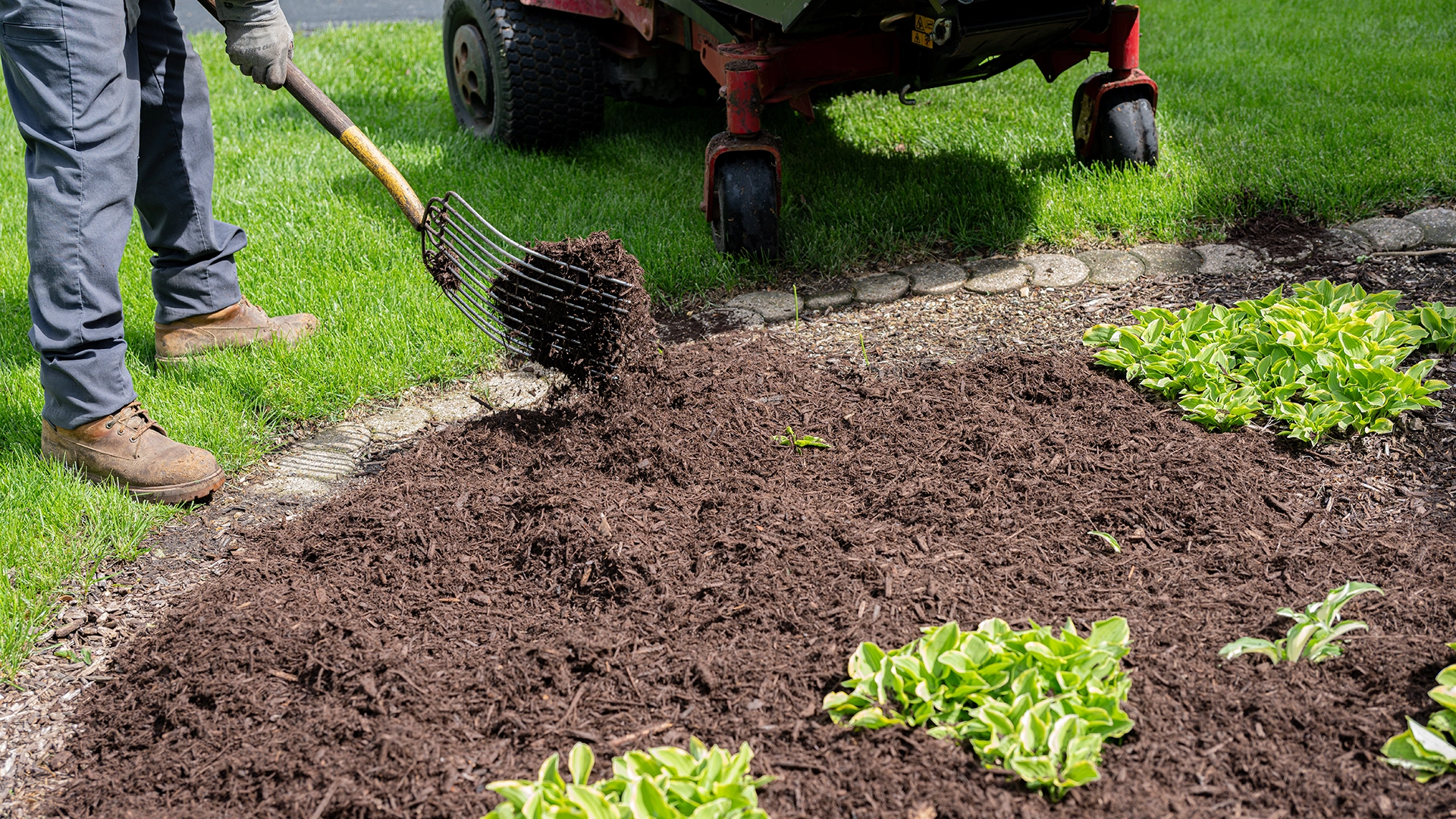
• Refresh, don’t just pile on. If a bed is matted and broken down, rake out the old mulch before adding new rather than burying the problem.
Why fresh mulch and the right depth matter
Almost every mulch-fungus problem traces back to the same two things: old mulch that’s been left to rot, and mulch piled too deep so it stays wet underneath. A clean bed at the correct 2 to 3 inch depth, refreshed each year, sheds water, breathes, and gives these fungi far less to work with – while still doing everything mulch is supposed to do: hold moisture for your plants, block weeds, and finish the beds. That’s the difference between mulch that works for you and mulch that grows science experiments.
Frequently Asked Questions
Get Your Beds Mulched Right
A clean, correctly mulched bed is the best defense against the funky stuff – and it keeps your plants healthier. Lawn Panther installs fresh mulch across the Triangle, edged and spread to the right depth. Call or text for a mulch quote.
Sources
Penn State Extension – What Is Growing in My Landscape Mulch? Mushrooms, Slime Molds, and Fungus
Penn State Extension – Solutions to Artillery Fungus
