

Why Is Evergreen Turning Brown? Needle Blight, Tip Blight, and Canker in NC
By Ken Erickson · Updated June 2026
An arborvitae turning brown is usually one of a few evergreen diseases — and most are treatable if caught early. Evergreens are the default privacy screen across Raleigh’s southern suburbs – drive through any neighborhood in Fuquay-Varina, Holly Springs, Apex, or Cary and you will see rows of them planted shoulder to shoulder along property lines. That is exactly why why is my Leyland cypress turning brown is one of the most common calls I get. Homeowners plant a beautiful green wall, and three or four years later a section browns out, then a whole tree, then a gap opens in the screen they paid for. Most of the time the culprit is a fungal needle blight or a canker disease – problems that thrive in the crowded, humid, poorly-drained conditions those tight rows create. But browning has a long list of possible causes, and treating the wrong one wastes money and time. This guide walks through what needle and tip blight actually are, how to tell them apart from the imposters, and what we do about it here in North Carolina.
Key takeaways
- A browning Leyland cypress, arborvitae, or juniper usually points to one of a handful of causes – and fungal needle blight and tip/canker diseases are the most common we diagnose on Triangle privacy screens.
- Needle blight browns foliage from the inside and lower canopy first, then works outward and upward; canker kills scattered branch tips with a sharp line between living and dead wood, often with cracked, resin-oozing bark.
- Crowded spacing, wet foliage, poor airflow, and drought stress are what tip these fungal diseases over the edge – the screen planted too tight is the classic setup.
- Not everything brown is disease: spider mites (bronze stippling), root rot on soggy soil, winter burn, and bagworms all mimic blight, so diagnosis comes first.
- Winter injury is actually uncommon on NC conifers, so do not assume cold snap – get eyes on the pattern before you spend money treating the wrong problem.
Arborvitae Turning Brown: What is needle blight and tip blight on evergreens?
Needle blight and tip blight are fungal diseases that infect the foliage and young stems of evergreens like Leyland cypress, arborvitae, and juniper. Needle blight – Passalora is the one we see most on Leyland cypress in North Carolina – attacks the needles themselves, usually starting on older, interior foliage and killing it in patches. Tip blight and the related canker diseases go after the branch tips and stems, girdling and killing everything past the point of infection. All of them are opportunists: the spores are almost always present, but they only take hold when the tree is crowded, wet, or stressed. Left alone, they spread up and through the plant and eventually open dead gaps in a screen. Because several of these fungi can be on the same tree at once, sorting out which one you are dealing with is the first real step.
What does needle and tip blight look like?
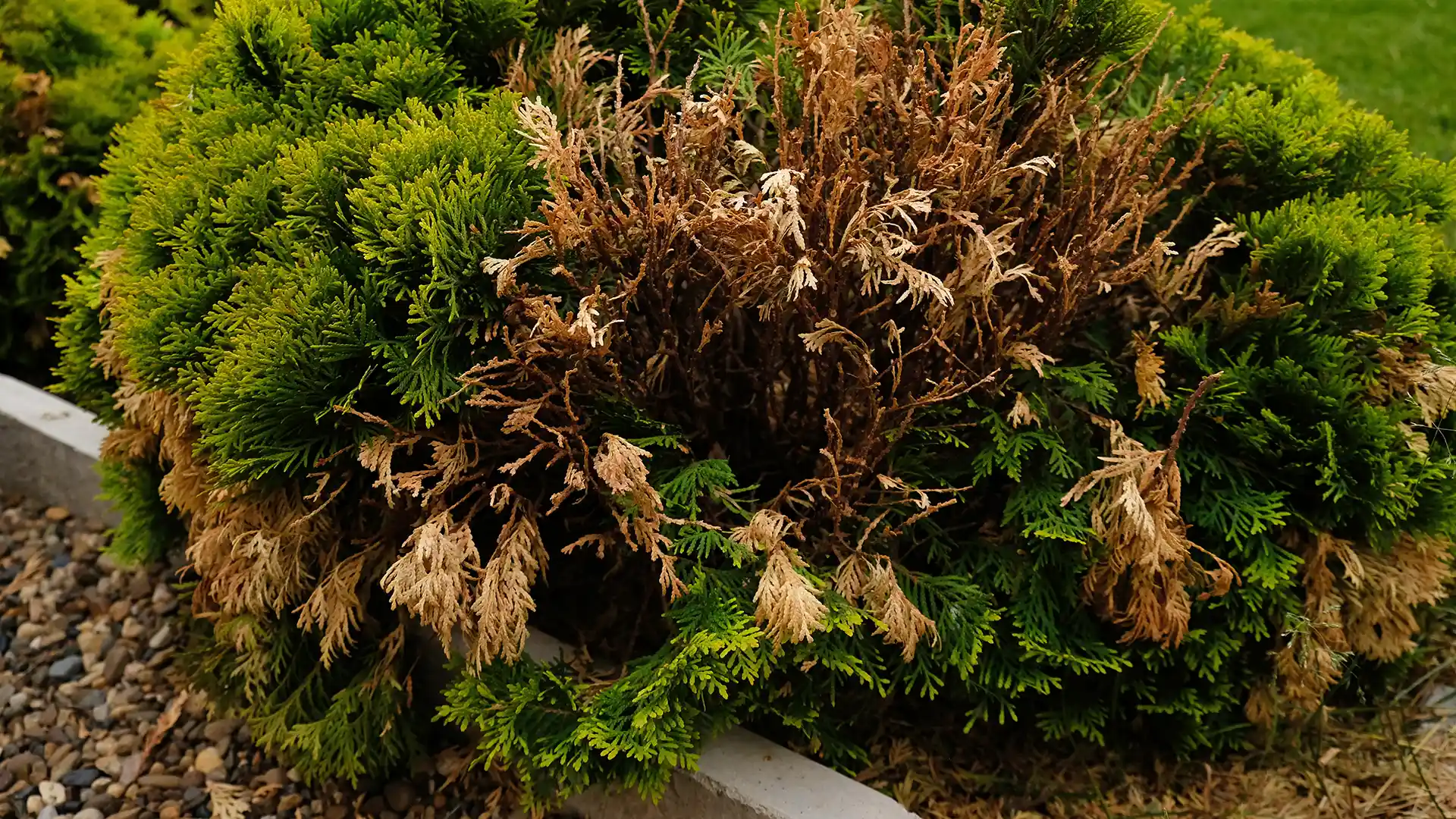
The tell-tale sign of needle blight is browning that starts on the inside and the lower part of the tree, then moves outward toward the branch tips and upward through the canopy – from a distance a mid-section of the tree can look scorched while the newest outer growth still looks fine. Canker and tip blight look different: scattered individual branch tips turn tan or orange and die, with a sharp, clean line between the living and dead wood rather than a gradual fade. On the stems you will often find cracked or sunken bark, sometimes with resin bleeding out of it, and tiny dark fruiting bodies of the fungus in the dead area. Needles killed by canker frequently hang on the branch instead of dropping. If you look closely at blighted Leyland foliage with a hand lens you can sometimes see faint tufts of olive-green spores – a diagnostic giveaway. Knowing which pattern you have points to whether you are fighting a foliage disease or a stem disease.
Cause | Where it shows first | What you see | What points to it |
|---|---|---|---|
Needle blight (fungal) | Interior and lower canopy, spreading out and up | Brown/dead needles in patches, older foliage first; faint spore tufts | Screen-wide pattern on Leyland; worse in crowded, humid, wet rows |
Canker / tip blight (fungal) | Scattered individual branch tips | Tips die tan or orange with a sharp line; cracked, resin-oozing bark | Random dying tips anytime of year; stress or drought history |
Spider mites | Anywhere, often whole-tree dull | Fine bronze or gray stippling, not clean brown; mites under a hand lens | Dull dusty color; hot dry spells; specks tap onto white paper |
Drought / root rot | Roots up; often whole-tree | Even browning and wilting; root outer layer slips off the core | Soggy or compacted soil, poor drainage, or a dry stretch |
Bagworms | Scattered, spreads fast | Stripped, thinning needles; cone-shaped bags hanging on branches | Visible bags; heavy summer feeding chews the foliage bare |

What causes needle blight and canker on Leyland cypress?
These are stress-and-moisture diseases, and the way Leyland cypress gets planted in North Carolina practically invites them. Trees crammed into a tight row have no airflow, so foliage stays wet after rain, dew, and irrigation – and wet foliage is exactly what these fungi need to infect. Overhead sprinklers, hedges that never dry out inside, and shade all make it worse. On the flip side, drought stress opens the door too: a tree fighting to get enough water drops its defenses and the canker fungi move in. Wet, poorly-drained soil is its own problem, weakening roots and stressing the whole tree. Pruning or shearing while the plants are wet spreads the spores from tree to tree down the entire row. In short, the disease is usually a symptom of a planting and care setup that is working against the tree.
Which NC evergreens get needle and tip blight?
In our area the big one is Leyland cypress, which is prone to Passalora needle blight plus Seiridium and Botryosphaeria canker – a triple threat that makes it the most disease-troubled screening evergreen in North Carolina. Arborvitae gets tip blight and canker too, though it is more often browned by spider mites, winter burn, and root rot than by needle blight specifically. Junipers and eastern redcedar are susceptible to their own tip blights, which brown and kill the young branch tips. Japanese cedar (Cryptomeria) – increasingly planted as a Leyland alternative – is comparatively tougher, and most of its twig dieback does not turn out to be an infectious disease at all. The point for a homeowner is that the same brown-evergreen complaint plays out differently by species, which is one more reason a real diagnosis beats guessing. That said, if you have got a long Leyland screen, needle blight and canker are the odds-on suspects.
Is it really disease, or something else?
This is the section that saves people money, because a lot of things brown an evergreen and only some are fungal. Spider mites cause a fine bronze or dull-gray stippling – not clean brown patches – and you can knock them off with a hand-lens check or a sheet-of-paper tap test. Root rot on soggy soil browns a tree fairly evenly and kills it from the roots up; a quick tug on a root, where the outer layer slips off the inner core, is a classic tell. Winter burn shows up on the windward or sunny side after cold, dry wind, but it is genuinely uncommon on NC conifers, so do not reach for it first. Bagworms strip needles and leave little cone-shaped bags hanging on the branches. Normal interior needle shed in fall – old foliage yellowing and dropping from inside – fools people every year and is nothing to treat. The pattern, the location, and a close look almost always separate these, which is exactly what a diagnosis is for. Pests brown out evergreens too — see our guides to sap-sucking pests (spider mites and adelgids) and leaf-chewing pests (bagworms), which are easily mistaken for blight.
How do you manage needle and tip blight: DIY or call a pro?
The foundation is cultural, and a homeowner can do a lot of it. Give the trees room and airflow – the single biggest fix is not planting them tight in the first place, and thinning or removing crowded trees helps an existing screen breathe. Water at the base, never overhead, and only when the tree needs it, so the foliage stays dry. Prune out dead and cankered wood well below the infection, and disinfect your tools between every cut and every tree so you are not spreading spores down the row. Keep the tree healthy and unstressed with proper mulching and drainage, since stress is what lets the fungi in. Where DIY hits its ceiling is diagnosis and any treatment program: telling needle blight from canker from mites from root rot on a 25-foot screen is hard, and there is no home cure that reverses an established canker – the goal shifts to slowing spread and protecting healthy growth. That is when it is worth having a licensed pro confirm what you have got and lay out a real plan. We are licensed by the state of North Carolina to work on trees and shrubs, and our background diagnosing and managing these evergreen diseases across the Triangle is extensive – if your screen is browning out, text us at 984-284-5399 and we will take a look before you spend money on the wrong fix. For a professional diagnosis and treatment, see our tree and shrub pest control service, or keep your evergreens healthy year-round with our tree and shrub maintenance plan.
Frequently Asked Questions
Your Leyland Cypress or Arborvitae Screen Browning Out?
A lot of things brown an evergreen, and the fixes differ. We diagnose whether it is needle blight, canker, mites, or root rot before you spend a dime. Text us for a look.
Sources
NC State Extension – Identification and Decision Guide for Cypress Problems
Clemson Cooperative Extension HGIC – Leyland Cypress Diseases and Insect Pests
NC State Extension – Leyland Cypress
NC Cooperative Extension (Lee County) – Problems With Leyland Cypress
