

The Different Types of Weed Control (and Which Your NC Lawn Actually Needs)
By Ken Erickson · Updated July 2026
The most effective weed control methods work together, not alone. Weed control is not one thing you buy in a jug. It is four different approaches, and the lawns that actually stay clean use them together. Most people reach for a bottle of weed killer and spray whatever is green, and then wonder why the weeds come back worse. Here is the honest breakdown of the types of weed control, what each is good for, and why timing matters more than the product you pick – especially here in North Carolina.
Key takeaways
- There are four families of weed control – cultural, mechanical, chemical, and organic – and a healthy lawn uses more than one.
- Chemical control splits two ways that matter: pre-emergent (stops seeds before they sprout) vs. post-emergent (kills weeds already up), and selective (spares your grass) vs. non-selective (kills everything).
- Timing beats product. In the Raleigh area, crabgrass germinates when soil hits about 55 degrees, so pre-emergent has to be down by late February – not spring.
- Weed ID and grass type decide the product. The wrong herbicide either misses the weed or burns your lawn.
- A real program – pre-emergent plus targeted post-emergent plus a thick, well-fed lawn – beats spot-spraying every single time.
The Main Weed Control Methods (and How They Work Together)
Four families, and each has a job:
Type | How it works | Best for |
|---|---|---|
Cultural (mow, feed, water, aerate) | A thick, healthy lawn crowds weeds out before they start | The foundation – prevention |
Mechanical (pull, hoe, mulch) | Physically removes or smothers weeds | Small patches, beds, spot weeds |
Pre-emergent herbicide | A barrier in the soil stops seeds as they germinate | Preventing crabgrass and poa annua – timed to soil temp |
Post-emergent herbicide | Kills weeds that are already growing | Weeds you can already see – dandelion, clover, nutsedge |
Selective vs. non-selective | Selective spares the grasses named on its label; non-selective kills everything | Selective on lawns; non-selective for beds and cracks |
Organic / natural | Weak pre-emergent or burns young tops only | Light touch-ups in beds and cracks, not a full program |
Cultural weed control: the foundation
This is the one everybody skips and it is the most important. A thick, dense, properly-fed lawn simply does not have room for weeds to move in – they need bare soil and sunlight to get started, and healthy turf denies them both. Mow at the right height for your grass, water deeply but not often, feed on schedule, and aerate – and overseed if you have fescue – to keep the stand thick. Get the cultural side right and you cut your weed pressure before you ever open a jug.
Mechanical and physical weed control
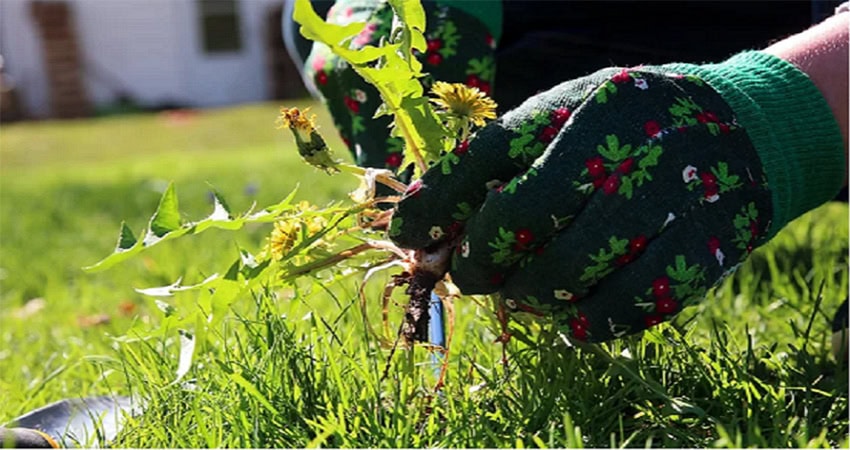
This is the hands-on stuff: pulling weeds, hoeing, and mulching beds to smother them. It works great on small patches of annual weeds, and in a bed a good layer of mulch is a real physical barrier that stops most weed seeds from sprouting. Where it fails is the perennials. Nutsedge rebuilds from tubers sitting in the soil, and pulling the top does not bring the tubers with it. Wild garlic – what most people call wild onion – grows from a bulb that NC State describes as covered with small bulbs which readily split apart, so digging it scatters them around the hole. Those two you treat, on the right timing, rather than pull: NC Cooperative Extension puts the window for wild onion and wild garlic at a 2,4-D application in March and again in October, while the plants are actively growing.
Chemical control: pre-emergent vs. post-emergent
This is the core of a real program, and the split matters. Pre-emergent lays down a barrier in the top layer of soil that stops weed seeds as they try to germinate – it prevents weeds, but it cannot kill one that is already up. Post-emergent kills weeds that are already growing, but it does nothing to stop the next batch of seeds. That is why you need both: pre-emergent to prevent, post-emergent to clean up what slips through.
Selective vs. non-selective, contact vs. systemic
Two more distinctions that keep you from killing your own lawn. Selective herbicides target the weeds and leave your grass alone – but read that word carefully, because selective means selective for the grasses named on that product’s label, not for grass in general. Every label lists the turf it is cleared for. Here in the Triangle bermuda and tall fescue sit on the same street, and a product cleared for bermuda can thin or kill tall fescue outright. Match the label to your grass before you match it to the weed. Non-selective herbicides like glyphosate kill anything green, so they are for beds, cracks, and renovations, never broadcast across a lawn.
Then there is contact versus systemic. Contact kills only the tissue it touches – fast, and fine on young annual weeds. Systemic moves through the whole plant down to the root, which is what you need for the perennials like nutsedge and wild onion that laugh at a surface burn. Picking the right one for the weed – and for your grass – is exactly where someone who does this every day makes the difference. If you are weighing a pro program against doing it yourself, here is whether professional weed control is worth it.

Pre-emergent timing in North Carolina
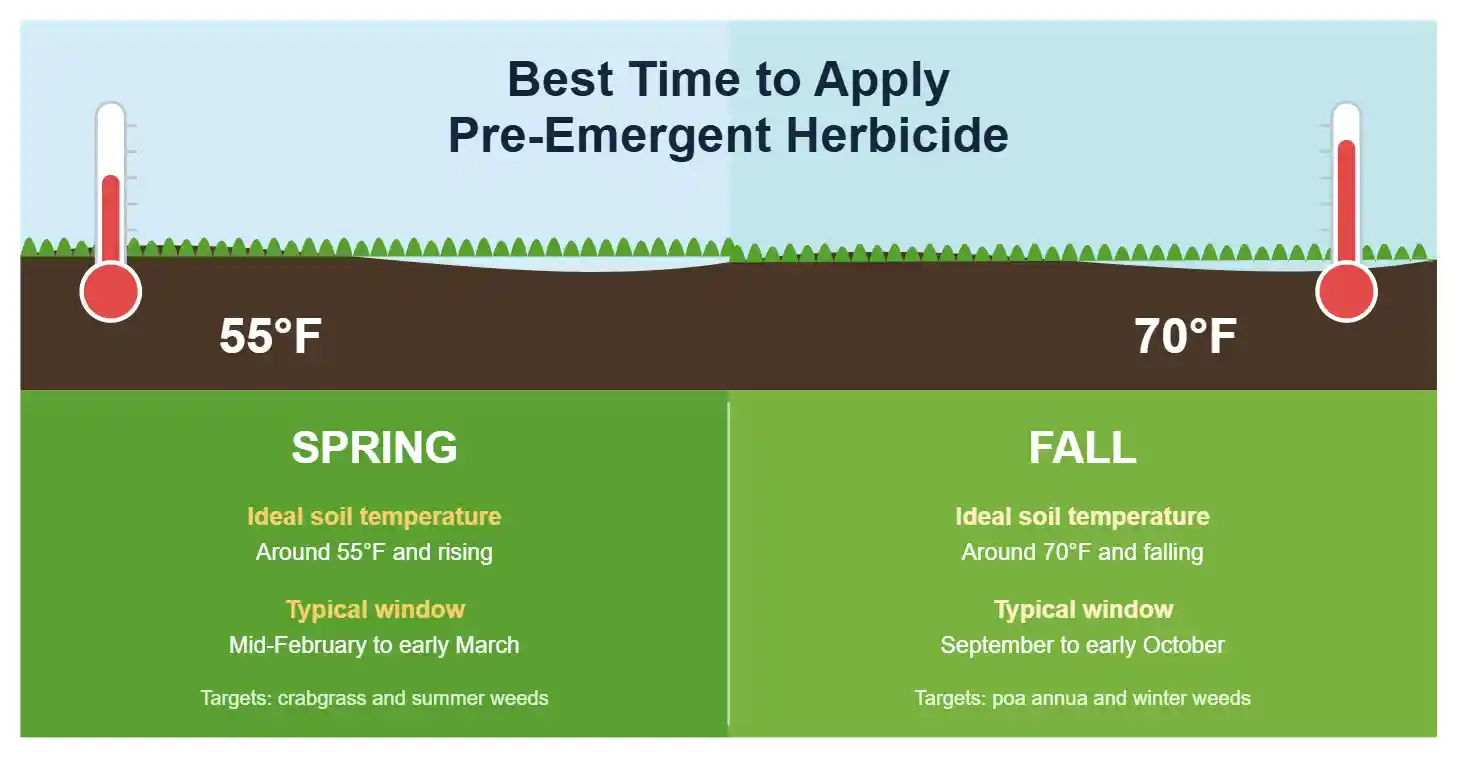
Here is the local detail that decides the whole year: pre-emergent is about soil temperature, not the calendar. Crabgrass germinates when the soil holds around 55 degrees for a few days, and once it sprouts your pre-emergent is too late. In the Raleigh area that means the pre-emergent needs to be down by the end of February – a little earlier east of us, early March out in the western Piedmont. Our winters have been warming, and crabgrass has been caught germinating in February in Wake County, so if anything you go earlier, not later.
A second pre-emergent in fall targets poa annua, the winter weed. Watch the collision on that one. In North Carolina the fall pre-emergent window and the fescue overseeding window are the same September weeks, and a standard pre-emergent stops your fescue seed right along with the poa. If you are overseeding fescue, skip the pre-emergent in the seeded area and come back to it once the new grass is established. On bermuda and zoysia there is no conflict – you are not seeding warm-season grass in the fall – so the fall round is a straight call. Miss the window and you spend the summer fighting weeds you could have prevented. If you have bermuda and you want the whole year laid out with dates and products, this is what a pro puts down on his own bermuda lawn.
Organic and natural weed control (and its limits)
I will be straight about this because a lot of marketing is not. Corn gluten meal is a weak pre-emergent – it can help a little, but it takes two or three seasons to build up and it will not kill an existing weed. Horticultural vinegar burns the tops off young annual weeds but does not touch a perennial root, so they regrow. It is also completely non-selective, and it is a registered pesticide with a label on it – the 20 percent horticultural strength is a far more corrosive product than the 5 to 10 percent bottle in your kitchen, and either one will burn your turf as fast as it burns the weed. Keep it on bed edges, cracks, and gravel, not out on the lawn. These have a place at the margins, and hand tools plus a thick lawn are legitimately organic. But none of it replaces a real program on a lawn that is already weedy – be honest with yourself about the size of the problem. Two of the summer weeds homeowners mix up most are broken down in our guide on how to identify and kill crabgrass and nutsedge.
Why a program beats spot-spraying
Put it together and the picture is clear: a thick, healthy lawn, pre-emergent down on the right soil temperature, and targeted post-emergent for what gets through – that combination gets you fewer weeds every year. Spot-spraying only reacts to what you can already see, and it never gets ahead of the seed bank. That is what our weed-control program is built to do – the right products, on the right timing, matched to whether you have bermuda, zoysia, or fescue – so you are preventing weeds instead of chasing them. We run it across Raleigh’s southern suburbs, including weed control in Holly Springs and Garner. If you would rather not track soil temperatures and herbicide types yourself, that is the whole point of the program. Text us at 984-284-5399.
Frequently Asked Questions
Want Weeds Prevented, Not Chased?
Our weed-control program puts the right products down on the right timing – pre-emergent by soil temperature, targeted post-emergent, and a thick lawn – matched to whether you have bermuda, zoysia, or fescue. Text us for a quote.
Sources
NC State TurfFiles – Timing of Preemergent (PRE) Herbicide Applications: Apply Earlier
NC State Extension – Smooth Crabgrass
NC State Extension Gardener Handbook – Integrated Pest Management
NC State TurfFiles – Weeds in Turf
NC State Extension – Yellow Nutsedge
NC State Extension – Wild Garlic
N.C. Cooperative Extension – Wild Onion and Wild Garlic in the Lawn
