

How to Fertilize a Crepe Myrtle Tree in NC
By Ken Erickson · Updated August 2026
Crepe myrtles are one of the toughest, lowest-maintenance trees we plant in the Triangle — and one of the easiest to hurt with a bag of fertilizer. They’re light feeders. Most established trees in our clay need one modest feeding a year, and some need none at all. If you want the full rundown on keeping them healthy, start with our guide to crepe myrtle care in NC; this article is just about feeding them.
Key Takeaways
- Crepe myrtles are light feeders. In our clay, most established trees need one modest feeding a year — sometimes none.
- Use a balanced fertilizer (8-8-8 or 10-10-10) in early spring, after the tree leafs out — usually mid-to-late April here.
- More nitrogen does not mean more blooms. Heavy feeding gives you leaves, fewer flowers, and tender growth that winter burns.
- Soil test first — North Carolina’s is free through the state and tells you what, if anything, the tree actually needs.
- I feed with a drill-and-fill, but you can get the same result at home by broadcasting and watering in. You do not need a $3,000 injection rig.
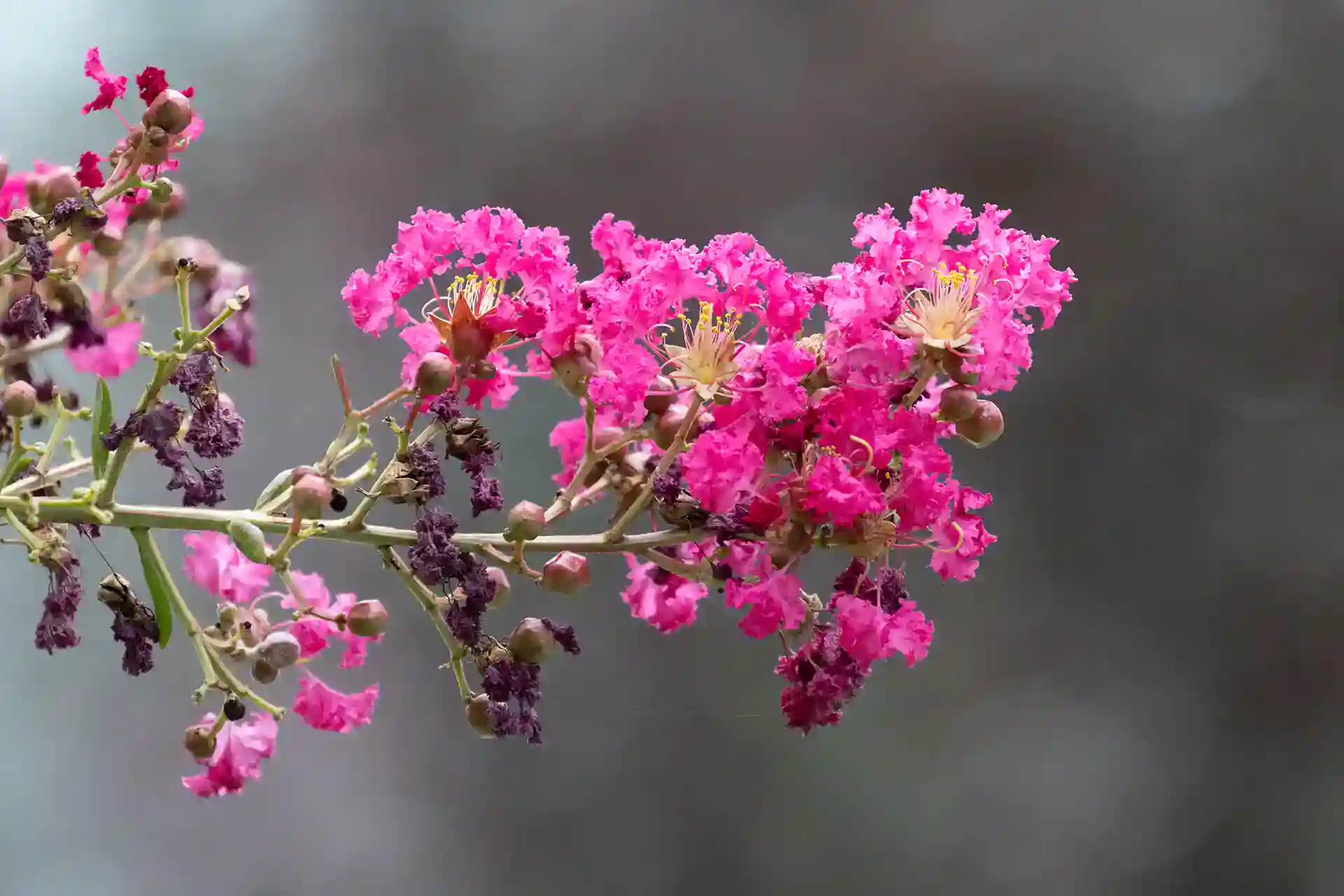
Do crepe myrtles even need to be fertilized?
Less than you’d think. A crepe myrtle is one of the toughest, lowest-maintenance trees we plant in the Triangle — it thrives in our heavy Piedmont clay on very little. NC State Extension’s line on it is basically two light feedings of a complete fertilizer in spring and summer, and a healthy, established tree that’s blooming and growing fine may not need feeding at all.
So before you buy anything, look at the tree. Good color, steady growth, a heavy set of blooms in July? Leave it alone. Pale leaves, weak growth, thin flowering? Then it’s worth feeding — but the right way, at the right time, with the right amount. Guessing is how people hurt these trees.
Question | The short answer |
|---|---|
What fertilizer? | Balanced 8-8-8 or 10-10-10 — skip the “bloom booster.” |
When? | Early spring, after leaf-out — mid-to-late April in the Triangle. |
How much (established)? | About 1 lb per 100 sq ft, once in spring. |
How much (young)? | About 1 tsp per plant, monthly, April–August. |
When to stop? | By mid-summer — never late summer or fall. |
Where? | Under the canopy, off the trunk, then water it in. |
What fertilizer should you use on a crepe myrtle?
A balanced, complete fertilizer — an 8-8-8 or a 10-10-10 — is exactly what you want. Those three numbers are nitrogen, phosphorus, and potassium; balanced just means they’re roughly even. That’s the workhorse for crepe myrtles, and it’s cheap and available anywhere.
Skip the bloom-booster products with a huge middle number. This is the single biggest myth I run into: people think more fertilizer, or a special high-phosphorus formula, means more flowers. It doesn’t. Crepe myrtles bloom because they get full sun and the right variety, not because you fed them harder. Overly fertile soil pushes leaves at the expense of flowers, and a slug of nitrogen late in the year forces soft growth that our winters kill back.
One honest note on soil: if your crepe myrtle’s newer leaves are yellow with green veins, that’s usually not a fertilizer shortage — it’s pH. In alkaline soil, iron locks up and the tree can’t use it. The fix there is a soil test and maybe some sulfur, not a heavier dose of 10-10-10.
When do you fertilize crepe myrtles in North Carolina?
Early spring, once the tree has leafed out — for us in the Triangle that’s usually mid-to-late April. This is the part the national articles get wrong for our area: our crepe myrtles leaf out later than the ones in the Deep South, so the feed-in-early-spring advice has to be anchored to your tree waking up, not a calendar date. Wait until you see new growth.
If you feed twice, a second light application in early summer is fine. But stop by mid-summer. Do not fertilize a crepe myrtle in late summer or fall — late-season nitrogen forces a flush of tender growth right when the tree should be hardening off for winter, and that growth gets burned by the first hard freeze. NC State specifically warns that heavy nitrogen makes them flower less and produces shoots that take winter injury.
How much fertilizer does a crepe myrtle need?
Not much, and less is safer than more. Two rough guides cover most yards:
Young or newly establishing trees: about a teaspoon of balanced fertilizer per plant, once a month through the growing season (roughly April through August). Small, steady, and gentle.
Established trees and shrubs: about 1 pound of 8-8-8 or 10-10-10 per 100 square feet of the area under the canopy, once in spring.

Keep the fertilizer off the trunk — spread it under the branches where the feeder roots are, not piled at the base. And if you’re planting a new one, never put fertilizer in the planting hole; you’ll burn the young roots. Feed it the following spring, after it’s rooted in.
Whatever you put down, water it in. Fertilizer sitting dry on the surface doesn’t do anything — it has to move down into the root zone.
How I actually feed them: drill-and-fill (and the DIY version)
Here’s how we do it, and how close you can get on your own.
How I do it — drill-and-fill. I put the fertilizer down where the roots are, not on top of the grass that’s competing for it. I drill a grid of holes about 8 to 12 inches deep, spaced roughly a couple feet apart, in a ring from the trunk out to a little past the branch spread — that’s where the feeder roots actually are. I split the measured fertilizer evenly between the holes and water it in. The holes get the food past the turf and down to the roots, and they loosen the soil a little while I’m at it.
The DIY version — you don’t need my equipment. Broadcast and water in: if the ground under the tree is mulched or bare, just spread the measured amount of granular 8-8-8 or 10-10-10 evenly under the canopy with a hand spreader and water it in well. Extension calls this economical and effective, and for most homeowners it’s all you need.
Or drill it yourself: if the tree sits in the lawn and you want the food to reach the tree instead of the grass, drill the same grid of 8-to-12-inch holes with an auger bit or a punch bar, divide the fertilizer between them, and water. It’s a little labor, but it’s the exact same method I use.
If this sounds like more work than you want to do, that’s what we’re for — text Aidan at (984) 284-5399 and we’ll fold it into our next round.
What about deep-root injection — isn’t that better?
You’ll see the big companies sell deep-root injection as a premium, and it sounds impressive — a probe in the ground, fertilizer pushed in under pressure. Here’s the straight truth, and I’ll stand on it: injection is not proven to feed a tree any better than drilling holes or broadcasting and watering in. It’s faster and easier for a crew to run, and it’s easy to charge a premium for a machine — but the university research (NC State, Virginia Tech, ISA, and a peer-reviewed review of the field) all lands in the same place: surface and drilled applications work as well as injection.
Two reasons it doesn’t out-perform, especially here. A crepe myrtle’s feeder roots are shallow — the top six to eight inches — so injecting at eight to twelve inches often shoots under the roots you’re trying to feed. And in our heavy clay, pressurized liquid mostly follows the probe hole and the cracks; it doesn’t spread through tight clay any better than fertilizer washing down from a drilled hole. You need a slow leach, and clay gives you that either way.
So don’t pay a premium for injection thinking it feeds better — it doesn’t. It just lets a company treat more trees per hour. I broke the whole injection-versus-drilling question down in how to fertilize a tree or shrub.
Feeding, health, and crepe myrtle bark scale
One reason to keep feeding sensible rather than heavy: a vigorous, properly-fed crepe myrtle shrugs off stress better, and the biggest stress we’re watching in the Triangle right now is crepe myrtle bark scale — the white, crusty stuff on the bark that leads to black sooty mold. Proper feeding keeps the tree healthy; it does not cure scale, and dumping on extra fertilizer won’t help. If you’re seeing white felt around the branch collars or black film on the leaves, that’s a pest problem to treat, not a feeding problem — here’s how we handle crepe myrtle bark scale.
Feed it right and a crepe myrtle will run for decades with almost no help. If you’re also fighting shoots at the base, that’s a separate job — here’s how to stop crepe myrtle shoots and suckers. And here are the questions we get most about fertilizing them.
Frequently Asked Questions
Ready to Hand Off Your Crepe Myrtle Feeding?
We fold crepe myrtle and tree-and-shrub feeding into our regular rounds — done right, at the right time, at the right rate — so you never have to think about the timing. Call or text (984) 284-5399 for a quote.
Sources
- NC State Extension — Crapemyrtles for North Carolina
- NC State Extension Gardener Plant Toolbox — Lagerstroemia
- NC State Extension — A Gardener’s Guide to Fertilizing Trees and Shrubs
- NC Cooperative Extension (Sampson County) — Crape Myrtles
- NC State Entomology — Time to Scout for Crape Myrtle Bark Scale
