

Best Mowing Height for Tall Fescue in NC
Key takeaways
- The best mowing height for tall fescue in the Triangle is 3 to 3.5 inches most of the year, and 3.5 to 4 inches through the summer heat.
- Follow the one-third rule: never cut off more than a third of the blade in a single mow.
- Tall fescue is a cool-season grass, so it needs the opposite mowing strategy from Bermuda and Zoysia.
- Mow higher, not lower, in summer. Taller turf shades the soil, holds moisture, and fights off brown patch.
- Keep the blade sharp and leave the clippings on the lawn.
Is tall fescue a warm-season or cool-season grass?
Tall fescue is a cool-season grass. That one fact changes everything about how you cut it. It does its best growing in the mild stretches of spring and fall, it slows down and struggles in July and August, and it stays green through our mild winters. Our month-by-month fescue calendar lays out what the lawn needs in each of those stretches. That is the opposite of Bermuda and Zoysia, the warm-season grasses that thrive in summer heat and go dormant and brown after the first hard frost. Warm-season grass is the opposite story — here’s the best mowing height for Bermuda grass and for Zoysia grass.
Because we sit in the transition zone here in central North Carolina, you will find both types on the same street, sometimes on the same property. It matters for mowing: warm-season lawns get cut low and tight, while cool-season fescue gets cut tall. If you are still deciding which grass belongs in your yard, we break down the trade-offs in our guide to Bermuda versus fescue for Triangle lawns. Cut your fescue like it is Bermuda and you will punish it right when the weather is already working against it.
What is the best mowing height for tall fescue in NC?
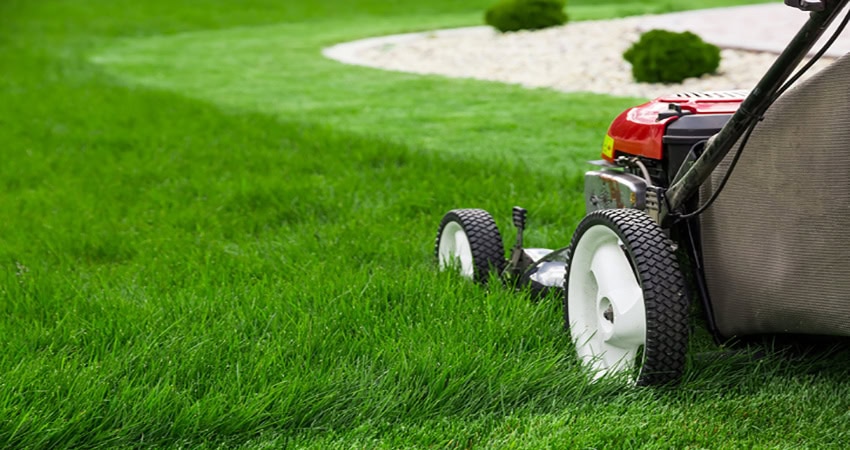
For a Triangle lawn, hold tall fescue between 3 and 4 inches year-round, and let the season set where you land in that range. Cutting on the taller end grows deeper roots, shades out crabgrass and other weeds, and keeps the soil cooler. Here is the schedule I use, built on NC State’s mowing guidance and adjusted for our summers:
A few notes on the numbers. NC State recommends mowing tall fescue to 2.5 to 3.5 inches in spring and fall and to 3.5 inches in summer, cutting before the grass tops 5 inches. I push the summer number to 3.5 to 4 inches on purpose, because our heat and humidity are harder on fescue than the statewide average, and the extra height pays off. Set your deck once with a tape measure on a hard surface, then leave it. Guessing by eye is how lawns end up scalped.
Newly seeded or freshly sodded fescue is the exception. Let it reach about 4.5 inches before the first cut, then bring it back to 3.5 inches maximum, and use a sharp blade so you tear nothing. If you seeded last fall, our guide on when to aerate and overseed in North Carolina covers the timing that gets you there.
Season | Months | Mowing height | Notes |
|---|---|---|---|
Spring | March – May | 3 – 3.5 in | Growth is fast; mow more often to keep up |
Summer | June – August | 3.5 – 4 in | Raise the deck; never let it top 5 in before you cut |
Fall | September – November | 3 – 3.5 in | Prime growing season; the recovery window |
Winter | December – February | 3 – 3.5 in | Growth slows; mow only as needed |
Why should you mow fescue higher in Triangle summer heat?
This is the part homeowners get backward. When July hits and the lawn is stressed, the instinct is to cut it shorter so you can mow less often. With fescue, that is exactly wrong.
Taller grass shades the soil surface. Cooler soil holds moisture longer, so the lawn dries out slower and needs less water. Taller blades also mean deeper roots, and deeper roots reach moisture that a shallow-rooted, scalped lawn never touches. Cut fescue short in August and you bake the crown of the plant, invite crabgrass into the thin spots, and set up the disease that does the most damage here: brown patch. If crabgrass has already crept into the thin spots, here is how to identify and kill crabgrass and nutsedge.
Brown patch is a fungal disease that loves exactly what our summer nights deliver — heat plus humidity. Fescue kept too short and too wet is its favorite target. Mowing higher, watering deep but infrequent, and keeping the blade sharp all cut your brown patch risk. This is where a background in turf management earns its keep; we know the diseases and how to head them off before they thin your lawn. That summer stress is also why fescue in our region needs a dialed-in feeding schedule, which we lay out in our complete guide to fertilizing your lawn in North Carolina.
What is the one-third rule, and why does it matter?
The one-third rule is the most important habit in mowing: never remove more than one-third of the grass blade in a single cut. If your fescue is sitting at 4.5 inches, the lowest you should take it is 3 inches. Take more and you shock the plant.
Cutting off too much at once removes the leaf tissue the grass uses to make food. The plant reacts by pushing energy into new blades instead of roots, so you get a shallow root system right when it needs depth. You also expose stems and soil to the sun, which dries out the lawn and opens the door to weeds.
In spring and fall, fescue grows fast enough that obeying the one-third rule may mean mowing weekly, sometimes more. That is normal. It is better to mow twice in a busy growth week than to let the lawn get shaggy and then scalp it back in one pass. If mowing on that schedule is not realistic, our lawn mowing service keeps it on rhythm for you.
What happens if you scalp tall fescue?
Scalping is cutting so low you expose the stems and crowns, leaving a pale, stubbly lawn. On fescue it is genuinely damaging. Scalped fescue loses its ability to shade and cool the soil, dries out fast, and thins into bare patches that crabgrass and summer weeds move right into.
Scalping usually happens one of three ways: the deck is set too low, the lawn got too tall between mows and someone took it all off in one cut, or the mower wheels dropped into a low spot or rut. A few fixes: measure your deck height instead of guessing, keep to a schedule so the grass never outruns the one-third rule, and consider addressing bumpy, rutted ground. Compacted red clay makes ruts worse, and core aeration helps both the soil and the surface. Warm-season lawns actually get scalped on purpose in early spring — but that is a Bermuda and Zoysia move, never fescue. See our Bermuda mowing height guide for how that side works.

Do sharp mower blades really matter?
Yes, more than most people think. A sharp blade slices the grass cleanly. A dull blade tears and shreds it, leaving a ragged edge that dries out and turns the lawn a grayish-tan a day or two after you mow. Those torn tips are also open wounds, and open wounds are how disease gets in — a real concern with brown patch already lurking in our summers.
Sharpen or swap your blade at least once a season, and more often if you mow a large lawn or hit sand and debris. Here is a quick field test: look at the grass tips a day after mowing. Clean, flat cuts mean the blade is sharp. Frayed, whitish, shredded tips mean it is time to sharpen. It is a small piece of maintenance that visibly changes how the lawn looks.
Should you bag or mulch your fescue clippings?
Leave them on the lawn. Grasscycling — mulching the clippings back into the turf instead of bagging them — returns nitrogen and organic matter to the soil and can cut your fertilizer needs by up to a quarter. As long as you are mowing on schedule and following the one-third rule, the clippings are short, break down fast, and do not contribute to thatch.
There is one exception worth knowing. If your lawn has an active disease outbreak like brown patch, bag the clippings while it is running to avoid spreading spores across the yard, then go back to mulching once the lawn recovers. Grasscycling is one of the easiest wins in lawn care: less work for you, free feeding for the grass.

When can you DIY this, and when should you call a pro?
Mowing is one of the most DIY-friendly jobs in lawn care, and I will tell you that plainly. If you own a mower with an adjustable deck, a tape measure, and twenty minutes a week in the growing season, you can hold the right height yourself. Set the deck, keep the blade sharp, follow the one-third rule, and mulch the clippings — that alone puts you ahead of most lawns in the neighborhood.
Where a pro earns the call is the part mowing cannot fix. If your fescue keeps thinning no matter how well you cut it, if brown patch comes back every summer, or if weeds are winning the bare spots, the problem is usually disease, soil, or a feeding and pre-emergent schedule that is off — not your mowing. That is our lane. We are licensed by the state of North Carolina to apply herbicides and pesticides on turf and ornamental plants such as shrubs and trees, and we treat every lawn like it is our own. We are not just another landscaper; we know the diseases and the treatments, and we make the outside of your home match the inside.
Ready for a fescue lawn that stays thick through summer?
Mowing at the right height is the foundation, but a truly full fescue lawn in the Triangle also needs the right feeding, disease control, and overseeding — done on schedule and matched to our soil and climate. That is exactly what our expert fescue lawn maintenance plan delivers, and we tailor it to your yard here in Fuquay-Varina, Holly Springs, Apex, Cary, and across South Raleigh. Want a straight answer on what your lawn needs? Get a fast quote, or call or text us at (984) 284-5399.
Frequently Asked Questions
Not Sure Your Deck Height Is Right?
I set the deck by the season, not by habit — 3 to 3.5 inches most of the year, 3.5 to 4 through the summer heat. Call or text us at (984) 284-5399.
Sources
