

How Does Weed Control Work? What Actually Happens When You Treat a Lawn
By Ken Erickson · Updated July 2026
So how does weed control work? It is not one thing — it is several tools doing completely different jobs. Most people think weed control is one thing: you spray the green stuff and it dies. It is actually several different tools that work in completely different ways, and knowing what each one does is the difference between a lawn that gets cleaner every year and one where the weeds keep winning. So let me pull back the curtain and explain what is actually happening when a lawn gets treated – no jargon, just how it works.
Key takeaways
- Weed control works two ways: stop weeds before they sprout (pre-emergent) and kill the ones already growing (post-emergent). A real program uses both.
- Pre-emergent does not kill seeds sitting in the soil – it forms a thin barrier in the top layer of soil and thatch that stops a seed the moment it germinates.
- Selective post-emergents kill broadleaf weeds while sparing your grass because they hijack a growth process the weeds cannot handle but the grass can.
- Contact kills only what it touches; systemic travels through the plant down to the roots – which is why deep-rooted perennials need a systemic product.
- The single best weed control is a thick, healthy lawn that shades the soil and crowds weeds out. Chemistry backs it up; it does not replace it.
How Does Weed Control Work? Start With Pre-Emergent
Mechanism | How it works | What it is for |
|---|---|---|
Pre-emergent | A barrier in the top of the soil kills weeds at germination | Stopping annual weeds like crabgrass before they sprout |
Selective post-emergent | Absorbed by leaves; overloads a growth process weeds cannot handle | Killing broadleaf weeds without harming the lawn |
Contact herbicide | Kills only the tissue the spray touches | Fast knockdown of young annual weeds |
Systemic herbicide | Moves through the plant to the roots and runners | Killing perennial, deep-rooted weeds at the root |
Non-selective | Kills nearly any plant it touches | Bed edges, cracks, renovations – never broadcast on turf |
Healthy turf | Dense grass shades the soil and crowds weeds out | Prevention – the foundation under everything |
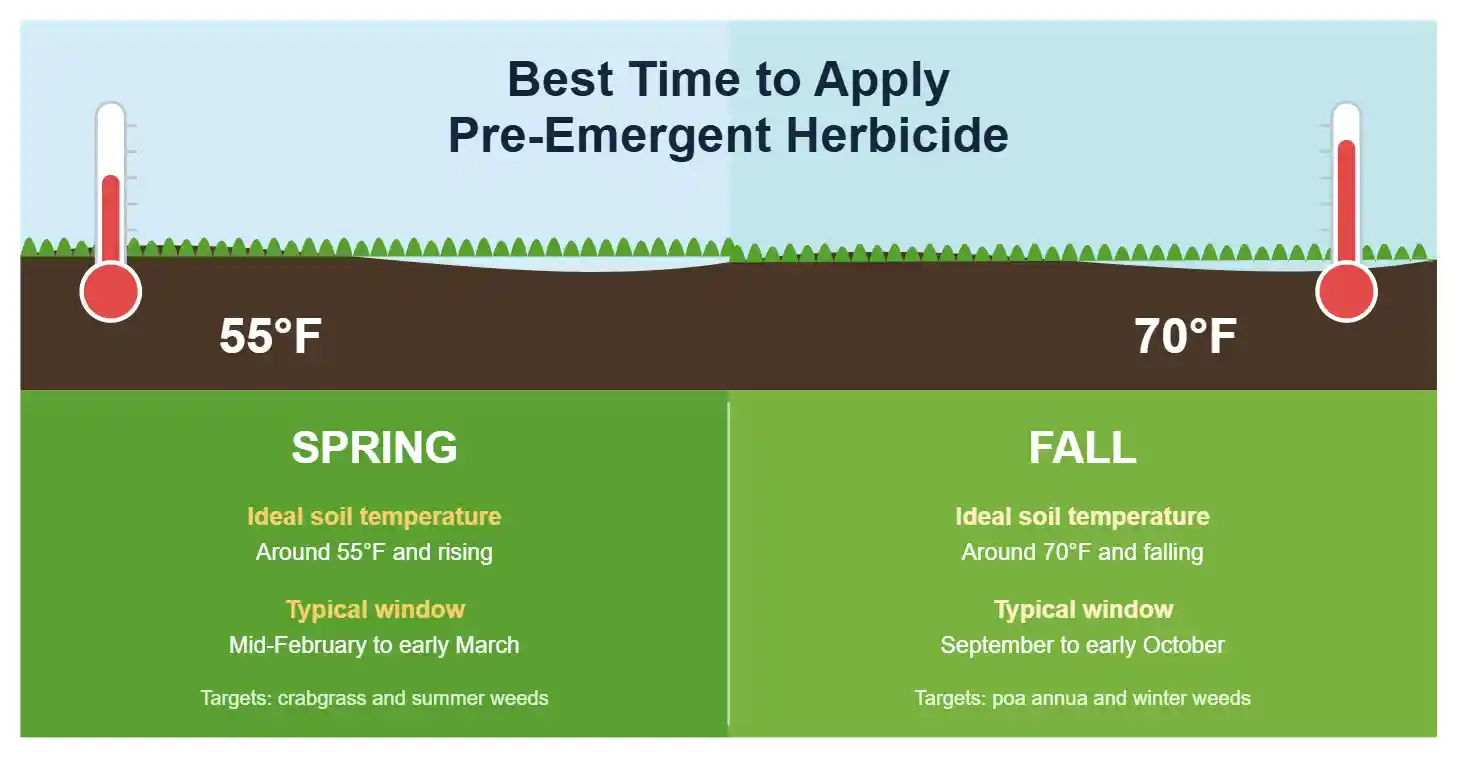
Pre-emergent is the one people misunderstand most. It does not kill the weed seeds already sitting in your soil – nothing does. Instead, once it is applied and watered in, it binds to the top inch of soil and thatch and forms an invisible barrier. When a weed seed germinates and pushes out its very first root and shoot, that tiny seedling hits the barrier and dies right there, before it ever breaks the surface. That is why you never see the weeds it stops – they die underground. And that is why timing is everything: the barrier has to be down before the seeds germinate. Crabgrass, for example, sprouts once the 24-hour average soil temperature runs between 53 and 58 degrees for several days straight – NC State measures that at a four-inch depth – which puts central North Carolina in late February to very early March. The pre-emergent has to beat that window.

How do selective post-emergents kill weeds but spare the grass?
Post-emergent products treat the weeds that are already up and visible. The clever ones are selective – they kill the broadleaf weeds like dandelion and clover while leaving your grass untouched. How? They are absorbed through the weed’s leaves and overload a natural growth process, essentially throwing the weed into fatal, uncontrolled growth. They are selective because grasses are built differently and handle that same process without harm. In plain terms: the product overloads the weed’s growth system, and your grass is built to shrug it off. That is why you can treat dandelions in a lawn without killing the lawn.
One caution on that word. Selective means selective for the grasses printed on that product’s label, not for grass in general. Every label names the turf it is cleared for, and a product cleared for bermuda can thin or kill tall fescue. The label has to match your grass before it matches your weed.
Contact vs. systemic: why some weeds need to be killed at the root
This distinction explains the number-one frustration – the weed that looked dead and came back. A contact herbicide only kills the plant tissue the spray actually touches. It works fast and it is fine on young annual weeds, but the roots survive, so anything perennial regrows. A systemic herbicide is absorbed and then travels through the plant all the way down to the roots, tubers, and runners, killing the whole thing. It is slower to show results, but it finishes the job. Deep-rooted perennials like nutsedge and wild onion need a systemic – and specifically one labeled for them. Nutsedge rebuilds from tubers and wild onion from bulbs, and the broadleaf three-way sitting in most garages will not touch either one. Hit them with a contact spray and you are just giving them a haircut.
What about non-selective weed killers?
Non-selective products, like glyphosate, kill just about any green plant they land on. Glyphosate is systemic – it moves through the whole plant, so it takes the roots too – and it works by blocking an enzyme that plants need to build the proteins that keep them alive. Because it does not discriminate – grass included – it is a spot tool for bed edges, cracks in the driveway, and full lawn renovations, never something you broadcast across a lawn you want to keep. Deciding whether to hire it out? Here is whether professional weed control is worth the money.
Why a thick, healthy lawn is itself weed control
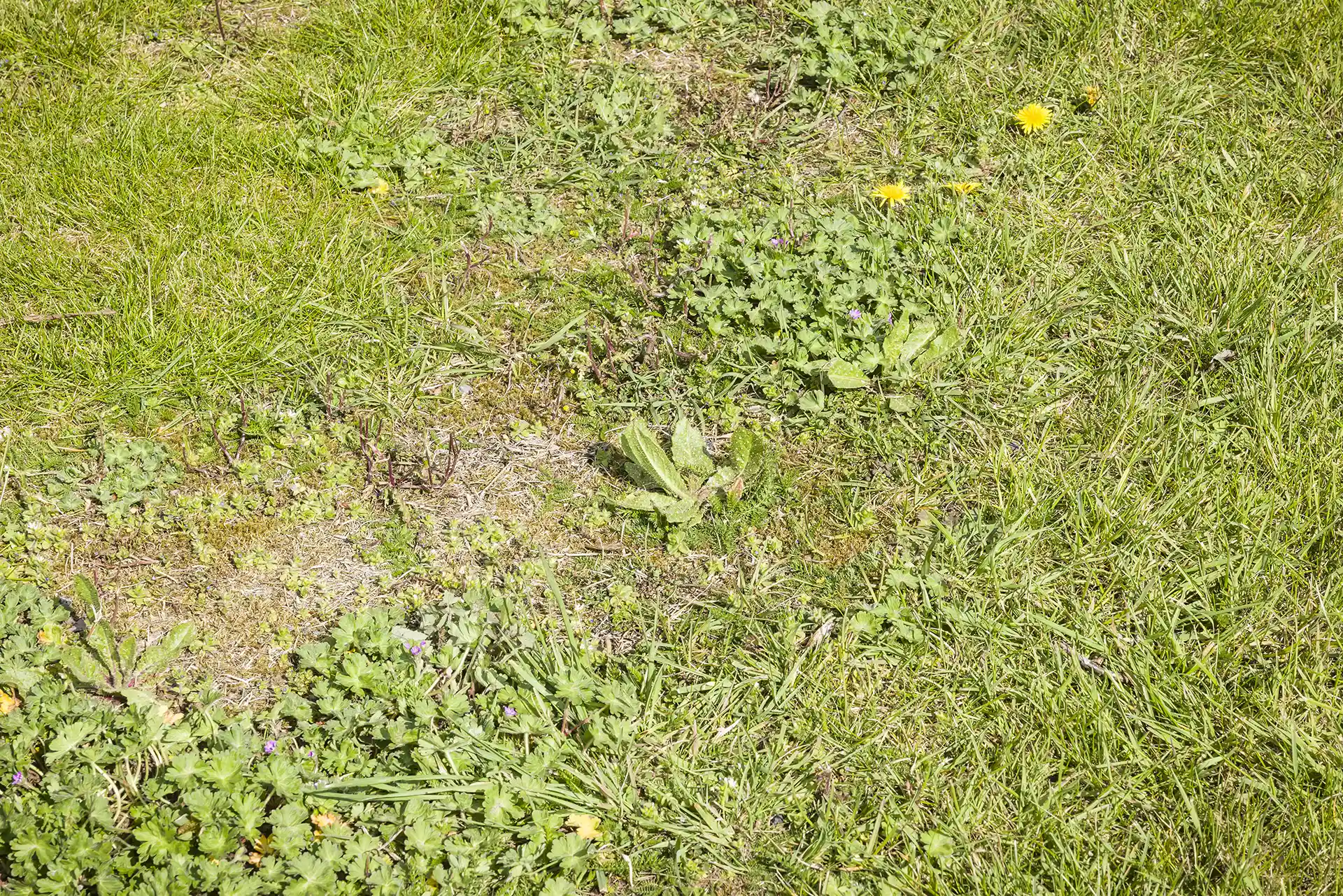
Here is the part no bottle can sell you. A dense, healthy stand of grass is weed control all by itself. Weed seeds need light and bare soil to get established, and a thick lawn denies them both – it shades the ground and leaves no room. That is why the fundamentals matter so much: mowing at the right height, feeding on schedule, and aerating to keep the turf thick. The chemistry and the healthy lawn work together. Do the cultural side well and you need far less spray to stay clean.
Why timing, coverage, and weed ID decide whether it works
Put it all together and you see why weed control sometimes fails – and it is almost never the chemistry. Pre-emergent applied too late, after the seeds already sprouted, does nothing. A contact product on a deep-rooted perennial just burns the top. Spotty coverage leaves escapes. And the wrong product on a misidentified weed misses entirely. Weed control that does not work is a timing, identification, or product-match failure. Getting those three right is the whole skill. For a closer look at two weeds that fool a lot of homeowners, see how to identify and kill crabgrass and nutsedge.
Professional program vs. store-bought DIY
So where does that leave you? Honestly, you can absolutely spot-spray a few dandelions yourself. Where DIY breaks down is the stuff that actually keeps a lawn clean: timing pre-emergent to soil temperature, sequencing the right post-emergents through the season, and matching contact, systemic, or selective to the specific weed – with even coverage at the right rate. That is what our weed control program does. I am licensed by the state of North Carolina to apply herbicides and pesticides on turf and ornamental plants such as shrubs and trees, and I watch the soil temperatures so you do not have to. We run the program across Raleigh’s southern suburbs, including weed control in Raleigh and Willow Spring. If you are tired of chasing weeds after they show up, text us at 984-284-5399 and we will get ahead of them instead.
Frequently Asked Questions
Tired of Chasing Weeds After They Show Up?
Our weed-control program gets ahead of them – the right products, on the right timing, matched to whether you have bermuda, zoysia, or fescue. Text us for a quote.
Sources
NC State Extension TurfFiles – Timing of Preemergent (PRE) Herbicide Applications
NC State Extension – Postemergence, Non-Selective Herbicides for Landscapes and Nurseries
National Pesticide Information Center – 2,4-D General Fact Sheet
University of Maryland Extension – Understanding Glyphosate and Other Pesticides
