

How to Fertilize Your Lawn in North Carolina: The Complete Guide for Fescue and Bermuda
By Ken Erickson · Updated July 2026
Knowing how to fertilize your lawn in North Carolina starts with the calendar, not the bag. North Carolina sits in the transition zone – the narrow band where it gets too hot for northern grasses and too cold for southern ones – which is why the same fertilizer bag, spread on the same weekend, will help one lawn and hurt the one next door. The two grasses we see most around Raleigh’s southern suburbs, cool-season tall fescue and warm-season bermuda, are fed on almost exactly opposite calendars, and getting that timing wrong is the difference between a thick stand of turf and an outbreak of lawn disease. We are licensed by the state of North Carolina to apply fertilizers and pest controls on turf and ornamentals, so this guide lays out exactly what your lawn needs, how much, and – most importantly – when.
How to Fertilize Your Lawn: Why It Matters and What Grass Needs
A healthy lawn pulls most of what it needs from sunlight, air, and water, but the three nutrients it draws down fastest – nitrogen, phosphorus, and potassium – have to be replaced, and that is what fertilizer does. Nitrogen is the one grass burns through quickest, which is why a lawn that is never fed slowly thins out, yellows, and loses ground to weeds that do not need rich soil to thrive. Fertilizing on schedule builds density, and a dense lawn is its own weed control: it shades the soil and crowds out crabgrass and clover before they start. It also builds the root system, and deep roots are what carry a lawn through a Carolina summer or a hard winter. The goal is not the greenest lawn on the street for two weeks – it is a consistently strong lawn that resists drought, traffic, and disease all year.
What do the numbers on fertilizer mean? Understanding N-P-K
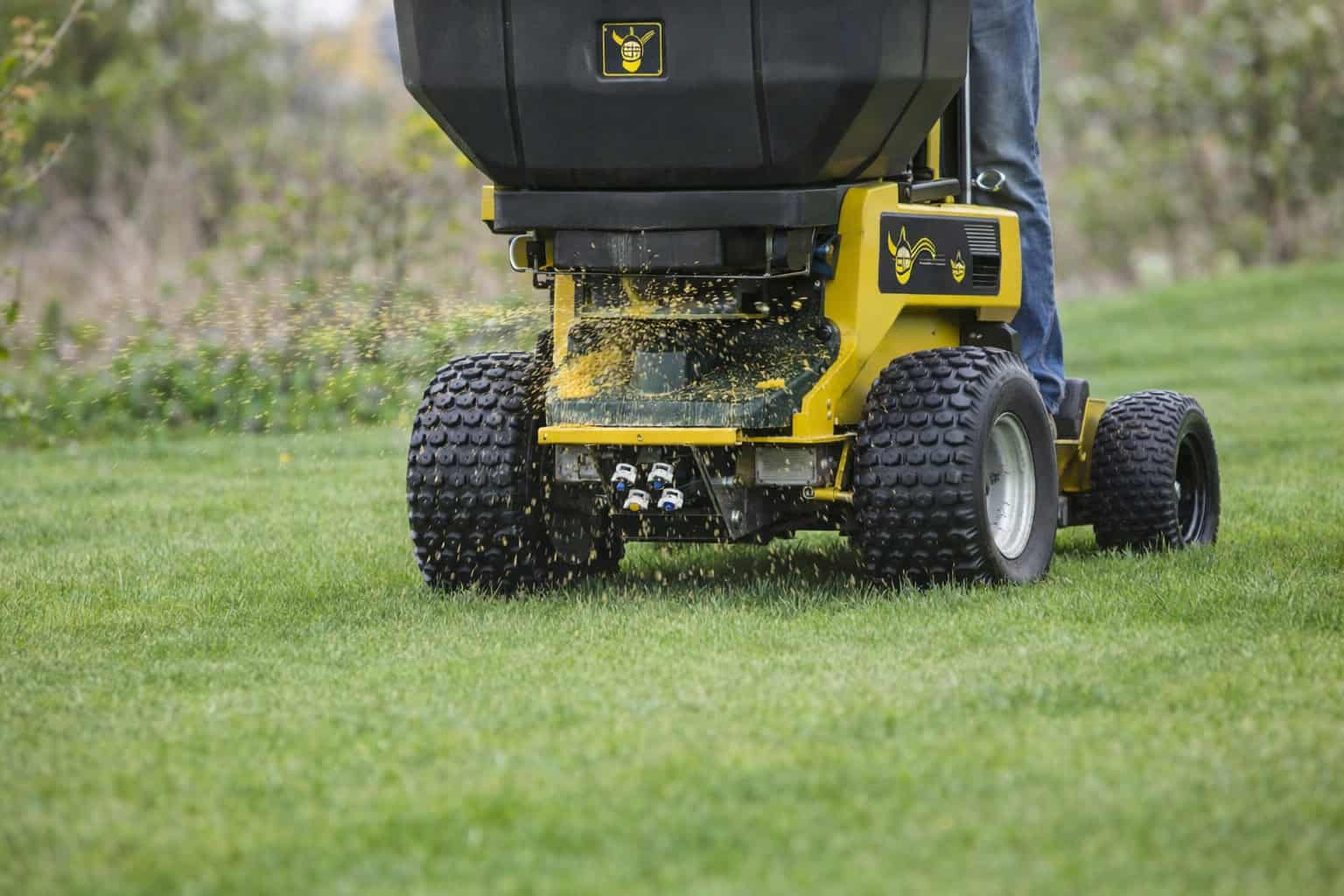
Every fertilizer bag carries three numbers, like 16-4-8 or 10-10-10, and they always appear in the same order: nitrogen, phosphorus, potassium (N-P-K). Nitrogen, the first number, drives green color and leaf growth – it is the nutrient lawns use most and the one most NC fertilizer programs are built around. Phosphorus, the middle number, feeds root development and is important when you are establishing new grass from seed or sod, which is why starter fertilizers are high in phosphorus. Potassium, the last number, is the toughness nutrient: it helps grass handle heat, drought, cold, and disease, and it is especially valuable heading into winter. The numbers are percentages by weight, so a 16-4-8 bag is 16 percent nitrogen – and here is the practical part: because our red clay soils across the Triangle usually already hold plenty of phosphorus, a soil test will often tell you to skip the middle number entirely and feed mostly nitrogen and potassium.
Should you test your soil before fertilizing? Do this first
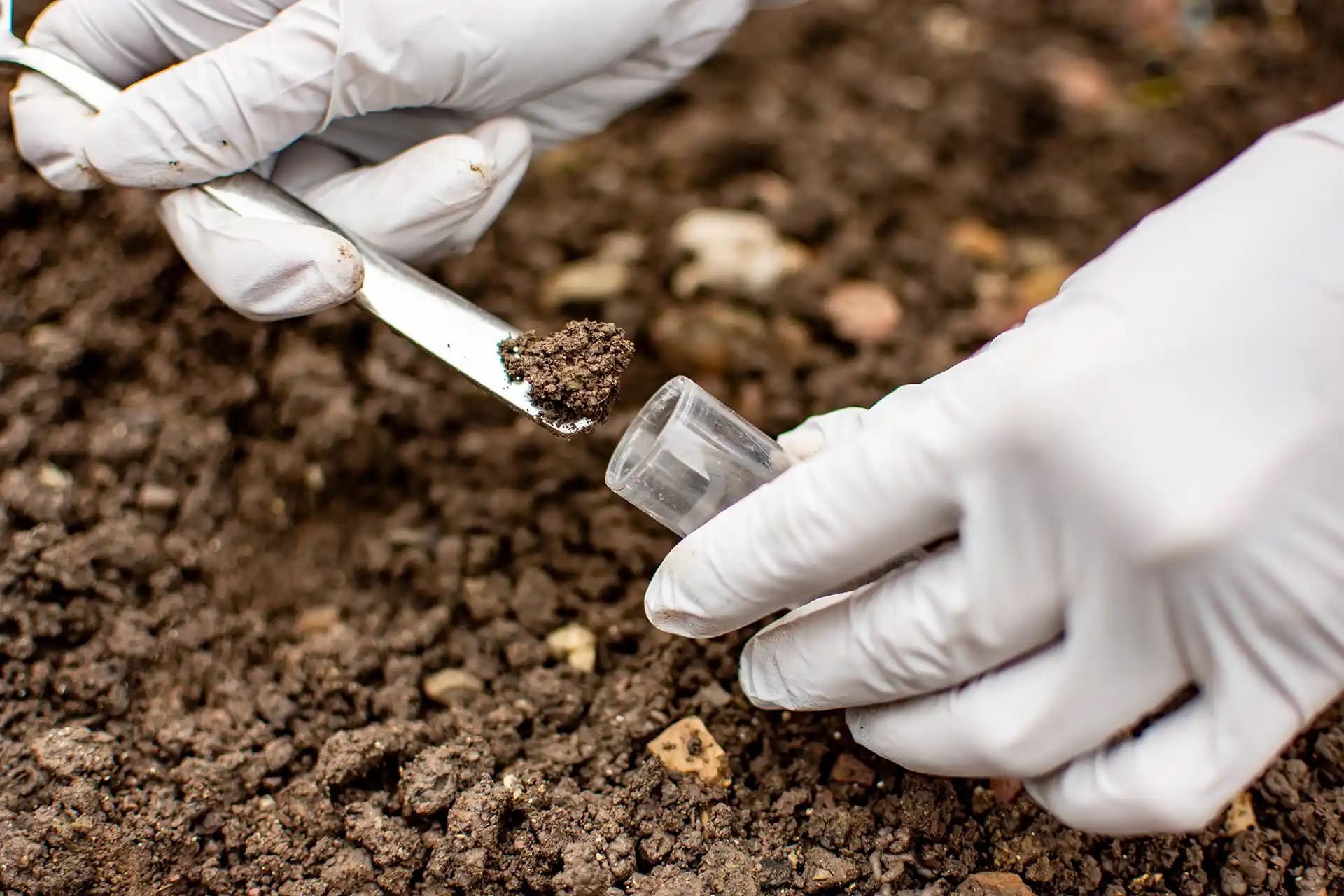
Yes – test before you spread, because everything else is a guess without it. A soil test tells you your pH and exactly which nutrients your lawn is short on, so you are not paying for phosphorus your clay already has or watching lime you did not need do nothing. In North Carolina this is easy and nearly free: the NCDA Agronomic Services lab runs standard soil tests free from April 1 through November 30, with a small $5-per-sample fee during peak season, December through March – so testing in the fall is both free and perfectly timed. Most NC turfgrasses want a soil pH of about 6.5 to 7.0 for good nutrient uptake; our native soils tend to be acidic, so the test frequently calls for lime to bring the pH up, and lime is best applied in winter when freeze-thaw cycles work it into the soil. Pick up a free soil box and instructions from your county Cooperative Extension office, sample a few spots across the yard, and retest every two to three years.
What are the different types of lawn fertilizer?
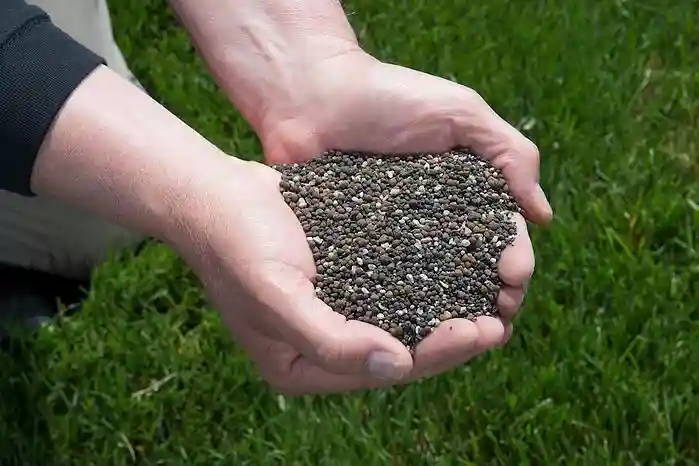
Fertilizer choices come down to a few decisions. Slow-release versus quick-release: quick-release (water-soluble) nitrogen greens up fast but burns off in a few weeks and can scorch the lawn if overapplied, while slow-release feeds steadily for six to eight weeks, gives more even growth, and is much harder to burn with – for most homeowners, slow-release is the safer choice. Granular versus liquid: granular is spread dry with a spreader and is the standard for covering a whole lawn evenly, while liquid is sprayed, acts fast, and suits spot-feeding or professional programs. Synthetic versus organic: synthetic delivers a precise, immediate dose of nutrients, while organic releases slowly and improves soil over time but costs more per pound of actual nitrogen. One product to treat with caution is weed-and-feed – it combines fertilizer with a herbicide, but its timing is set by the herbicide, not the grass, so it often fertilizes at the wrong point in the calendar and can injure young grass or the wrong turf type. We generally recommend keeping weed control and feeding on their own correct schedules rather than forcing them together.
When should you fertilize your lawn in NC? Fescue vs. bermuda
This is where North Carolina lawns split in two, and it is the part most people get wrong. Cool-season tall fescue does its growing in spring and fall, so you feed it in the cool months: apply 1 lb of N per 1,000 sq ft in mid-September and again in November, add another pound in February, and keep spring and summer feeding light – critically, do not hit fescue with heavy nitrogen after mid-March, because summer nitrogen fuels brown patch disease instead of grass. Warm-season bermuda is the mirror image: it is dormant and brown all winter, greens up in late spring, and is fed through the heat – apply half a pound to 1 lb of N per 1,000 sq ft several weeks after it fully greens up (roughly April to May), then 1 lb every four to six weeks through August. Bermuda’s last feeding of the year is a low-nitrogen, high-potassium application in early September to build winter hardiness, and then no nitrogen at all through winter. Zoysia follows the same warm-season pattern as bermuda. The one-sentence version: feed fescue in the fall, feed bermuda in the summer, and never feed either one heavily going into its dormant season. A thick, well-fed lawn is your best defense against summer weeds — here is how to identify and kill crabgrass and nutsedge.
Tall fescue (cool-season) | Bermuda (warm-season) | |
|---|---|---|
When to feed | Fall and late winter | Late spring through summer |
First feeding | Mid-September | A few weeks after full green-up (April to May) |
Rate per feeding | 1 lb N per 1,000 sq ft | Half to 1 lb N per 1,000 sq ft |
Feeding schedule | September, November, and February | Every 4 to 6 weeks |
When to stop | No heavy nitrogen after mid-March | After August |
Why timing matters | Summer nitrogen feeds brown patch, not grass | Feed only while it is growing in the heat |
How often and how much should you fertilize? And the mistakes to avoid
The governing rule for both grass types is no more than 1 pound of actual nitrogen per 1,000 square feet in a single application – more than that does not grow a better lawn, it just fuels disease, burns the turf, and runs off into storm drains. To turn that into pounds of product, divide 100 by the first number on the bag: a 16-4-8 needs about 6.25 lbs per 1,000 sq ft, a 10-10-10 needs 10 lbs. Measure your lawn’s square footage, calibrate your spreader to that rate, and spread in two passes at right angles for even coverage – overlapping stripes are why some lawns end up with dark-green and yellow bands. The most common NC mistakes are all timing and dosage: feeding fescue in the summer heat, feeding bermuda before it wakes up, dumping a whole season’s nitrogen in one application, and skipping the soil test entirely. Fertilizing correctly takes measuring, calibrating, and a calendar that matches your specific grass, and it is genuinely something a homeowner can do. But if you would rather not chase soil tests, spreader settings, and split-timing between two grass calendars, that is the core of what we do. Text us at 984-284-5399 for a quote.
Frequently Asked Questions
Want Your Fertilizer Program Run on Schedule?
Soil tests, spreader settings, and split timing between two grass calendars are easy to get wrong. We are licensed to apply on turf in NC and run the whole program for you. Text us for a quote. For a full breakdown of pricing, see what lawn care and fertilization cost in the Triangle.
Sources
NC State Extension – Tall Fescue Lawn Maintenance Calendar (AG-367)
NC State Extension – Bermudagrass Lawn Maintenance Calendar (AG-431)
NCDA and CS Agronomic Services – Soil Testing
Clemson Cooperative Extension HGIC – Fertilizing Lawns
