

What a Weed Control Pro Puts Down on a Fescue Lawn
By Ken Erickson · Updated October 2026
There’s no best weed killer for tall fescue. There’s a calendar, and it runs almost backward from bermuda. Fescue grows hardest in spring and fall, struggles in summer heat, and gets brown patch when the nights stay warm. Our Signature fescue program is 12 applications a year: 8 rounds of weed control and fertilizer, one grub application and three summer fungicides. Below is every round, when it goes down, and what goes in the tank.
Half of keeping fescue clean is knowing what not to spray. Some of the best weed killers for bermuda will kill a fescue lawn outright.
I’m not publishing rates. That’s the part I sell. But the chemistry and the timing decide whether a lawn is clean, and most people get the timing wrong long before they get the product wrong.
Key takeaways
- Twelve applications a year on our Signature fescue program: 8 rounds, plus grub control and three summer fungicides.
- Four pre-emergent rounds, all prodiamine. Specticle Flo, our fall pre-emergent on bermuda, is not labeled for tall fescue.
- Fall is when fescue gets fed. Summer feedings stay light, because heavy nitrogen in the heat feeds brown patch.
- Several bermuda weed killers kill fescue: Celsius, Certainty and Katana stay off a fescue lawn.
- Seeding changes the program. No pre-emergent goes down where we seed.
What’s safe on fescue, and what isn’t
Read this before you buy anything for a fescue lawn:
Product (active ingredient) | On tall fescue | Why |
|---|---|---|
Stonewall (prodiamine) | Safe | Our pre-emergent all year on fescue |
LESCO Three-Way (2,4-D, MCPP, dicamba) | Safe | Broadleaf control, labeled for tall fescue |
Change Up (MCPA, fluroxypyr, dicamba) | Safe | Tough broadleaf, and the first spray on new seed once it’s established |
Drive XLR8 (quinclorac) | Safe | Crabgrass that slipped the barrier |
Empero (halosulfuron) | Safe | Our nutsedge spray on fescue |
Specticle Flo (indaziflam) | Not labeled | Our fall pre-emergent on bermuda only |
Celsius (thiencarbazone, iodosulfuron, dicamba) | Do not use | Labeled for warm-season grass only |
Certainty (sulfosulfuron) | Do not use | Its label lists tall fescue as a weed it kills |
Katana (flazasulfuron) | Do not use | It controls tall fescue. We spot-spray it to pull fescue clumps out of bermuda |
Our fescue program, round by round
Here is our Signature fescue program. These are windows, not dates. Each round moves with soil temperature and the weather.
Round and window | What goes in the tank or spreader | What it does |
|---|---|---|
1. January to mid-February | Stonewall (prodiamine) | First pre-emergent barrier for crabgrass |
2. Mid-February through March | LESCO 32-0-8 with iron; Stonewall (prodiamine); LESCO Three-Way (2,4-D, MCPP, dicamba); non-ionic surfactant | Spring feeding, second barrier, broadleaf cleanup |
3. April to mid-May | Light LESCO 32-0-8; spot Drive XLR8 (quinclorac) | Light spring feeding, spot crabgrass and grassy weeds |
4. Mid-May through June | Light LESCO 32-0-8; spot Drive XLR8 and Empero (halosulfuron) | Kept light on purpose; spot crabgrass and nutsedge |
Grub control: early to mid June, with Round 4 | Acelepryn Xtra (chlorantraniliprole plus thiamethoxam), watered in | Stops white grubs before they eat the roots |
Fungicide 1: once nights stay above 60°F, usually late May or June | Artavia (azoxystrobin) | First brown patch prevention |
Fungicide 2: three to four weeks later | Propiconazole | Brown patch and dollar spot, rotated chemistry |
5. July to mid-August | Pelletized dolomitic lime; spot Empero | Moves soil pH; spot nutsedge |
Fungicide 3: the hottest stretch, usually mid-July to early August | Artavia (azoxystrobin) plus propiconazole, no surfactant | Peak-heat brown patch knockdown, two chemistries |
6. Late August, down before September 1 | LESCO 32-0-8 with iron; Stonewall (prodiamine) | First fall feeding; Poa annua and winter weed barrier |
7. October | Stonewall (prodiamine); Change Up (MCPA, fluroxypyr, dicamba) | Second fall barrier, fall broadleaf cleanup |
8. November | LESCO 32-0-8 winterizer | Last feeding while the grass is still green |
That’s 12 applications a year. Here’s what’s in our fescue lawn maintenance plans.
Round 1 (January to mid-February): the first barrier
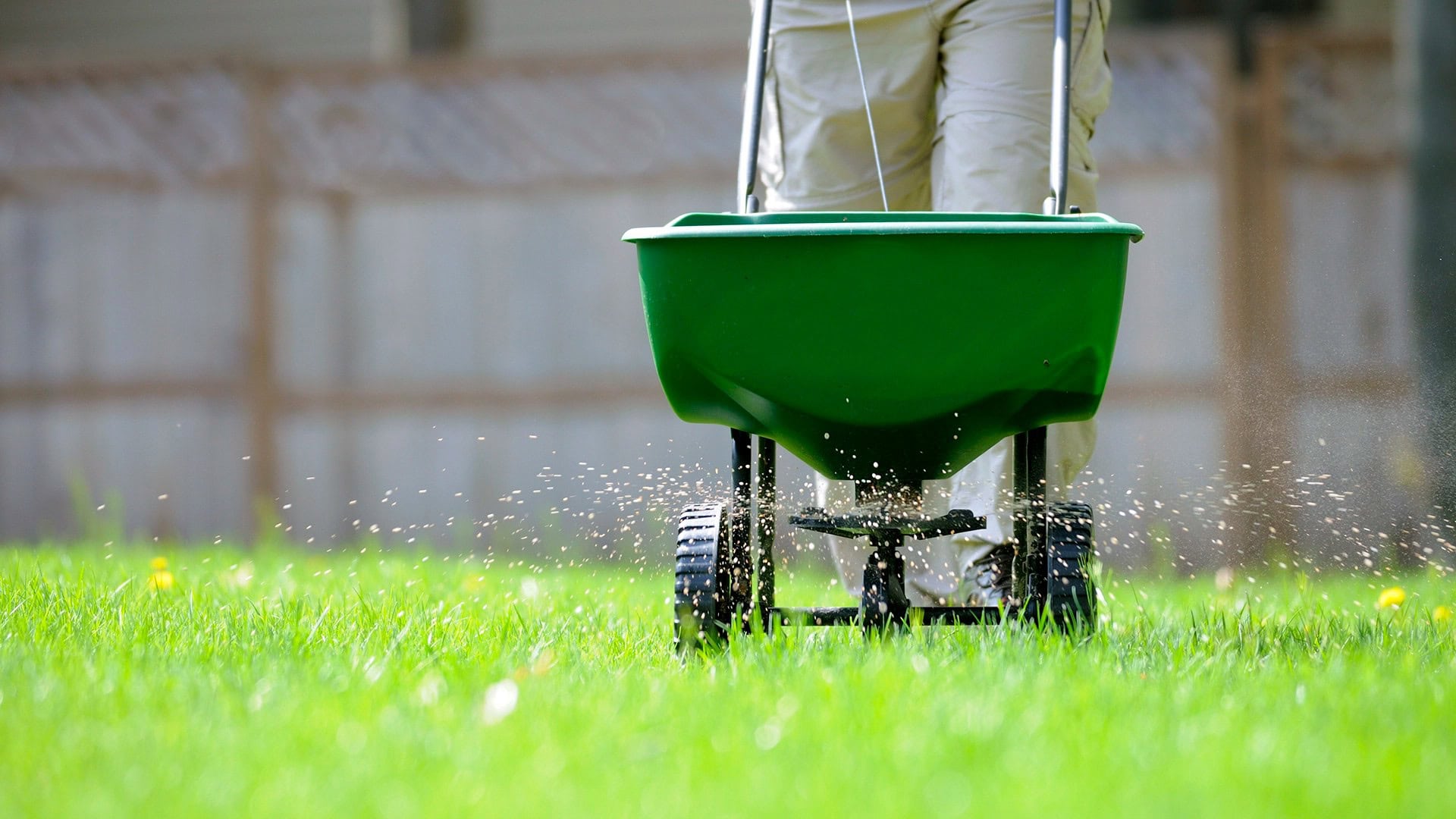
Stonewall (prodiamine) goes down before the soil warms. It stops crabgrass and other annual weed seeds from rooting. Nothing else goes in this tank. My field marker is the same as on bermuda: get it down before the forsythia blooms yellow. Crabgrass starts to sprout once the soil holds near 55°F for a few days.
Round 2 (mid-February through March): feed, second barrier, broadleaf
Fescue wakes up early, so this is its first feeding: LESCO 32-0-8 with iron. Stonewall (prodiamine) goes down again for the second half of the crabgrass barrier, and LESCO Three-Way (2,4-D, MCPP and dicamba) takes out the winter broadleaf. Two winter pre-emergent rounds beat one.
Round 3 (April to mid-May): light feeding, spot weeds
A light 32-0-8. Spring is fescue’s growing season, but every pound of nitrogen now is top growth that has to survive July. I spot-spray crabgrass and grassy weeds that slipped through with Drive XLR8 (quinclorac).
Round 4 (mid-May through June): kept light on purpose
Another light 32-0-8, and spot sprays: Drive XLR8 for crabgrass, Empero (halosulfuron) for nutsedge. Heavy summer nitrogen on fescue is how you grow brown patch.
Grub control. It rides with this round in early to mid June: Acelepryn Xtra (chlorantraniliprole plus thiamethoxam), watered in so it reaches the roots. If you’ve never had grub damage, moles or turf that lifts like carpet, you can skip it.
The three summer fungicides: brown patch season
Brown patch is fescue’s disease, and it runs on night temperature, not the calendar. Fungicide 1 is Artavia (azoxystrobin), once nights stay above 60°F, usually late May or June. Fungicide 2 follows three to four weeks later with propiconazole, a different chemistry that also covers dollar spot. Fungicide 3 goes down in the hottest stretch, usually mid-July to early August: azoxystrobin and propiconazole together, with no surfactant in that heat.
Rotating and pairing chemistries is how you avoid building resistance. These stay on the leaf, so they are not watered in. Here’s why NC fescue gets brown patch and how to fix it.
Round 5 (July to mid-August): lime and spot nutsedge
Pelletized dolomitic lime, which works slowly to move soil pH so the fall feeding works. Empero goes on any nutsedge that shows up, as a spot spray only and never on drought-stressed turf. Nothing gets blanket-sprayed on fescue in July heat.
Round 6 (late August, down before September 1): the first fall feeding
LESCO 32-0-8 with iron starts the fall feeding, and Stonewall (prodiamine) goes down as the Poa annua and winter weed barrier. NC State times the main fall feeding for mid-September. We put ours down at the end of August so it’s working as soon as the nights cool. Here’s why fall nitrogen is king for fescue.
Prodiamine is the only fall pre-emergent I put on fescue, because Specticle Flo isn’t labeled for it.
Round 7 (October): second fall barrier and broadleaf
Stonewall (prodiamine) again to reinforce the barrier, with Change Up (MCPA, fluroxypyr and dicamba) for the fall broadleaf.
Round 8 (November): the winterizer
A last LESCO 32-0-8, mostly quick-release nitrogen the grass takes up while it’s still green but has slowed down for winter. Potash and iron ride along. Fescue stores it and uses it to green up in spring.
Aerating and seeding fescue: what changes
Fescue gets aerated and seeded in the fall, and a lawn being seeded moves to the seeding version of our program. Round 6 becomes a starter fertilizer, LESCO 18-12-2, put down the same day we aerate and seed. The phosphorus drives new roots. No pre-emergent goes down, because a barrier that stops weed seed stops grass seed too.
Round 7 becomes Change Up alone, and only once the new grass is established. NC State calls a new lawn established after it has been mowed three times, so that’s the soonest I spray.
I also recommend lime with the aeration, because the holes carry it down to the roots, and an insect spray first if the lawn hasn’t been on bug control. Both are options, not requirements. Planning to seed this fall? Tell us before the late-August round, so the plan can change.
Here’s what to do before and after we seed, and how our fescue aeration and overseeding works.
What Is the Best Weed Killer for Tall Fescue?
There isn’t one. The closest honest answer is prodiamine four times a year to stop seeds, a three-way or Change Up for broadleaf, Drive XLR8 for crabgrass, Empero for nutsedge, and glyphosate only where you want bare ground.
Run them on schedule and the lawn stays clean, because the weeds never got established. That’s the difference between preventing weeds and chasing them.

The weeds that get their own spot spray in fescue
The rounds handle most of a fescue lawn. These are the weeds that need their own spray:
Weed | What I spray | Note |
|---|---|---|
Clover, dandelion, henbit, chickweed | LESCO Three-Way (2,4-D, MCPP, dicamba) | Safe on established fescue |
Buttonweed, ground ivy, oxalis | Change Up (MCPA, fluroxypyr, dicamba) | Buttonweed needs a follow-up |
Crabgrass and foxtail that slipped the barrier | Drive XLR8 (quinclorac) | Fescue tolerates it well |
Nutsedge | Empero (halosulfuron) | Weaker on kyllinga |
Wild garlic and wild onion | LESCO Three-Way, spot-sprayed | Plan on two seasons |
Weeds in beds, cracks, fence lines | Glyphosate | Never on the lawn |
Not sure what you’re looking at? Here’s how to tell crabgrass from nutsedge.

Is professional weed control safe around kids and pets?
Every product we put on a lawn carries a re-entry interval on its label, and for most turf herbicides that interval is simply until the treated area is dry. We tell you that time on every application and we do not guess at it. We also put down less product than a typical DIY pass: metered to a steady pace and placed low and on target, instead of an uneven blanket from a hose-end bottle whose dose swings with your walking speed. Less product, in the right place, is both more effective and easier to keep off the people and animals using the yard. If you want the specifics for your lawn, see how our weed control works.
When you can do it yourself, and when to call a pro
If you can hit the four pre-emergent rounds and get the fall feeding down on time, you’ve got most of fescue care right there. Our fescue lawn care calendar lays out the year month by month for a homeowner.
Two warnings: don’t put a bermuda product on fescue without reading the label, and don’t put a pre-emergent down anywhere you plan to seed.
Call somebody when you can’t. Late August starts the fall feeding that decides how a fescue lawn looks for a year, and it lands in the busiest week of everybody’s summer. Not sure a pro program is worth it? Here’s what separates a premium weed service from a cheap one.
The bottom line
Tall fescue weed control is a schedule, not a jug: prodiamine four times, the right broadleaf and spot sprays, light summer feeding, three fungicides through brown patch season, and the big feedings in the fall.
At Lawn Panther, that’s our specialty. We’re a weed control and turf management company, not a landscaper who also sprays. Call or text us at 984-284-5399 for a free quote, or see our fescue lawn maintenance plans. Got bermuda instead? Here’s what a weed control pro puts down on his own bermuda lawn.
American/Veteran/Family-owned and local, serving Raleigh’s suburban homeowners, HOAs, and commercial properties since 2019 — for the Purrfect lawn.
Frequently Asked Questions
Want Weeds Prevented, Not Chased?
Our weed-control program puts the right products down on the right timing – pre-emergent by soil temperature, targeted post-emergent, and a thick lawn – applied by licensed NC applicators. Text us for a quote.
